

Personal funds in a sole proprietor’s account in Ukraine: when they count as income and when they don’t


When a sole proprietor's account is low on funds, entrepreneurs often top it up with their own money - from a salary card, deposit, or personal savings. And here the main question arises: will this amount become income that will have to be taxed? The tax office has different approaches for the general system and simplified tax systems, and individual receipts are not considered income at all. In this article, I will explain in which cases you can deposit your own money without taxes, when it creates risks, how to properly top up your account, and what you must take into account to avoid claims from regulatory authorities.
Imagine: your individual entrepreneur account is empty, and you urgently need to pay taxes, buy goods, or pay a contractor. You want to take your money from your card and put it in your account, but the question immediately arises: won't you also have to pay tax on it? In this article, we will analyze whether you need to include your own money deposited into your individual entrepreneur account in your income and how to do it correctly so as not to pay too much!
Should I include my own funds deposited into the account in my individual entrepreneur's income?
According to Article 320 of the Civil Code of Ukraine, you have every right to use your personal money for business.
For example: they opened a sole proprietorship, put 10 thousand hryvnias from their “pocket” (card) into a business account to pay for rent or hire an employee.
Sole proprietorship on the general system
For an individual entrepreneur on the general system, everything is simple: such a replenishment is not income, and is not subject to tax. After all, you simply transferred your own money from one “pocket” to another. But with a single tax, especially in groups 1-3, the tax authorities have long interpreted this differently.
In practice, the tax interprets this as follows:
“ If your personal funds (which are not business income) are received into the account of a sole proprietorship, they may consider this part of the sole proprietorship's income and include it in the tax base.
Exception: If you deposit cash that has already been considered as income before and taxes have been paid on it (for example, revenue for a certain period), and this is clearly stated in the payment document, then this income is not taxed a second time.”.
And if you replenish the account with previously received business cash, mark it in the purpose of the payment (“revenue for the period” and specify it), and the tax office will not charge tax again.
Individual entrepreneur on a single tax
For individual entrepreneurs on a single tax (simplified tax), the situation is different. Previously, the tax authorities considered that any replenishment of the account was potential income from which a single tax had to be paid. Because of this, many entrepreneurs came up with cunning business financing schemes and trivially risked unnecessary taxes.
But there is good news: over the past year, the tax authorities have gradually softened their approach. That is, if you are a simplified individual entrepreneur, then from a formal point of view, your own savings that you have deposited into the account are indeed considered income and are taxable. Because the Tax Code of Ukraine explicitly states: everything received in cash or non-cash form is considered income.
What income is not included in the income of an entrepreneur?
Not all income is counted as an entrepreneur's income. The main exceptions include:
Passive income
- Interest on deposits
- Dividends
- Royalty
- Insurance payments
Sale of property used in business
- Movables
- Real estate
Such receipts are not included in the income of a single-tax FOP / sole proprietor (Article 292.1 of the Tax Code of Ukraine) and are not reflected in the FOP’s tax reporting. However, this does not exempt them from taxes altogether: passive income and the sale of property are taxed separately - under the rules applicable to individuals.
Would you like to consult with a specialist as soon as possible?
Leave a request and our specialist will contact you shortly.
How to deposit your own money tax-free

Cash proceeds from business activities
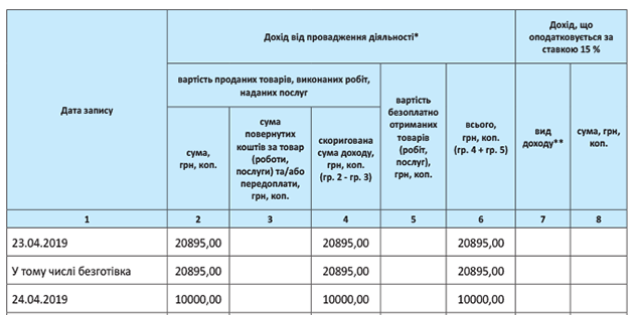
If this is cash that you have already received as an individual entrepreneur and it was passed through the cash register, in other words, fiscalized, you can deposit this money into the account - in the purpose of the payment, write: “Deposit of trade revenue for the period…”.
Example: A group 2 individual entrepreneur received cash for services at the market, deposited this money into an account through the cash register - taxes have already been paid, they will not be charged a second time. For a group 1 individual entrepreneur - this works even without a check.

Own funds from which taxes have already been paid
This includes salary, dividends, interest on deposits, rent - everything from which personal income tax and military service have already been withheld. Write in the purpose: “Contribution of personal funds for conducting business activities.”
Example: You are employed part-time, received your “net” salary, and deposited it into your FOP account to buy a laptop for work. The tax authorities may ask you to prove that these are already taxed personal funds, so keep a salary payment statement or information from Appendix 4DF (formerly Form 1DF) on hand.

Transfers between business accounts
If you have several sole proprietorship accounts in different banks, simply transfer money between them - this is not considered new income.

Reimbursement of financial assistance
You can take out an official loan from relatives or friends, sign a contract. But if you don't repay this assistance within 12 months, it will become your income and you will have to pay tax.
IMPORTANTLY!
- During an audit, the tax authority has the right to request confirmation: statements, certificates, receipts, contracts.
- Not all funds can be deposited without risks: proceeds from the sale of an apartment or car, received loans - a bank loan is not directly considered income under Article 292.11 of the Tax Code of Ukraine, but it requires supporting documents - grants, or funds previously withdrawn from a FOP account, if there are no documents, are all questionable. For example, the sale of an apartment or car: even if the first sale in a year is not subject to personal income tax, the tax authorities may still treat these funds as income.
Is it possible to pay with counterparties not from the account of an individual entrepreneur?
In general, this is also possible: you can pay in cash, through a bank cashier, self-service terminal, or even with a personal card - if these purchases are related to business. Another option is to open a credit limit for an individual entrepreneur and pay with it when your own funds are insufficient.
However, remember: the tax office will include in income everything that has been deposited into the account, unless you can prove that these funds have already been taxed, or correctly registered as revenue or financial assistance. That is, the tax office will include your own funds deposited into a current account opened for entrepreneurial activity in the income of an individual entrepreneur who is a single tax payer. The only exception is the deposit of income with the wording "Deposit of trade revenue for the period __", but provided that during this period these receipts were made through a cash register or as "Provision of repayable financial assistance", then the financial assistance will need to be returned. After all, it can also change in the other direction again. Therefore, if there is no critical need to deposit personal funds into the account of an individual entrepreneur, then it is better to spend them from a personal card for the needs of entrepreneurial activity. Moreover, this is definitely not prohibited.
Despite the fact that the opinion of the tax office has changed in support of entrepreneurs, you should not trust it too much. After all, it can also change in the other direction again. Therefore, if there is no critical need to deposit personal funds into the account of an individual entrepreneur, then it is better to spend them from a personal card for the needs of entrepreneurial activity. Moreover, this is definitely not prohibited.
Follow these rules and you can safely use your own money for business without risking unnecessary questions from the tax office.
Conclusion
To avoid unnecessary taxes and questions from regulatory authorities, it is important to clearly understand which revenues are considered income of an individual entrepreneur and which are not. Let's summarize the key rules that you should rely on in your daily work:
- Own funds deposited into an individual entrepreneur's account, as a general rule, do not necessarily have to be included in income if they are money from which taxes have already been paid, or revenue processed through the cash register.
- Passive income (interest, dividends, royalties, insurance payments) and the sale of property used in the business are also not included in income.
- To avoid problems with the tax office, it is important to properly process payments: indicate the purpose (“deposit of trade proceeds”, “personal funds for business”), and keep supporting documents (statements, certificates, contracts).
- Transfers between individual entrepreneur accounts and official loans from relatives/friends are also not considered income if the conditions for repayment are met.
And remember: if possible, use personal funds directly for business expenses from your own card, and deposit only officially confirmed receipts into your individual entrepreneur account to avoid unnecessary taxes and audit risks.
Would you like to consult with a specialist as soon as possible?
Leave a request and our specialist will contact you shortly.