


Employee reservation: companies vs Diia.City - what actually works in 2026


Martial law remains in effect, mobilization rules are constantly being updated, and businesses face the daily risk of losing key specialists due to the lack of a clear and fast reservation procedure. Companies struggle with document errors, delays in processing applications, and confusion regarding who is actually eligible for deferment. In this material, I explain in detail how employee reservation works in 2026: who can submit lists, who is allowed to be reserved, how the process works through “Diia”, what has changed in 2026 after resolutions No. 692, No. 862 and No. 954, and what special rules apply to Diia.City residents and critically important enterprises.
Martial law has been extended, mobilization continues, and the rules are being updated regularly. The absence of a clear procedure for granting deferment creates risks not only for employees but also for the company itself: fines, reputational losses, staffing issues. Formally, the process is overseen by the manager, but in practice difficulties are increasingly common: people do not receive timely deferments, procedures are delayed, and documents are returned with comments.
This article provides a practical guide: who has the right to reserve employees, who can/cannot be reserved, how to prepare the document package and submit it through Diia, and what has changed for critically important enterprises (CIE) and Diia.City residents.
If you still have questions after reading - don’t act blindly. Consulting a tax accountant or a legal advisor will help tailor the solution to your specific business and avoid unpleasant surprises.
Want to get expert advice as soon as possible?
Leave a request and our specialist will contact you shortly
You may also be interested in
Regulatory documents on employee reservation
Employee reservation is one of the grounds for granting deferment from mobilization. During martial law, employee reservation is regulated by three key documents that define who can reserve, how to submit documents, and what restrictions apply.
CMU Resolution No. 76 of 27.01.2023
The base document. It contains two separate procedures at once - the Reservation Procedure for military liable persons and the Criteria and procedure for designating critically important enterprises. The current version is dated 01.09.2026, on the basis of resolutions No. 692 of 30.05.2026 and No. 862 of 01.07.2026; resolution No. 954 of 15.07.2026 is also in the chain of amendments.
Law of Ukraine No. 4630-IX of 09.10.2025
Effective from 04.12.2025. It allows hiring and temporarily reserving employees with military registration violations - for up to 45 calendar days and no more than once per calendar year. But only for enterprises in the defence industrial complex, which is stated explicitly in the text of the law. More on this below.
Law of Ukraine "On Mobilisation Preparation and Mobilisation" No. 3543-XII of 21.10.1993
The base mobilisation law. It sets the rules of mobilisation preparation, the mobilisation procedure, the duties of citizens and enterprises, and the grounds for reserving military liable persons. It is clause 4 of part one of Article 25 of this law that Law No. 4630-IX amended.
The basic law of Ukraine on mobilization, which defines the rules of mobilization preparation, the mobilization procedure, the obligations of citizens and enterprises, as well as the issues of reserving military liable persons.
All updates in the field of reservation are gradually moving to a digital format: applications and decisions are made through electronic services of the Ministry of Economy and the “Diia” portal.
Which enterprises can reserve employees
During martial law, the right to reserve military liable persons is held not only by government authorities. Private companies that meet the criteria of CMU Resolution No. 76 may also do so. Reservation allows companies to retain key employees and ensure stable business operations, especially in critical industries. All enterprises that have the right to reserve fall into two main categories:
1. Critically important for the functioning of the national economy and ensuring the livelihood of the population
This group includes enterprises operating in areas important for the state and regions: energy, transport, communications, healthcare, agriculture, water supply, public utilities, etc.
2. Critically important for the needs of the Armed Forces of Ukraine
This category includes enterprises that:
- carry out mobilization tasks (orders);
- produce defense-related products;
- perform works or provide services necessary for the Armed Forces or other security forces;
- are involved in critical defense programs or supply chains for defense.
Can sole proprietors (FOP) reserve employees?
No, they cannot.
A sole proprietor does not have the right to reserve their employees. According to legislation - in particular, the Law “On Mobilization Preparation and Mobilization” and Resolution No. 76 - FOP is not included in the list of entities that can carry out employee reservation. Only legal entities, government bodies, and companies that have obtained the status of a critically important enterprise (CIE) have this right.
Who can be granted reservation during the war
Enterprises, institutions, and organizations that have the right to reserve may reserve any of their employees if they meet certain conditions.
Key conditions for employee reservation
| Condition | Explanation |
|---|---|
| Official employment | The employee must have a labor agreement or contract with the enterprise. It is prohibited to reserve sole proprietors, gig-specialists, or individuals under civil law contracts. |
| Military registration | The employee must be military liable, fit for service, and registered with the Military Conscription Office.* |
| No prohibitions or restrictions | The employee must not have active deferments on other grounds or violations of military registration rules (updated personal data and not listed as wanted by the TCC). |
How to check whether an employee is reserved from mobilization
The most common question from employees and HR departments: “Where can we see that a person is actually reserved?” The reservation can be checked in several ways, depending on who submitted the documents. The simplest and fastest way is to contact the manager or the HR department of the company. If this legal entity submitted the reservation lists, it should have:
- a reservation decision,
- and the lists of individuals who were granted a reservation.
Starting from 2025, companies that reserve employees via the Diia portal (for Diia.City residents) receive an electronic confirmation. An employee can check their reservation status in their profile in the Reserve+ application.
Also, an employer through the Diia portal may request information from the registry of military-liable employees, where the overall situation regarding such employees will be reflected, including whether they have a reservation, a deferment or a reason for impossibility of reservation.

The confirmation of reservation is an electronic document from the Reserve+ application. If there is no possibility to always have the app on the phone, an extract from the military-registration document can be ordered via the Diia web portal or application and printed out, or obtained at a CNAP or a TCC.
In case of any doubts or issues - do not delay and consult a lawyer. Reservation is a complex bureaucratic procedure requiring strict compliance with regulations. The buh.ua legal team supports companies at all stages: from document preparation to a positive reservation decision.
Want to get expert consultation as soon as possible?
Leave a request and our specialist will contact you shortly
Who cannot be reserved from mobilization during martial law
Even if all grounds for reservation exist, there are categories of employees who cannot be reserved. Here are the main ones.
- Individuals who already have a deferment on other grounds
If the employee has already received a deferment from conscription - for example, has orphaned children in care, is raising a child under 18 alone, or is a full-time student - they cannot be additionally reserved.
This rule prevents “double” deferments and is set out in the letter of the Ministry of Economy dated 08.03.2022 № 2714-20/9420-03. Before submitting lists, check whether the employee has an active deferment.
- Employees of critically important enterprises whose monthly accrued salary is below three minimum wages, that is below UAH 25,941 in 2026. For enterprises located and actually operating in areas of possible or active hostilities and in temporarily occupied territories the threshold is lower - 2.5 minimum wages, UAH 21,617.50. The exceptions are state and municipal enterprises, Diia.City residents, religious organisations, certain energy companies and other categories listed in clause 8 of the Reservation Procedure
- Persons who are not registered for military service, are wanted, or have not updated personal data in TCC.
Can “violators” of military registration be reserved?
Yes, but with two limitations, and the second one usually gets lost in retellings: temporarily and only for critically important enterprises in the defence industrial complex. For an ordinary critically important enterprise - a shop, a farming business, an IT company - this rule does not apply.
As mentioned above, on 31.10.2025 the President signed the Law of Ukraine dated 09.10.2025 №4630-IX “On amendments to certain laws of Ukraine regarding the organization of labor relations under martial law” (effective from 4 December 2025).
The law restated clause 4 of part one of Article 25 of the mobilisation law. Word for word, it extends the rule to enterprises "which are critically important for meeting the needs of the Armed Forces of Ukraine… or for the functioning of the economy and the sustenance of the population in a special period in the sphere of the defence industrial complex".
Those last words are what make the rule narrow. If your enterprise is not in the defence industrial complex, this provision does not let you hire and reserve someone who is wanted for violating military registration rules. For all other critically important enterprises the general rule of the Reservation Procedure applies: the employee must not be wanted and must be on the military register with updated data.
Employees who may now fall under reservation include those who:
- do not have military-registration documents or they are improperly issued;
- and/or are not registered for military service;
- and/or did not update personal data in accordance with the Law №3633-IX on military registration and mobilization;
- and/or are wanted for violations of military registration rules; defense legislation; mobilization training and mobilization.
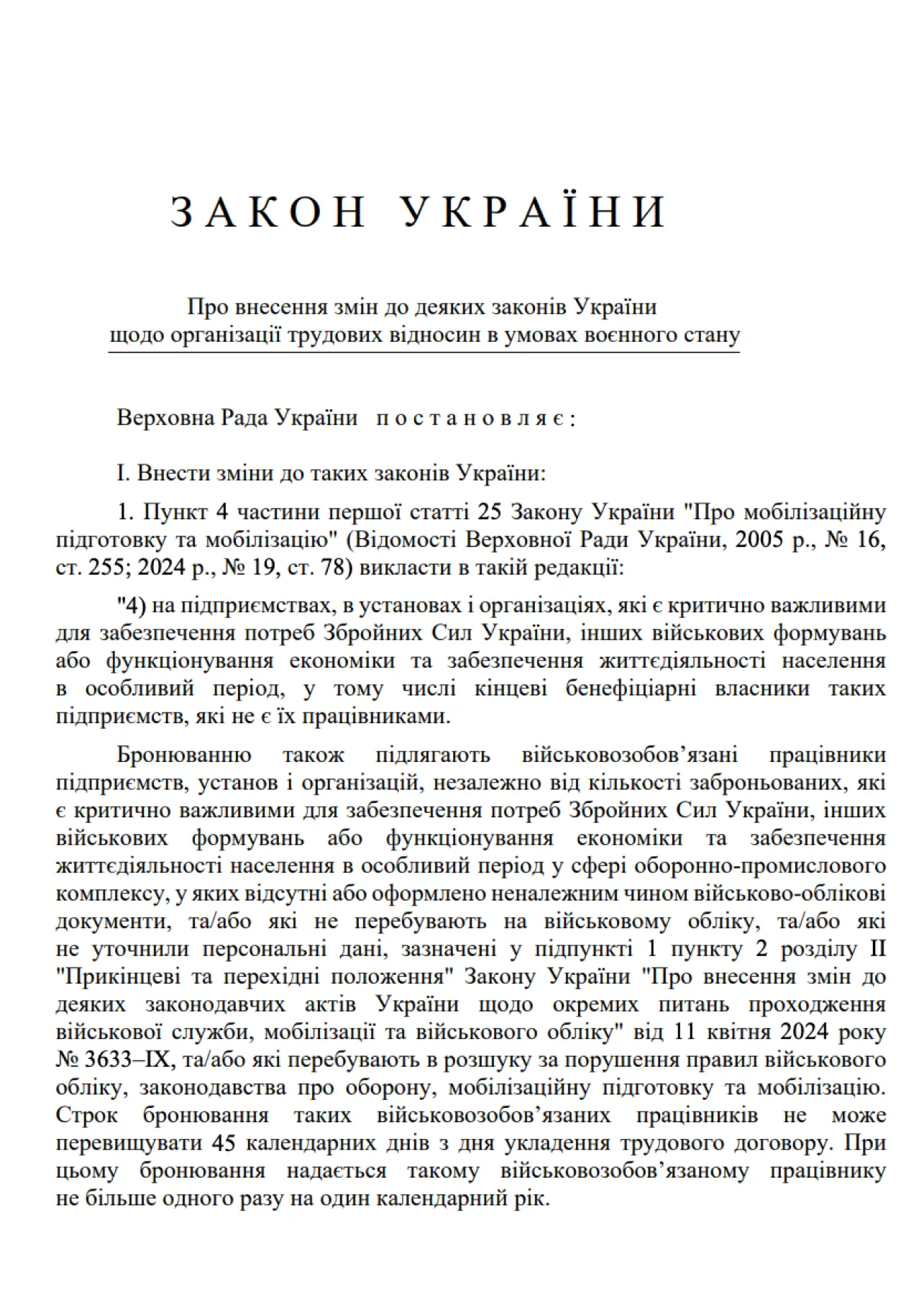
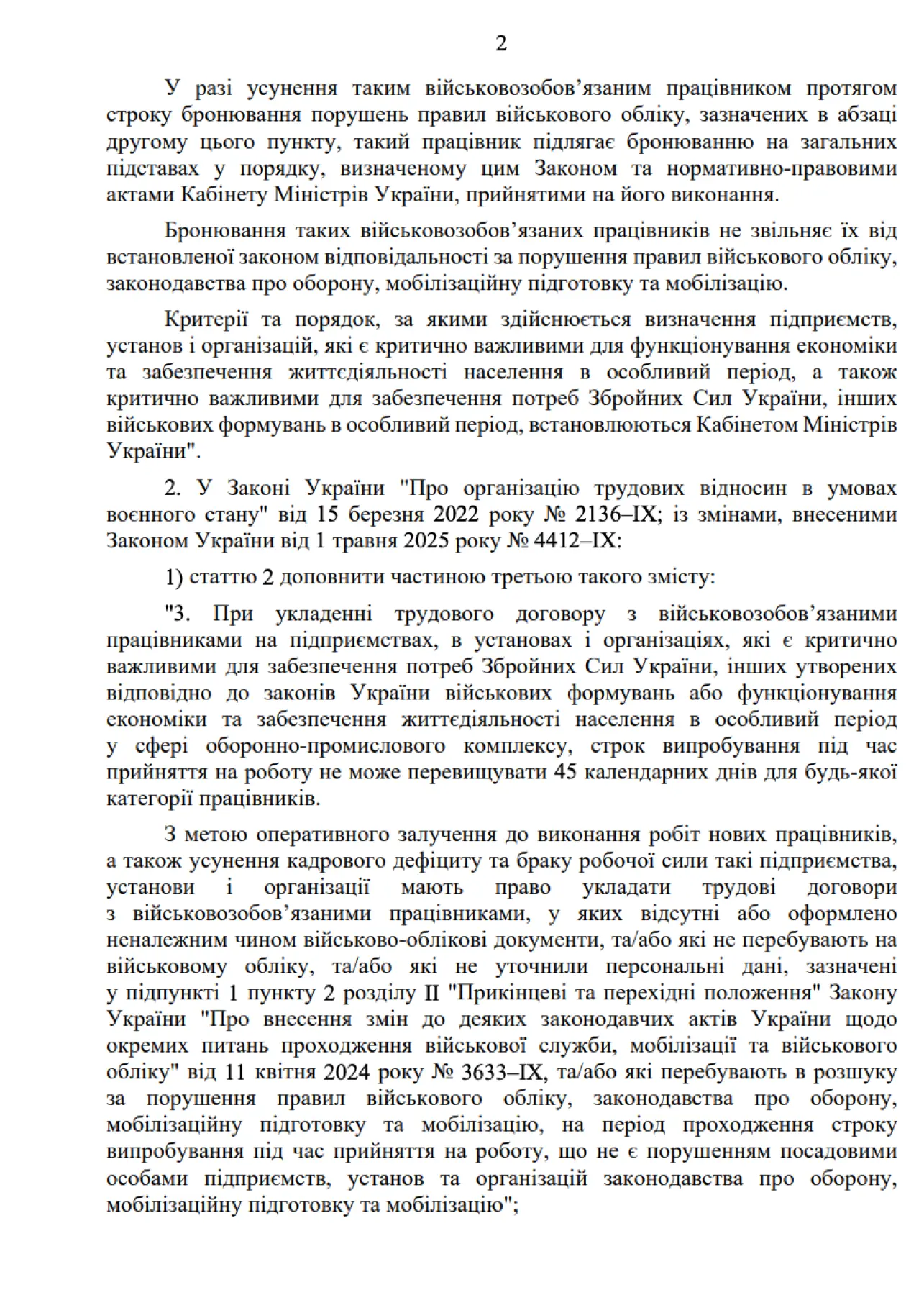
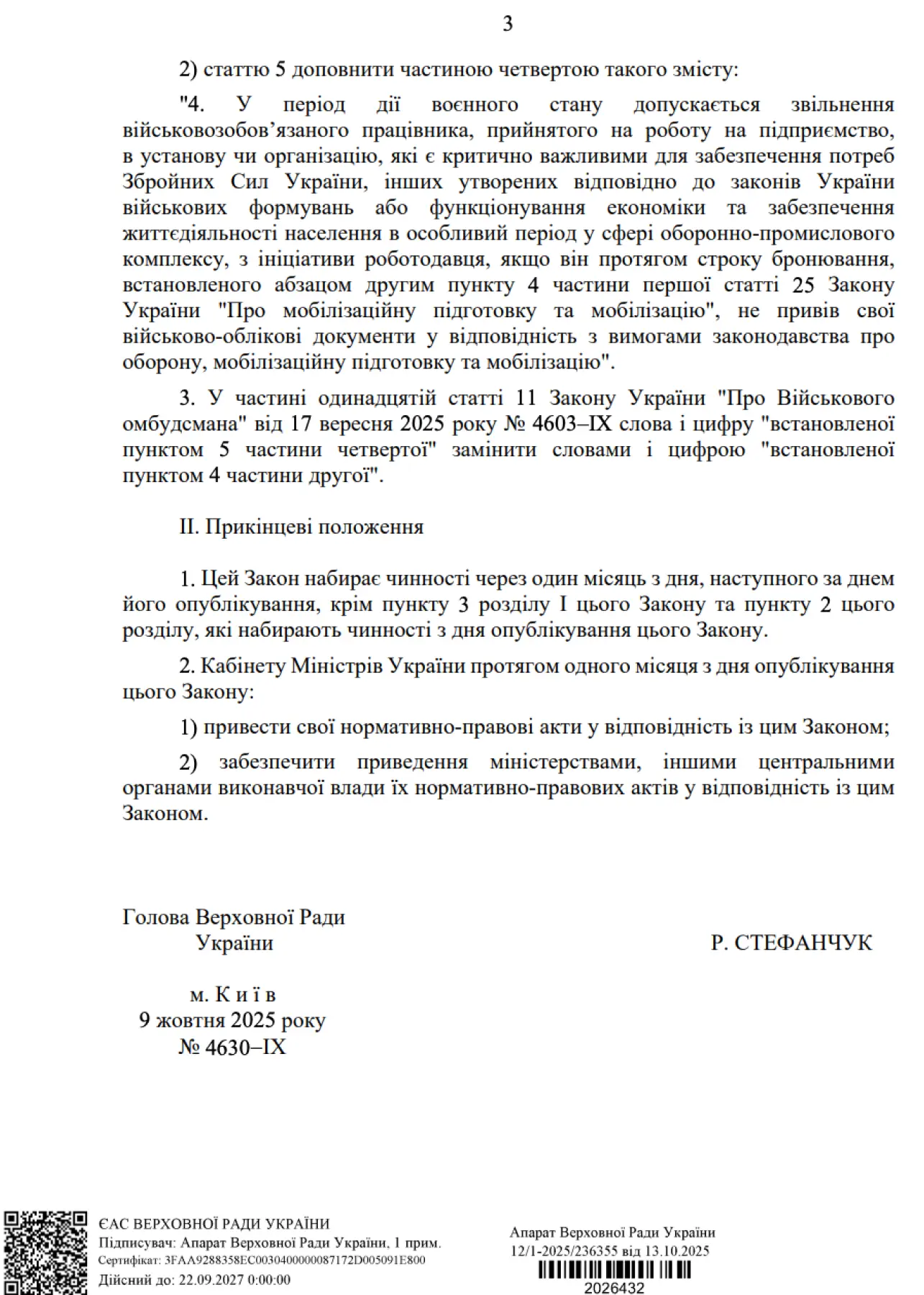
At the same time, the reservation period for such employees is limited - it cannot exceed 45 calendar days from the date of signing the employment contract. Also, such a reservation may be granted to a military-liable employee no more than once per calendar year. This time is given to eliminate existing violations.
If the employee fixes military-registration violations within the reservation period, they may be reserved again on general grounds according to the law and decisions of the Cabinet of Ministers.
Important: temporary reservation does not exempt the employee from liability for violations of military registration rules or mobilization legislation.
How to arrange employee reservation: step-by-step instructions
The reservation procedure may seem complicated at first glance. In fact, it consists of several logical stages, and if you act consistently - the chances of refusal are minimal.
Determine who can be reserved
At this stage, the company forms a list of employees without whom its work would simply “stop”. Before submitting, you need to check two key criteria:
| Criterion | What to consider |
|---|---|
| Grounds for reservation | Whether the company has the status of a critically important enterprise for the economy or for the needs of the Armed Forces |
| Employee status | The employee must be military-liable, fit for mobilization, employed under a labor agreement or contract* with an accrued salary of at least UAH 25,941 per month (three minimum wages), or at least UAH 21,617.50 in areas of hostilities and temporarily occupied territories, except legislative exemptions |
Preparing documents for reservation
Reservation is carried out through the Diia Portal by forming electronic lists by the head of the company. To create the list, information about the employee’s full name, date of birth, and tax number (or passport data if the employee refused a tax number) is required. After entering the data, the head reviews the formed reservation list and submits it with an electronic signature.
The list is reviewed within 72 hours. Based on the review results, a notification is sent to the company’s profile on the Diia web portal indicating whether the employee has been reserved or whether the reservation has been denied with specified reasons. After eliminating these reasons, the application may be resubmitted.

If the review is successful, transferring the military-liable employee to a special military record for the duration of the deferment is carried out automatically. This means that the company does not need to inform TCC about the employee’s reservation, as information exchange is performed electronically.
If the company has no technical ability to carry out the reservation through the Diia Portal, it must apply with the corresponding list of employees to the state authority that granted the status of a critically important enterprise or institution and which submits applications through Diia on their behalf. If you do not have the status yet, start there, see how we do it on the page critical enterprise status and employee reservation.
If it's complicated, delegate your
accounting to professionals
Our experienced accountants will analyze your business, take all nuances into account, and ensure complete order in your reports and taxes.
Employee reservation in Diia.City: how to protect IT and deftech teams
For most IT companies, Diia.City residency is not only about taxes but also about the legal opportunity to reserve key specialists.
How IT companies can obtain the status of a critically important enterprise (CIE)
| Option | Condition | Who grants the status |
|---|---|---|
| For defense contractors | The company performs state contracts for the Armed Forces of Ukraine | Ministry of Defense |
| For economically important companies | Compliance with the criteria of clause 2 of the Criteria under Cabinet Resolution No. 76 plus the criteria of the relevant authority. The "so many criteria out of a list" rule is not part of the resolution itself but a requirement of the specific authority or regional military administration, so check the number with them | Ministry of Economy, Environment and Agriculture, or the relevant central executive authority or regional military administration for your industry |
For IT companies, the following criteria are most common:
- Diia.City residency
- No tax debt (confirmed by a certificate)
- Average salary - at least 3 minimum wages (UAH 25,941 in 2026; for frontline territories - 2.5 minimum wages = UAH 21,617.50)
Once CIE status is obtained, the company may reserve employees. However, specific rules apply here as well.
Only military-liable men aged 25 to 60 can be reserved. Women and conscripts/reservists are not eligible for reservation.
Before applying for reservation, the company:
- checks military registration documents;
- evaluates eligibility for deferment;
- and plans the reservation process.
Additionally, the reservation of employees should generally not exceed 50% of military liable staff (excluding conscripts, military registered women, individuals removed from military registration, or those reserved by other companies), except in cases where a higher quota is set by a separate decision of the Minister of Defense.
After obtaining the reservation, the company gains the legal right to send reserved employees on business trips abroad or on leave outside Ukraine.
Important: to maintain Diia.City residency, it is necessary to meet the basic requirements: 90% of income from IT activities, an average salary of at least €1200, and a team of at least 9 people (or special conditions for startups).
What changed in reservation in 2026
2026 rewrote the rules twice. Resolution No. 692 of 30.05.2026 changed both the criteria of critical importance and the Reservation Procedure, resolution No. 862 of 01.07.2026 supplemented it, and some provisions were deferred and took effect on 01.09.2026. Below is what applies now.
The new salary threshold
This is the main change that cost some enterprises the right to reserve. The bar rose from 2.5 to 3 minimum wages, and 2.5 is now not an "old figure" but a separate threshold for front-line enterprises.
| Category | Minimum accrued salary |
|---|---|
| Ordinary enterprises | UAH 25,941 - three minimum wages |
| Enterprises located and actually operating in areas of possible or active hostilities and in temporarily occupied territories | UAH 21,617.50 - 2.5 minimum wages |
| State and municipal enterprises, Diia.City residents, religious organisations, certain energy companies | the requirement does not apply |
This is the accrued salary, that is before tax rather than take-home. The threshold works in two places at once - as a criterion of the enterprise's own critical importance and as a condition for the deferment of a specific reserved employee to remain valid.
Part-time employees: one person, one quota
Previously an employee registered at several enterprises increased the reservation quota for each of them. Since 01.09.2026 a military liable person counts towards the quota of only one workplace, and not necessarily the main one. The rule also covers employees who already hold a deferment on other grounds.
The practical consequence for an employer is simple - before filing the lists, check whether your part-time employee is already counted in another enterprise's quota. The same person cannot be counted twice.
Exceeded the limit? Ten business days to fix it
If an enterprise has reserved more employees than allowed, the director is obliged, within 10 business days of the excess arising, to file an application through the Diia Portal to cancel the surplus reservations. The wording is "files", not "may file" - clause 9-2 of the Reservation Procedure. Fail to do it and exceeding the limit becomes a standalone ground for revoking the status of a critically important enterprise.
Resolution No. 862 also removed the "no more than once every 5 calendar days" restriction on filing cancellation applications, so an excess can now be corrected immediately.
Confirming the status: nothing renews automatically
Statuses granted under the old criteria did not roll over by themselves. Once the industry criteria were updated, an enterprise had to confirm that it met the new requirements, and those that had obtained the status on minimal justification risked losing it along with the right to reserve.
A confirmation application is reviewed within no more than 10 business days, but only if the document package is complete. Incomplete or unreliable documents stretch that period, and reservations hang in the meantime.
For Diia.City residents the conditions also tightened: simply holding resident status is not enough, compliance with the requirements of Article 5 of the law on stimulating the development of the digital economy has to be confirmed through tax filings for the last 6 months.
What to do now
- Calculate the average accrued salary across the enterprise and for each person you plan to reserve. If it is below UAH 25,941, critical importance will be refused, and a deferment already granted will not work.
- Check part-time employees - whether they are already counted in another employer's quota.
- Recount the limit. The general rule is up to 50% of military liable employees. File the lists in stages so as not to end up in excess and fall under clause 9-2.
- Check the industry criteria with your own authority. The Ministry of Economy updated its own by order No. 6954 of 24.06.2026 (agriculture, forestry, cross-regional activity); other ministries and regional administrations publish their own.
This topic changes faster than anything else in accounting. A reform is in preparation under which the procedure, criteria, terms and categories of reservation will be set by law rather than by Cabinet resolutions, and "economic" critical importance as a ground for reservation may work differently. The figures in this article were verified against the versions in force as of 19 September 2026. Before filing documents, check the current version or ask us.
Conclusion
Employee reservation is not a formality, but a real tool to protect business and the team during wartime. Properly arranged deferment preserves specialists, operational stability and the peace of mind of business owners.
Key points to remember:
- Employees may be reserved by government bodies, critically important enterprises (CIE), and Diia.City residents who have CIE status. Sole proprietors (FOP) do not have this right.
- From 4 December 2025 employees with military registration violations can be reserved temporarily for up to 45 calendar days, but only by enterprises in the defence industrial complex. For all other critically important enterprises this rule does not apply.
- Only military liable men aged 25 to 60 who work under an employment contract or service contract can be reserved. Conscripts, reservists and women are not subject to reservation.
- From 1 September 2026 a reserved employee must be accrued at least UAH 25,941 (UAH 21,617.50 in areas of hostilities), and a part-time employee counts towards the quota of only one workplace.
- The reservation procedure includes several steps: identify key employees, prepare the required documents, and submit everything via the Diia portal or the respective ministry.
The buh.ua team supports a full-cycle reservation process: from preparing documents and obtaining CIE status - to receiving a positive decision.
A short call with an accountant or lawyer today - and you save weeks of stress and thousands of hryvnias tomorrow. Do not hesitate to ask even “silly” questions - this is where the smartest decisions begin.
Frequently asked questions about employee reservation
For what period is employee deferment (booking) granted?
For critically important enterprises, institutions and organizations that are officially recognized as vital for the functioning of the economy and ensuring the livelihoods of the population in a special period - 12 months;
For critically important enterprises, institutions and organizations recognized as critically important for the needs of the Armed Forces or other military formations - the duration of the contract for the supply of goods, performance of work, or provision of services necessary to meet the needs of the Armed Forces and other military formations.
What confirms the employee reservation (deferment)?
An electronic military registration document.
How many employees can be reserved (deferred)?
As a general rule, up to 50% of military liable employees and beneficiaries (beneficiaries are not included in the 50% quota) can be reserved.
Who can reserve (defer) 100% of employees?
1. Enterprises in combat zones
Such companies have the right to reserve their entire staff if they are registered or operate in settlements included in the list approved by the Ministry of Communities and Territories Development (in particular, regions of Donetsk, Luhansk, Kharkiv, Sumy, Chernihiv, Dnipropetrovsk, Zaporizhia and Kherson). The list is regularly updated.
2. Defense (deftech) companies - companies recognized as critically important for the economy, due to meeting the criterion of significant importance for the national economy in the defense industry sector (based on a separate decision of the Minister of Defense).
To do this, the company must meet one of the following 3 criteria:
- Execution of a state defense contract or participation in it on the basis of contracts, including foreign economic ones. The volume of defense production must exceed 50% of the company’s total production for the last reporting period.
- Receiving state financial support in the form of grants in accordance with the Resolution of the Cabinet of Ministers of Ukraine No.262 dated March 8, 2024 “Certain issues of ensuring the development of innovations and technologies for the needs of defense”.
- Performing the functions of an authorized entity managing state-owned defense enterprises, which regulates, controls and coordinates their activities.
If the company does not meet these key requirements, it may still qualify as important for the national economy if it meets at least 3 of the following conditions:
- has state contracts in the defense sector;
- is involved in defense orders (including foreign economic contracts);
- is included in the electronic register of participants and executors of state defense contracts;
- participates in state aviation or space industry programs;
- implements defense industry development programs, introduces new technologies or expands production capacity;
- produces goods, performs work or provides services used in the production of defense products.
3. Ultimate Beneficial Owners (UBO). All UBOs of critically important enterprises who are not their employees are reserved outside the quota.
4. Enterprises recognized as critically important for the needs of the Armed Forces by a decision of the Ministry of Defense.
A separate provision is defined for enterprises operating in combat zones: they have the right to reserve up to 100% of military liable employees. However, simply being located near the frontline does not grant automatic privileges or advantages. Such defense companies use the same support mechanisms as other enterprises: the ability to reserve personnel, obtain preferential loans, participate in “Defense City” programs, as well as state insurance and compensation for businesses operating in frontline territories.
What salary is required for reservation in 2026?
At least three minimum wages, that is UAH 25,941 accrued per month. For enterprises located and actually operating in areas of possible or active hostilities and in temporarily occupied territories the threshold is lower - 2.5 minimum wages, UAH 21,617.50. State and municipal enterprises, Diia.City residents, religious organisations and certain energy companies are exempt from this requirement.
Can documents for critical importance be filed with a district administration, or only a regional one?
Not with a district administration. The decision to designate an enterprise as critically important is taken by the relevant central executive authority for the industry or by the regional military administration, depending on the field of activity and the form of ownership. District administrations have no such powers. Before filing it is worth confirming exactly which authority applies to you - it differs by industry.
Can an employee who is wanted by the enlistment office be reserved?
As a general rule no - not being wanted is a condition of the Reservation Procedure. There is one exception: enterprises in the defence industrial complex may, under Law No. 4630-IX, hire such a person and reserve them for up to 45 calendar days, no more than once a year, so that they can fix the violations. This exception does not extend to ordinary critically important enterprises.
What happens if you reserve more employees than the limit allows?
The director is obliged, within 10 business days of the excess arising, to file an application through the Diia Portal to cancel the surplus reservations. If that is not done, exceeding the limit becomes a standalone ground for revoking the status of a critically important enterprise, and with it the right to reserve employees at all.
Want to talk to a specialist as soon as possible?
Leave a request and our specialist will contact you shortly