

How to remove a company from the list of risky VAT payers

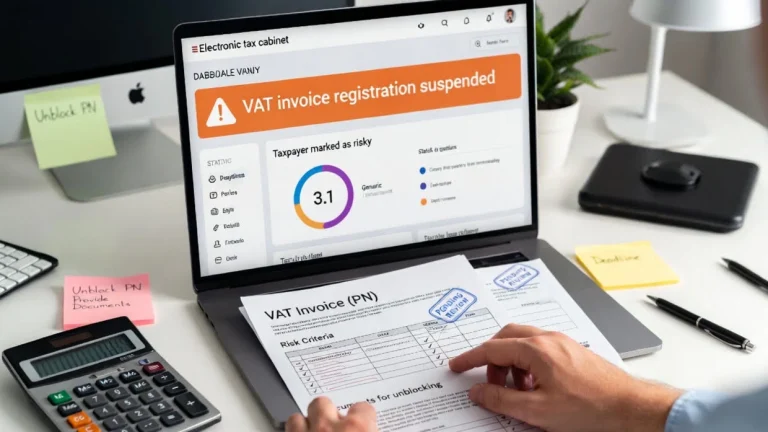
One notice about the suspension of a tax invoice registration - and the business literally “comes to a standstill.” Counterparties are unable to claim input VAT, phone calls begin with demands to “urgently unblock the invoice or return the money,” new partners refuse to cooperate, and a decision appears in the Electronic Cabinet stating that the “taxpayer has been classified as high-risk.”
Often, entrepreneurs do not fully understand why they were included in this list in the first place or how to get out of the situation.
In this article, we will break down: what the list of risky VAT taxpayers is and under which criteria companies are included, what real consequences the risky status has for business, how to understand why exactly your company was recognized as risky, and what to do to avoid being included in this list in the future.
At the end, you will receive a ready-made checklist: where to start, which documents to collect, where and within what deadlines to submit them in order to increase the chances of being excluded from the risky list and return to normal VAT operations.
What is the list of risky VAT taxpayers and why companies may be included
The list of risky VAT taxpayers is a register of business entities that, in the opinion of the tax authority, carry out activities in violation of the rules.
This list is formed based on inspection results and includes enterprises suspected of:
- fictitious transactions - for example, creating shell counterparties, conducting unreal VAT transactions,
- tax manipulations - inconsistency between transaction volumes and available resources (no warehouses, equipment, or employees),
- violations of tax discipline - lack of reporting, late payment of taxes, a significant increase in turnover without proper justification.
The law clearly establishes 8 criteria under which verification is carried out (Appendix 1 to the Procedure). The verification is carried out not by the SMKOR system (Risk Assessment Criteria Monitoring System), but by a commission of the regional tax authority. If a taxpayer meets at least one risk criterion, the commission adopts a decision on compliance with risk criteria. Below is the list of these criteria:
- the taxpayer is registered on the basis of invalid or forged documents;
- ownership or management of the company has been transferred to non-existent, deceased, or missing persons;
- the taxpayer registration was carried out by individuals who stated that they had no intention to conduct business activities;
- information has been received that financial and economic activities are carried out without the knowledge of the founder or director;
- the legal entity has no open bank accounts, only an account with the Treasury;
- VAT returns have not been submitted for the last two reporting periods;
- financial statements have not been submitted for the last reporting period (for those on the general taxation system);
- the tax authority has information indicating the VAT taxpayer’s risk (there are 20 tax information codes under which a taxpayer may be included in the risky list).
Most often, VAT taxpayers are classified as risky precisely under criterion No. 8.
The tax authority has even developed a Directory of tax information codes under which a taxpayer may be included in the risky list. There are 20 such codes, and we strongly recommend reviewing them.
What are the consequences if a business is included in the risky list
Being included in the list of risky VAT taxpayers is not just a “warning” from the tax authority. It is a status that effectively blocks normal business operations and creates serious financial and reputational risks. The most important consequences include:
- Blocking of VAT invoices
After being included in the risky list, the absolute majority of VAT invoices will be blocked (with the exception of a small number that will pass automatic unconditional registration. However, even at the unconditional registration stage, in some cases, the “risky” status will not allow such registration). This means the company will be unable to register VAT invoices, and its counterparties will not be able to claim input VAT. This, in turn, leads to consequences such as loss of counterparties unwilling to cooperate due to the inability to include VAT in tax credit, deterioration of the company’s financial reputation, and increased tax burden. In addition, many contracts provide for penalties in case your invoices are “blocked.”
- Suspension of financial transactions
The tax authority may monitor all financial transactions of the enterprise, including transactions with counterparties who may subsequently also be recognized as risky. This, in turn, can lead to delays in payments, blocking of bank accounts, and loss of partners due to doubts about the company’s integrity.
- Tax audits
The tax authority may initiate unscheduled audits to verify the reality of transactions, availability of resources, and counterparties. This results in additional costs for audit preparation, the risk of penalties for fictitious transactions, and the risk of additional VAT and other tax assessments.
- Risk of litigation
If a company is unjustifiably included in the risky list, it has the right to challenge the tax authority’s actions in court. This again brings inconvenience: costs for legal support and court fees, as well as reputational risks due to negative publicity about the company.
- Loss of VAT payer status
If a company is recognized as fictitious or as systematically violating tax legislation, it may lose its VAT payer status. This can lead to the inability to work with VAT payers, an increased tax burden, and loss of competitive advantages in the market.
- Reputational losses
Even if a company is removed from the risky list, information about its prior inclusion may negatively affect its image. Counterparties may be wary of cooperation due to potential tax risks.
What to do if your business is included in the list of risky VAT taxpayers
If you are included in the list of risky VAT taxpayers, you will receive a decision about this in the Taxpayer’s Electronic Cabinet. The decision will specify:
- the risk criterion and the tax information code;
- the type of transaction due to which you were classified as risky;
- the period of the transaction;
- UKTZED/DKPP codes (i.e., the product or service code);
- the counterparty’s EDRPOU code.
If, for some reason, the decision does not clearly specify why exactly you were included in the risky list, first of all you need to determine this reason. The most effective and fastest option is to submit a lawyer’s request. The tax authority is obliged to respond to a lawyer’s request within 5 working days (in exceptional cases, the term may be extended to 20 working days).
Removal from the list of risky taxpayers may take several stages:
Stage 1: submission of explanations to the tax authority
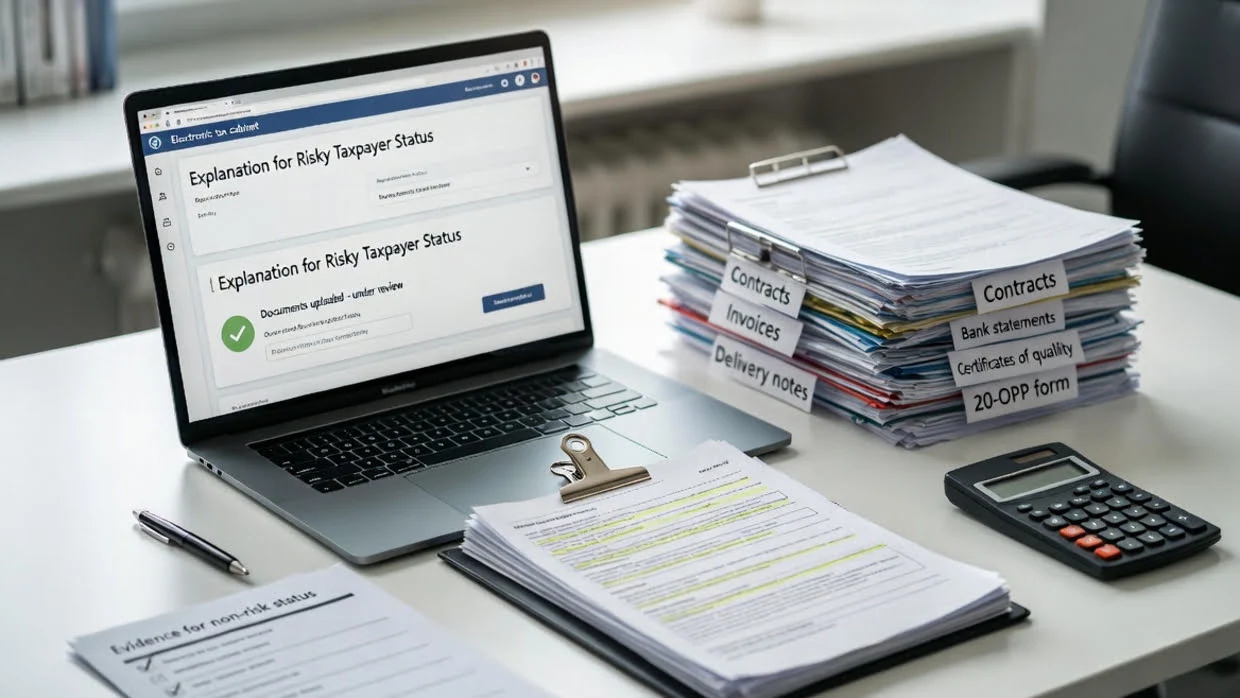
After you determine the reason why the enterprise was included in the risky list, in order to refute the risk status you need to submit explanations and copies of documents confirming non-compliance with the VAT taxpayer risk criteria. Documents are submitted via the Electronic Cabinet.
In the explanations, you should clearly and understandably describe why the information about risk is erroneous or unfounded and provide documents confirming the stated circumstances. Such documents may include:
- contracts (including foreign economic activity contracts) and annexes thereto;
- powers of attorney, governing body acts regarding the authority of persons receiving goods in the interests of the taxpayer;
- primary documents on supply/purchase, transportation, storage, invoices, acceptance certificates;
- settlement documents and/or bank statements;
- documents confirming product compliance (certificates, quality passports);
- other supporting documents.
The specific documents to be submitted depend on the reason why the enterprise is considered risky.
For example, if the issue concerns counterparties, you should provide a complete package of documents confirming the reality of business transactions with these counterparties.
If the decision indicates a lack of employees or material and technical resources, these statements must be refuted. To do this, submit or update Form 20-OPP, indicating all taxable objects, and provide documents confirming ownership or use of the property. Regarding employees, explain to the tax authority who exactly performed the work, provided services, or supplied goods.
We also recommend reviewing the VAT invoice unblocking instructions, which will help form the document package.
The law does not specify a deadline for submitting documents to remove the risky status. The taxpayer has the right to submit a document package at any time after being assigned the risky status.
The documents are reviewed by the commission within 7 working days and a decision on compliance/non-compliance with the risk criteria is adopted, which the VAT taxpayer receives in the electronic cabinet on the day it is made.
If a decision is made to keep the taxpayer on the risky list, the decision specifies the reason and a list of documents that are missing to confirm non-compliance with the risk criteria.
Can documents be submitted again? Yes.
After receiving such a decision, the VAT taxpayer has the right to resubmit information and copies of documents by supplementing them. The number of such attempts is unlimited.
Stage 2: administrative appeal
If you have already submitted all possible documents, but the tax authority’s decision to exclude the enterprise from the risky list has not changed, you may file a complaint against such a decision with the commission of the central tax authority, or immediately go to court (this is Stage 3).
A complaint against the decision of the regional-level commission must be submitted electronically within 10 working days following the date of adoption of this decision (clause 3 of Procedure No. 1165). To submit a complaint, the form with the identifier J(F) 1316002 is used.
Explanations and their attachments (identifier J/F1360102) are attached to the complaint.
The period for consideration of the complaint by the central-level commission depends on whether the taxpayer has expressed a desire to be present at the review:
- if participation in the review is not requested - within 10 calendar days from the date of receipt of the complaint,
- if the taxpayer wishes to be present - within 30 calendar days from the date of receipt of the complaint.
If within these time limits the decision on the complaint is not sent to the taxpayer, the complaint is automatically deemed satisfied in favor of the taxpayer from the day following the expiration of the specified time limits (clause 16 of Procedure No. 1165).
If you have already filed a complaint with the commission of the central tax authority against the decision of the regional tax authority commission, then it is impossible to submit explanations again with attachments regarding your business transaction .The next stage is only an appeal to the court.
Stage 3: appeal to court
The law establishes specific time limits within which a taxpayer may challenge the tax authority’s decision in court. It is important to be attentive in order not to miss them. An important role here is played by whether you used the pre-trial dispute resolution option.
If administrative appeal was not used, the time limit for filing a claim with the court is 6 months from the moment the taxpayer learned that the explanations submitted to the tax authority did not produce results (Part 2 of Article 122 of the Code of Administrative Procedure of Ukraine).
If administrative appeal was used:
- 3 months from the date of receipt of the decision on the complaint (Part 4 of Article 122 of the Code of Administrative Procedure of Ukraine).
- 6 months if the decision on the complaint was not adopted or delivered within the установлені time limits. The term is calculated from the date of filing the complaint with the commission of the central tax authority (Part 4 of Article 122 of the Code of Administrative Procedure of Ukraine).
We also recommend submitting an application to secure the claim by suspending the effect of the decision on compliance with the risk criteria until the court decision enters into legal force. Such security may temporarily unblock the company’s activities and allow registration of VAT invoices while the case is pending in court.
Courts of first and appellate instances often grant such applications, but recently the Supreme Court has begun to overturn these decisions, arguing that the very fact of being classified as risky is a form of tax control (Supreme Court rulings dated 08.02.2024 in case No. 160/19014/23, dated 23.11.2023 in case No. 140/13016/23, dated 16.11.2023 in case No. 600/5531/23-a).
Nevertheless, it is still worth using this opportunity.
And of course, it is worth thoroughly preparing for court, collecting all necessary evidence, and analyzing current court practice.
If you need assistance
With preparing explanations, forming a document package, or unblocking VAT invoices, the team of accountants and lawyers at buh.ua can do this for you.
How to avoid being included in the risky list
Avoiding inclusion of an enterprise in the risky list is much easier than later achieving its exclusion. To do this, it is recommended to:
- Check counterparties before starting cooperation. Unfortunately, there is no open register of risky taxpayers. You can find out whether your counterparty is risky in the following ways:
- simply by asking the partner directly;
- try to register a VAT invoice. If registration is successful, your partner is not risky. If VAT invoice registration is suspended due to your partner being risky, you will receive information about this;
- find out the partner’s reputation in the market;
- check possible involvement in court cases, including with the tax authority regarding fictitious VAT credit or suspicious transactions;
- there is information online about the “Learn more about your business partner” service on the State Tax Service website, however this service is currently unavailable.
- Register the VAT taxpayer data table for goods that the enterprise regularly supplies.
- Timely fulfill tax obligations and avoid violations of tax legislation.
- Do not participate in dubious schemes that may raise suspicions from tax authorities.
- Organize proper accounting so that all transactions are transparent and documented.
- Ensure sufficient labor resources for business operations.
- Maintain an average salary level depending on the industry/region.
Checklist: How to remove an enterprise from the list of risky VAT taxpayers
Conclusion
The most common ground for including a business in the list of risky VAT taxpayers is criterion No. 8, when the tax authority obtains information about possible violations during business transactions. It is important to understand that not only a company that purchases from dubious counterparties can be recognized as risky, but also one that supplies such counterparties. That is, risks arise for both buyers and suppliers.
Before submitting documents for exclusion from the list, the enterprise must accurately identify the reason for the risk status. This is the foundation. It is necessary to carefully analyze the tax authority’s decision and determine which actions or transactions became the grounds for inclusion in the risky list.
To be removed from the list of risky VAT taxpayers, it is necessary to prepare and submit to the regional tax commission explanations with a complete package of documents confirming that the information about risk is erroneous or unfounded.
If, after submitting documents, the situation does not change and the enterprise remains in risky status, it makes sense to appeal the decision of the controlling authority to the commission of the central tax authority or to the court. The choice of appeal method depends on the specific circumstances, the available evidence base, and the business’s readiness to defend its position.
If your business has been included in the risky list - do not waste time
Leave a request and we will return your business to normal operations without blockages and risky statuses.