


Employment Contract, Service Agreement or Sole Proprietor: How to Hire a Contractor in 2026 and Avoid Reclassification


When a business needs to engage an employee, contractor or sole proprietor, the question arises of how to formalise the relationship correctly. This affects not only the tax burden but also the risk of reclassification as an employment relationship, penalties and additional tax assessments. A contractor can be engaged in at least four ways: an employment contract, a civil law contract, cooperation with a sole proprietor or a gig contract.
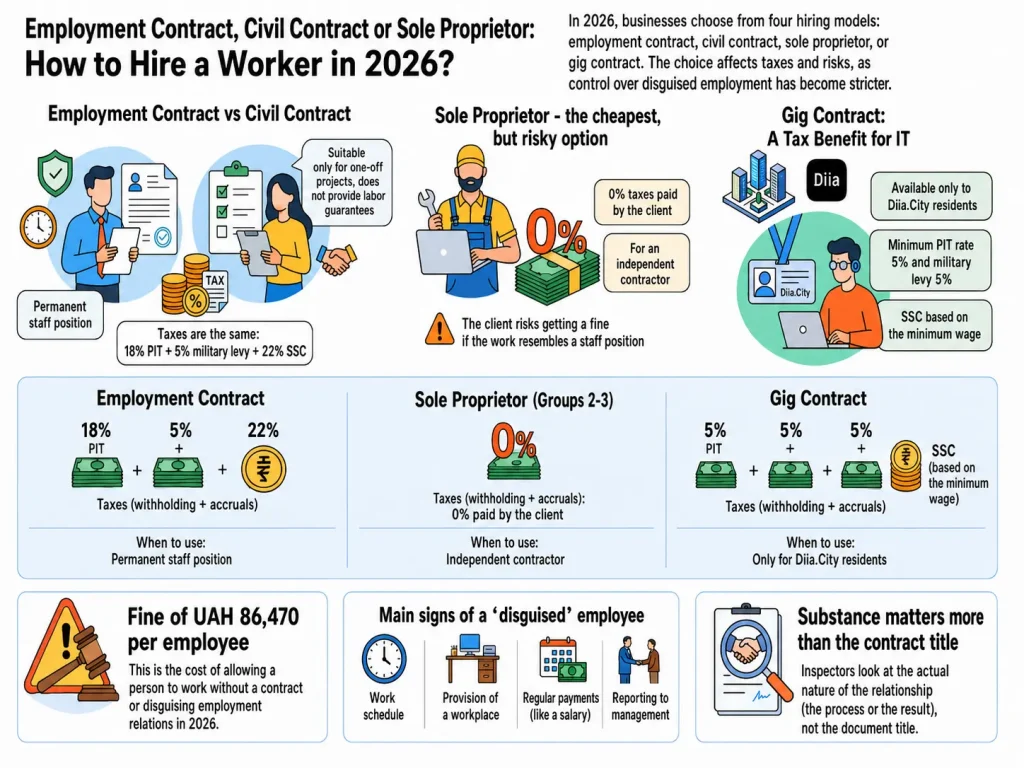
The greatest risk is reclassification: when the tax authorities or the State Labour Service determine that an agreement with a sole proprietor or a civil law contract actually conceals an employment relationship. This may result in significant additional tax assessments and penalties, which in some cases can reach UAH 86,470 for each employee. We will explain how these arrangements differ and how to choose the right one without unnecessary risk.
Four ways to engage a contractor
Here is a brief overview of each option, followed by a detailed explanation:
The key difference between these arrangements is who pays taxes on the remuneration and what guarantees and risks arise.
Employment contract: guarantees and cost
An employment contract is the traditional way to hire an employee under the Labour Code of Ukraine. The employer acts as the tax agent and:
- withholds 18% personal income tax and a 5% military levy from the accrued salary;
- charges a 22% unified social contribution on top of the salary at its own expense.
For example, from a minimum monthly salary of UAH 8,647, the employee will receive approximately UAH 6,660 after tax, while the total monthly cost to the employer will be approximately UAH 10,549 - the salary plus a unified social contribution of UAH 1,902.34.
In return, the employee receives a full package of employment guarantees: paid annual leave, sick pay, regulated working hours and protection upon dismissal. This is the most expensive and heavily regulated arrangement, but it is the only appropriate option when a person works permanently and under the employer's direction.
Employing staff also involves regular reporting and payroll processing, which are often outsourced to avoid employing a separate HR specialist and accountant.
Civil law contract
A civil law contract, such as a contract for work or services under the Civil Code, is used when a specific result is required rather than ongoing work: developing a website, completing repairs or preparing a project. The contractor is not part of the staff, organises their work independently, and receives payment for the result, which is documented by an acceptance certificate.
A common misconception is that a civil law contract is cheaper than an employment contract because it saves on the unified social contribution. This is not true. When remuneration is paid to an individual under a civil law contract, the customer must also withhold 18% personal income tax and a 5% military levy and charge a 22% unified social contribution. The tax burden is the same as under an employment contract - the only saving relates to employment guarantees, which do not apply under a civil law contract.
A civil law contract is therefore appropriate specifically for one-off and project-based assignments. If a person attends work every day according to a set schedule, this is an indication of an employment relationship rather than a civil law arrangement. The subject of such a contract must be the result of the work, not the process of performing it.
Cooperation with a sole proprietor: taxes and reclassification risk
The most common arrangement in small businesses and the IT sector is to work with a contractor registered as a sole proprietor under the simplified taxation system. In this case, the customer is not a tax agent: it does not withhold anything from the remuneration, while the sole proprietor independently pays the single tax and the unified social contribution. For the customer, this is generally one of the least expensive forms of cooperation.
However, this is also where the main risk arises - reclassification as an employment relationship. If a sole proprietor effectively works as a salaried employee, with one customer, a designated workplace, a fixed schedule and managerial supervision, the tax authorities may recognise the relationship as employment, with all the resulting consequences. This may be regarded as a form of business fragmentation, which regulatory authorities are monitoring increasingly closely.
Gig contracts for Diia.City residents
A gig contract is a special arrangement available only to Diia.City residents, primarily IT companies.
A gig specialist is neither an employee nor a sole proprietor but has a separate legal status. Their remuneration is subject to 5% personal income tax and a 5% military levy, while the unified social contribution is charged at no less than 22% of the minimum salary.
This arrangement has the lowest tax burden among the official forms of engagement, but it is available only to companies that meet the Diia.City eligibility criteria. For companies already operating under Diia.City, it often provides a compromise between an employment contract and cooperation with a sole proprietor. Read more in our articles comparing a gig contract and a sole proprietor and explaining taxation under Diia.City.
Comparison of engagement arrangements: table
Here is a summary table to make the choice easier:
| Arrangement | When it is appropriate | Taxes on remuneration | Main risk |
|---|---|---|---|
| Employment contract | Ongoing work under supervision and according to a set schedule | 18% personal income tax + 5% military levy withheld + 22% unified social contribution charged on top | The highest tax and administrative burden |
| Civil law contract | A one-off or project-based result | 18% personal income tax + 5% military levy + 22% unified social contribution | Reclassification if the work is ongoing |
| Cooperation with a sole proprietor | An independent contractor with several clients | Customer - 0; the sole proprietor pays the single tax + unified social contribution | Reclassification as an employment relationship |
| Gig contract | IT, Diia.City resident | 5% personal income tax + 5% military levy + unified social contribution based on the minimum salary | Available only to Diia.City residents |
The least expensive model is not always the safest - the final choice depends on how the contractor actually performs the work.
Not sure which contract is appropriate for your situation?
The buh.ua team will analyse the relationship, recommend a safe engagement model and help prepare the correct contract.
Reclassification of employment relationships: indicators and penalties
The main point to understand is that regulatory authorities consider not the title of the contract but the actual nature of the relationship. If cooperation with a sole proprietor or under a civil law contract has the characteristics of employment, it may be reclassified regardless of what the contract says.
There is currently no exhaustive statutory list of criteria. Eight indicators of disguised employment relationships are included in the draft new Labour Code, but they are not yet legally binding. In practice, however, the State Labour Service, tax authorities and courts consider the following indicators:
- the work is ongoing rather than one-off;
- the contractor follows internal workplace rules and a set schedule;
- the customer provides the workplace, equipment and materials;
- payment is made regularly, like a salary, rather than for a final result;
- the work is performed personally, and the contractor is integrated into the company's structure;
- for a sole proprietor - a significant share of income comes from one customer within the customer's core business activities. This is a risk factor, not an automatic prohibition.
None of these indicators alone results in automatic reclassification - the regulatory authorities assess all the circumstances of the particular working relationship.
The more of these indicators are present, the higher the risk. Consequences of reclassification include additional assessments of 18% personal income tax, a 5% military levy and a 22% unified social contribution for the entire period, late-payment interest and a penalty for an undeclared employee.
Penalties for undeclared employment under Article 265 of the Labour Code of Ukraine: allowing an employee to start work without an employment contract or without notifying the tax authorities results in a penalty of 10 minimum salaries = UAH 86,470 for each employee. A repeated violation within two years is subject to a penalty of 30 minimum salaries, or UAH 259,410. Single-tax payers in Groups 1-3 receive a warning for the first violation. A mitigation rule applies during martial law: if the employer complies fully and on time with an order to remedy the violation, the penalty may not be imposed. Such violations may be identified, in particular, during State Labour Service inspections.
Learn more about the 7 signs of disguised employment, how a fine can be imposed even without an inspection, what the sole proprietor risks losing, and how to safely draft a contractor agreement in the article “Sole Proprietor Instead of an Employee: 7 Signs of Reclassification.”
How to engage a contractor correctly
There is no universal contract: first, you must determine the actual nature of the cooperation and only then choose the appropriate legal arrangement. The key requirement is that it must reflect the true nature of the relationship:
- Employment contract - issue an employment order and submit the mandatory notification to the tax authorities before the employee starts work, using the form approved by Resolution No. 413 of the Cabinet of Ministers of Ukraine. Allowing the employee to start work without this notification is already a violation.
- Civil law contract - specify the exact result, deadline and payment for the completed result, and document completion with an acceptance certificate. Avoid provisions concerning working hours and subordination.
- Cooperation with a sole proprietor - make sure the contractor is genuinely independent: they have several clients, their own equipment, an appropriate KVED activity code, and the contract describes a service rather than a job position.
If you are planning to hire your first employee, see the step-by-step procedure in our article explaining how a sole proprietor can hire an employee.
Frequently asked questions (FAQ)
Which is cheaper - a civil law contract or an employment contract?
The tax burden is the same in both cases: 18% personal income tax + a 5% military levy + a 22% unified social contribution. The difference lies elsewhere: a civil law contract does not provide employment guarantees and is concluded for a specific result. There is no saving on the unified social contribution under a civil law contract - this is a common misconception.
Can I engage a sole proprietor instead of hiring an employee?
Yes, provided that the contractor is genuinely independent and works with several clients. However, if the sole proprietor effectively works as a salaried employee, with a fixed schedule, a designated workplace and only one customer, the relationship may be reclassified as employment, resulting in additional tax assessments and a penalty.
What is the penalty for an undeclared employee in 2026?
Under Article 265 of the Labour Code of Ukraine, the penalty is 10 minimum salaries, or UAH 86,470 for each employee. A repeated violation within two years is subject to a penalty of UAH 259,410. Single-tax payers in Groups 1-3 receive a warning for the first violation.
When must an employee notification be submitted to the tax authorities?
Before the employee starts work - before they actually begin performing their duties. The notification form is established by Resolution No. 413 of the Cabinet of Ministers of Ukraine.
Who pays the taxes when I work with a sole proprietor?
The sole proprietor independently pays the single tax and the unified social contribution. The customer is not a tax agent and does not withhold anything from the sole proprietor's remuneration, provided that the documents are properly prepared and the cooperation is genuine.
Can a sole proprietor work with only one customer?
Yes, the law does not prohibit this. However, if the sole proprietor receives most of their income from one customer and works according to that customer's schedule and at its workplace, this may become one of the risk factors for reclassification as an employment relationship. Having only one client is not in itself a violation.
What does the State Labour Service examine when considering reclassification?
The State Labour Service assesses the actual nature of the relationship: whether the contractor is subject to a schedule and internal rules, has a designated workplace, receives regular payments, performs the work personally and is integrated into the company's structure. Read more in our article about State Labour Service inspections.
Conclusion
Choosing how to engage a contractor requires balancing cost, guarantees and risk. An employment contract is the most expensive option but is safe for ongoing work. A civil law contract is convenient for one-off assignments but is not cheaper in terms of taxes. Cooperation with a sole proprietor is the most cost-effective option, but it carries the main risk of reclassification. A gig contract is available only to Diia.City residents.
The golden rule is that the legal arrangement must reflect the actual nature of the relationship. If a person works permanently and under the employer's direction, this is an employment relationship, and no agreement with a sole proprietor will change that. Ensuring that the arrangement matches the real relationship protects against additional tax assessments and penalties.
*This material is current as of the publication date. The rates and amounts are linked to the 2026 minimum salary. There is currently no single statutory list of reclassification criteria - court practice and the approaches of regulatory authorities continue to develop.
Planning to engage a contractor and want to do it without unnecessary risk?
We will select the appropriate engagement model, prepare the contract and handle the reporting so that you do not overpay or worry about inspections.