

Open Banking in Ukraine 2026: What It Is and Whether There Is Real Cause for Concern

As of August 1, 2025, open banking has come into effect in Ukraine - a system that allows accounts from different banks to be combined in one app only with the client's consent. Banking secrecy is not abolished, and the state does not get automatic access to accounts.
And panic started immediately: "Banking secrecy is gone!", "The government can now see all your money!", "The tax office knows about every purchase!" But what has actually changed? Is it really that bad? And what does it mean for ordinary people, Sole Proprietors, and business owners in 2026?
Let's break it down: what open banking is, what changes to expect in financial monitoring, who may be affected, and what to do to avoid problems.
What open banking is
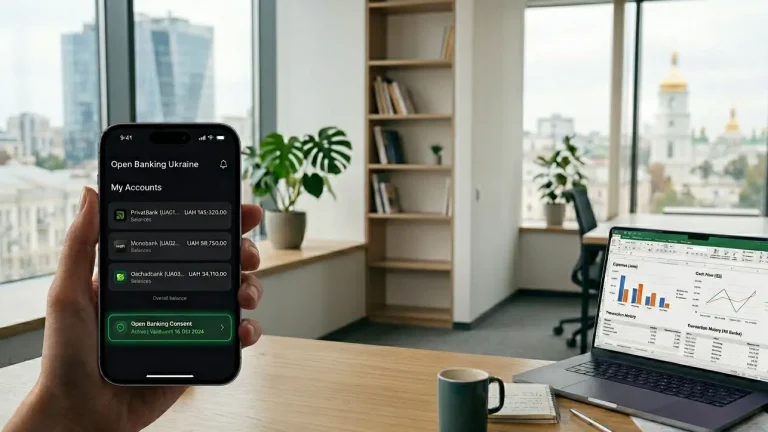
Open banking means that all your accounts in different banks can be combined in one app. It works through secure APIs (application programming interfaces), and only with your consent. In other words, you decide who gets access to your financial data and when.
What does it look like in practice?
Right now, you may have accounts with PrivatBank, Monobank, and Oschadbank - and each one has its own app. With open banking, it will be possible to manage all accounts through one app: monitor balances, make payments, and see the full picture of your finances at any moment.
A real example of how it works
Imagine buying something for UAH 700, but one card only has UAH 500. Right now, you open your banking app, transfer money from another card, wait for it to arrive, and then pay.
With open banking, the system will automatically "pull" the remaining UAH 200 from another one of your accounts - and you won't have to transfer anything manually. Fast, convenient, and without extra steps.
For businesses, this is even more of a relief: faster customer service, fewer technical limitations, and more process automation.
Who is responsible for this
This system has already been operating in Europe for several years under the PSD2 (Payment Services Directive 2) standard. Now it is being implemented in Ukraine.
On August 1, 2025, the legal framework for open banking came into effect (Chapter 4 of Law No. 1591-IX "On Payment Services" and NBU Regulation No. 80 dated July 25, 2025). This marks the legal launch, while the widespread opening of APIs will take place gradually: the NBU is expected to approve a unified technical specification within 18 months, so banks are expected to become operationally ready around 2026-2027.
But this is the important part: all of it happens only with your consent. You decide who gets access to your accounts and when.
Banking secrecy: myths and reality
Things are not as scary as internet headlines or social media posts make them sound.
MYTH #1: "Now everyone can see my money!"
REALITY: Without your consent, no app or service will get access to your accounts.
No random person will see how much you spent on coffee or at the hair salon. You grant access only yourself, and only to the services you trust.
MYTH #2: "The tax authorities can spy on income through open banking!"
REALITY: The tax authorities cannot "spy on" your income through open banking.
For that to happen, Parliament would have to separately abolish banking secrecy for fiscal authorities. That is a completely different process and has nothing to do with open banking.
MYTH #3: "Anyone can see my spending!"
REALITY: Only licensed financial institutions authorized by the NBU can access data. And even then, only with your consent.
To get access to your data, a financial institution must:
1. Pass a review by the National Bank of Ukraine
2. Obtain official authorization
3. Comply with all security standards
For banks, this is easier. For other companies, it is much more difficult. There will be no such thing as "free access."
The key thing to understand: Banking secrecy has NOT disappeared. It remains fully in force.
Open banking is not about disclosing your data to the state or third parties. It is about making it easier for you to manage your own finances.
Benefits of open banking
Now for the good part - what exactly is changing for the better.
For ordinary people
For businesses and Sole Proprietors
If you have several accounts in different banks, as many Sole Proprietors do, open banking becomes a real lifesaver.
Less manual work - no need to log into 3-4 banks every day, check balances, and take screenshots of statements.
Example: You are a Sole Proprietor with accounts in PrivatBank, Monobank, and PUMB. Right now, every morning you open three apps, check payments, and enter everything into a spreadsheet. With open banking - you open one app and see everything at once. Time saved - at least 20-30 minutes every day.
Do you have questions about open banking, accounts, and data control?
Book a consultation to understand how open banking, financial monitoring, and access to banking data may affect your business activities
What risks open banking involves
As with any new technology, there are some points worth knowing about:
What will change in the near future
For now, there is no need to worry about the "opening" of banking secrecy. Since 2025, the open banking system has only just begun to be implemented.
The reality:
- Banks are currently working on the technical details
- Fintech companies are developing apps
- Everything definitely will not be fully open either in August or in autumn
Information exchange will take place only with your consent, and the data will not go beyond the banking system. So all the talk about the "end of privacy" is exaggerated.
The real changes that will make life easier will appear gradually, as the system is refined and convenient apps become available.
How financial monitoring has become stricter
Alongside open banking, Ukraine is also tightening the rules of financial monitoring. This is a separate process that is not part of open banking, but it is happening in parallel.
The main changes:
1. Topping up cards through terminals - now with verification
From June 26, 2026 (NBU Resolution No. 67), when depositing cash onto someone else’s card through a terminal, you must confirm that the phone number belongs to the sender - using a one-time password (SMS) or a phone call. It is no longer possible to top up someone else’s card anonymously. Exceptions include paying taxes, fines, utility bills, topping up your own account, and similar transactions.
Purpose: combating money laundering through "money mules" (people who allow others to use their bank cards).
2. Cash transfers are strictly monitored
Even small amounts are being checked. Banks are required to ask about the source of cash if they detect suspicious activity.
3. Cards issued under someone else's passport cannot be used
Using cards issued under someone else's passport will become practically impossible. Banks are checking whether the owner's details match the person actually using the card.
The purpose of these changes is to combat:
- Shadow income
- Money laundering
- Fictitious low-income status - when people hide income in order to receive state assistance
FAQ: open banking in Ukraine in 2026
Can the tax authorities see bank accounts through open banking?
No. Open banking does not give the tax authorities automatic access to your accounts or transactions.
Access to data is possible only with the client's consent and only for licensed financial services, not for fiscal authorities.
Can you opt out of open banking?
Yes. Open banking is not mandatory.
You decide for yourself whether to grant access to your accounts, and you can withdraw permission at any time through the bank or the app.
Is open banking mandatory for sole proprietors?
No. For Sole Proprietors, open banking is a convenience tool, not a legal requirement.
It can simplify accounting and bookkeeping, but not connecting it is not a violation.
Is it safe to grant access to fintech apps?
Yes, if these are licensed services authorized by the NBU. Such companies go through verification, operate via secure APIs, and get access only within the scope of the permission you grant.
Conclusion
Open banking in Ukraine is not the "end of privacy" or "total state control," but a convenient tool for managing finances. Your data remains protected, banking secrecy remains in force, and only you grant access to your accounts.
What to remember:
- Open banking works only with your consent - without your permission, no one will see your data
- Banking secrecy has not disappeared - the tax authorities cannot "spy on" income through open banking
- It is about convenience, not control - all accounts in one app, faster loans, automatic bookkeeping
- Use only licensed apps - check NBU authorization before granting access
- Financial monitoring is tightening in parallel - cash transfers are being monitored, and cards issued under someone else's passport will not work
Do not rush to grant access to your accounts to just anyone - choose only trusted services.
If you are working "in the shadows" and receiving income on a personal card - it may be time to legalize your activities and become a Sole Proprietor.
If you report on time and pay taxes, there will be no problems with financial monitoring or banks.
Follow the news - open banking is only just launching, and convenient apps will appear during 2025-2026.
Need advice on finance, taxation, or financial monitoring? Contact the buh.ua team - we will help you understand the new rules and set up your finances properly.
Need a consultation on open banking for your business?
Get a clear explanation of how open banking in Ukraine may affect accounts, access to financial data, banking secrecy, and company operations.