

Changing the Single Tax Group in 2026: How and When to Switch Groups


Changing the single tax group is rarely planned. Most often, switching to another single tax group suddenly becomes relevant: income has approached the limit, the first employee has been hired, or a client has asked for an invoice with VAT.
Most entrepreneurs do not even realize that the group can be changed in two different ways, and the deadlines do not match. Miss the application deadline - and instead of moving to a more advantageous group, you may end up on the general taxation system.
Let us look at the rules: when the group is changed voluntarily, when the change is mandatory, what application deadlines apply in each case, and what happens if the tax authority discovers the violation before you do.
Two ways to change your single tax group
The deadlines and consequences depend on which route applies. There are two scenarios for changing the taxation system (a voluntary or mandatory change of the single tax group):
The difference is fundamental: in the first case, you choose; in the second, you only respond to the situation, and some of the decisions have already been made for you by the Tax Code.
When a sole proprietor can voluntarily change the single tax group
There are two conditions, and both must be met. First, you must have complied with all the requirements of your current group. Second, you must file the application no later than 15 calendar days before the start of the next quarter.
According to the tax authority's position, the new group takes effect from the first day of the next quarter.
To switch from January 1, the application must be filed no later than December 16; from April 1 - no later than March 16; from July 1 - no later than June 15; and from October 1 - no later than September 15.
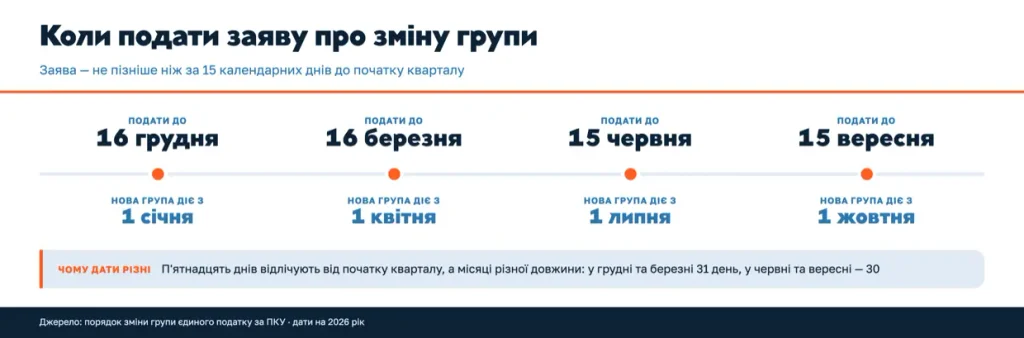
*The application deadline is established by the Tax Code. The specific date on which the new group takes effect follows from the tax authority's guidance, so in unusual situations it is worth checking its position separately.
A separate nuance for VAT payers. If a Group 3 sole proprietor registered for VAT switches to Group 1, Group 2, or Group 3 at the 5% rate, the VAT registration is cancelled. It is worth calculating in advance which option is more advantageous - 3% with VAT or 5% without VAT.
A common myth. Many materials say that the group can be changed "no more than once per quarter" or "once a year". There is no such rule in the Tax Code. The "once per calendar year" restriction does exist, but it applies only to switching from the general taxation system to the simplified system.
What income limits apply to single tax groups in 2026
The limit is calculated based on the minimum wage as of January 1, so it does not change during the year.
| Group | Income limit for 2026 | Employees |
|---|---|---|
| Group 1 | UAH 1,444,049 | not allowed |
| Group 2 | UAH 7,211,598 | up to 10 people at the same time |
| Group 3 | UAH 10,091,049 | no limit |
*Calculated based on the minimum wage of UAH 8,647 as of January 1, 2026. Even if the minimum wage is increased during the year, the limits will remain unchanged.
It is important to understand how to calculate the remaining limit when switching groups - this is a separate mechanism that we covered in detail in the article on calculating the income limit when changing groups.
Another restriction for Group 2 that is often overlooked. Intermediary services related to the purchase, sale and lease of real estate, internet access services, and the sale of jewellery are available exclusively under Group 3.
What to do if a sole proprietor exceeds the income limit
There is almost no choice here: the Tax Code determines exactly where you may switch and gives you a fixed deadline to do so.
| Group | Where you can switch | Tax on the excess amount |
|---|---|---|
| Group 1 | to Group 2 or Group 3, or to the general taxation system | 15% |
| Group 2 | only to Group 3 or to the general taxation system | 15% |
| Group 3 (sole proprietor) | only to the general taxation system | 15% |
| Group 3 (legal entity) | only to the general taxation system | double rate |
The application deadline is the same for everyone - no later than the 20th day of the month following the quarter in which the limit was exceeded.
Pay attention to Group 2. From this group, you can only move up to Group 3. You cannot switch to Group 1, even if your income later decreases.
There is also a consequence for the following year that is often overlooked. If a Group 1 or Group 2 taxpayer uses the right to switch because the income limit was exceeded, the right to remain on the simplified taxation system in the following year is preserved only if the annual income does not exceed the Group 3 limit.
For more details on the consequences of exceeding the limit, see the article on exceeding the income limit for sole proprietors.
When a sole proprietor is required to switch to the general taxation system
Exceeding the income limit is only one of the grounds. The Tax Code also provides for other cases in which a single tax payer is required to switch to the general taxation system.
- exceeding the income limit for your group;
- non-cash settlements - barter, set-off, or any payment method other than those permitted by the Tax Code;
- a prohibited type of activity or non-compliance with the required legal form;
- exceeding the permitted number of employees;
- income from a KVED activity code that is not included in the single tax payer register;
- for Groups 1 and 2 - carrying out activities outside those permitted for the respective group;
- tax debt exceeding UAH 3,060 as of the first day of each month during two consecutive quarters;
- obtaining Diia.City resident status.
The last point is the most surprising. Joining Diia.City automatically ends eligibility for the simplified taxation system - this is expressly provided for by the Tax Code.
The deadlines differ. For most grounds, the switch takes place from the first day of the month following the quarter or reporting period. In the case of tax debt - on the last day of the second of two consecutive quarters.
A nuance that changes the date. For some grounds, the Tax Code refers to the "reporting period" rather than the quarter. For Groups 1 and 2, the reporting period is the calendar year; for Group 3, it is the quarter. As a result, the switching date may differ depending on the group.
To avoid losing your group because of a KVED code, keep the types of activities in the register up to date - see the article on selecting and changing KVED codes.
What happens if the tax authority discovers the violation
This is the most expensive scenario, and it is exactly why filing the application on time is beneficial.
If the tax authority discovers a violation of the simplified taxation rules during an audit, the single tax payer registration is cancelled by its decision - from the first day of the month following the quarter in which the violation occurred.
Then a waiting period applies. You can return to the simplified taxation system only after four consecutive quarters have passed from the date of that decision. In other words, you spend a full year on the general taxation system, with income and expense accounting.
Compare this with the voluntary scenario: if a sole proprietor files the application themselves, the registration is cancelled on the last day of the quarter in which the application is filed, and no waiting period applies.
The difference between "filed voluntarily" and "discovered during an audit" is one year of operating under the general taxation system plus additional tax assessments.
Not sure whether you have violated the conditions of your group?
The accountants at buh.ua will check your income, KVED codes and settlements, determine whether you can remain in your current group, and, if necessary, prepare the application for switching within the required deadline.
How to leave the simplified taxation system and how to return
These two procedures are closely related, but their deadlines differ - and this is where mistakes are most common.
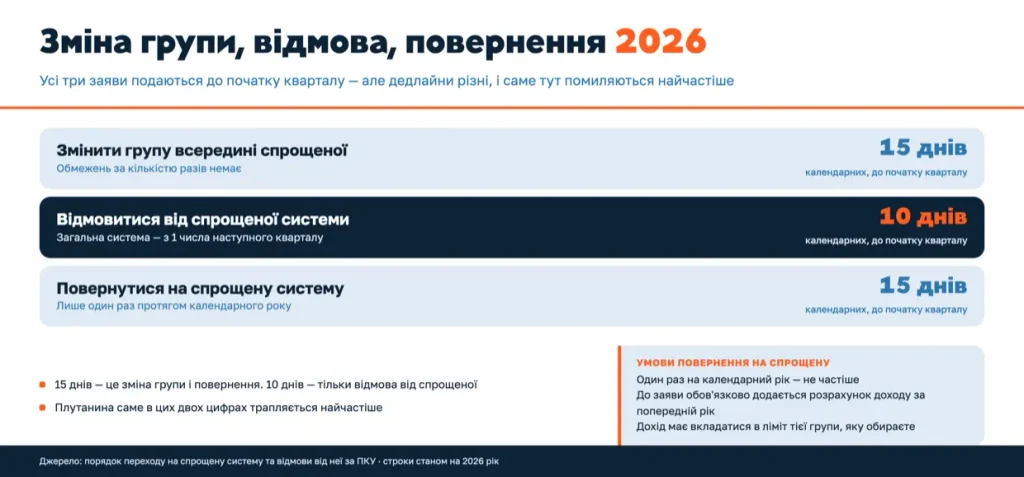
Remember the difference: 15 days applies to changing the group and returning to the simplified taxation system, while 10 days applies to opting out of it. These two figures are the ones most often confused.
There are two additional conditions for returning to the simplified taxation system:
- first, this can be done only once per calendar year,
- second, an income calculation for the previous year must be attached to the application - without it, registration will be denied.
Your income for the previous year must fall within the limit of the group you choose. The conditions for returning are explained in more detail in the article on returning to the simplified taxation system.
How to file an application to change the single tax group
The application form was approved by Order No. 308 of the Ministry of Finance dated July 16, 2019. The application contains a separate checkbox specifically for changing the group and tax rate - this is the one you need to select.
A clarification for those who have read older materials. Order No. 1675 of 2011, which some articles still refer to, ceased to be effective on October 22, 2019. The current form is established by Order No. 308, as amended by Ministry of Finance Order No. 440 dated September 11, 2024, which has been effective since December 24, 2024.
The application can be submitted in three ways: in person, by post with an inventory of enclosures, or electronically.
The most convenient option is the Electronic Taxpayer Cabinet. In the private section of the cabinet, the application is submitted using Form F0102003, while the income calculation for the previous year, if required, is submitted using Form F0102103. For legal entities, the application form is J0102003.
Common mistakes when changing the single tax group
1. Filing the application after the deadline. An application filed 14 days in advance instead of 15 will not work: the new group will take effect only from the following quarter, and until then you will continue paying taxes under the old rules.
2. Confusing 10 days with 15 days. Opting out of the simplified taxation system has a shorter deadline than changing groups. A mistake costs you an entire quarter.
3. Forgetting the income calculation. When returning from the general taxation system, an application without the income calculation for the previous year is a direct ground for refusal.
4. Failing to check your KVED codes. Income from an activity that is not included in the single tax payer register is taxed at 15% and may result in the loss of your group.
5. Waiting for the tax authority to notice the violation. This is the most expensive mistake: a four-quarter waiting period instead of a straightforward voluntary switch based on your application.
FAQ: questions about changing the single tax group
How many times a year can you change your single tax group?
The Tax Code does not limit the number of times you can change groups within the simplified taxation system. The restriction of once per calendar year does exist, but it applies only to switching from the general taxation system to the simplified system.
How many days in advance should you file an application to change groups?
No later than 15 calendar days before the start of the next quarter. To switch from October 1, the application must be filed by September 15; to switch from January 1 - by December 16.
Can you switch from Group 2 to Group 1?
For a voluntary change - yes, if you meet the requirements of Group 1. But if you exceed the Group 2 income limit, you can switch only to Group 3 or to the general taxation system.
What happens if you do not file an application after exceeding the income limit?
A sole proprietor automatically switches to the general taxation system - from the first day of the month following the quarter in which the limit was exceeded. In addition, a 15% tax rate applies to the excess amount.
How soon can you return to the simplified taxation system?
If you left voluntarily by filing an application - from the next quarter, provided you meet the 15-day deadline and submit the income calculation. If your registration was cancelled by the tax authority after an audit - only after four consecutive quarters.
Is VAT registration lost when changing groups?
Yes, if a Group 3 VAT payer switches to Group 1, Group 2, or Group 3 at the 5% rate. In this case, the VAT registration is cancelled.
Can you remain on the simplified taxation system after joining Diia.City?
No. Obtaining Diia.City resident status is a separate ground for mandatory transition to paying other taxes, from the first day of the month following the quarter in which the status was obtained.
Conclusion
A single tax group can be changed either voluntarily or mandatorily, and these two routes should not be confused: they have different deadlines and different consequences.
Three figures worth remembering: 15 calendar days to change groups and to return to the simplified taxation system, 10 days to opt out of it, and the 20th day of the month following the quarter - if you exceeded the income limit.
The main risk is not a fine, but the waiting period. If the tax authority discovers the violation, you will be able to return to the simplified taxation system only after four quarters. Therefore, the less costly strategy is always the same: monitor your income throughout the quarter and file the application yourself before the deadline expires.
Need reliable accounting support for your sole proprietorship?
The buh.ua team monitors limits, taxes and deadlines and responds in advance if your business needs to change its group or taxation system.