

CRS Agreement: Will the tax authorities find out about foreign accounts? Which institutions share information under CRS, and what data about you will the tax authorities receive?

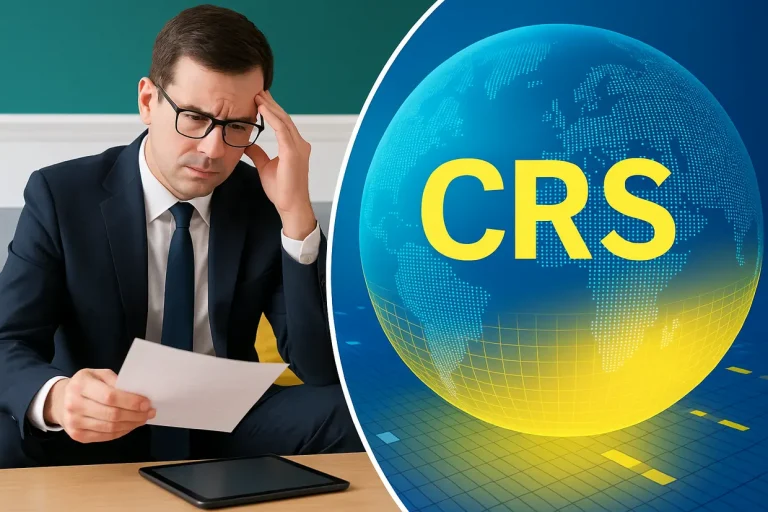
If you have accounts in foreign banks, starting from the fall of 2024, the Ukrainian tax authorities will already be receiving data about them. This became possible thanks to the international CRS (Common Reporting Standard) agreement, which Ukraine officially joined in 2023.
About 120 countries, from Poland to offshore jurisdictions, are now exchanging information about non-residents’ bank accounts.
What does this mean for you personally?
The tax authorities will see not only the fact that an account exist, but also the total amount of all incoming transactions.
In this article, we will explain how the CRS system works, what risks arise from ignoring reporting requirements (including fines of up to 800,000 UAH), and most importantly - how to correctly determine your tax residency to avoid problems.
CRS Agreement: What data about you do the tax authorities receive
Do you have accounts in foreign banks? The Ukrainian tax authorities can now gain access to this information. How? Through the international CRS agreement signed back in 2023. What risks does this pose for you? And if the State Tax Service of Ukraine receives information about foreign accounts, is it then obliged to collect data on that person’s accounts in Ukraine and send it back in response? We answer all these questions in this article.
This happens even if you’ve completely forgotten about it - the process is already underway, and you can no longer influence it.
If you have citizenship, a permanent place of residence, and close ties with Ukraine, you are most likely considered a Ukrainian tax resident. For all other countries, you are, on the contrary, a non-resident.
For many people, the issue of tax residency may seem confusing. You can read more about this status in Article 14.1.213 of the Tax Code of Ukraine.
The United States, by the way, is not a CRS participant, but it has its own system - FATCA.
How does it work? Ukrainian banks are required to report to the U.S. about accounts belonging to U.S. citizens or U.S. tax residents. However, this exchange is one-sided: Ukraine provides information to the U.S., but data about Ukrainians’ accounts in American banks are not shared back. In other words, FATCA protects American tax residents - not the other way around.
Note: Tax residency is not the same as citizenship. Each country has its own rules for determining residency, but the most common criteria include:
- actual place of residence;
- center of vital interests - where personal and business ties are concentrated;
- staying in the country for more than 183 days per year;
- citizenship.
What to do if two countries claim your tax residency status?
This is where the rules of double taxation avoidance agreements between countries come into play.
For example, if you have permanent residences in both countries or in neither, and it’s difficult to determine where your center of vital interests lies, the deciding factor becomes the country where you usually live.
If that still doesn’t clarify things, citizenship is taken into account.
In the context of CRS, financial institutions rely primarily on the data you provide in the self-certification form.
There, the account holder declares their tax residency - specifying their country of residence, tax identification number, etc.
In addition, banks use information collected under AML and KYC procedures.
So, if a person has lived in another country for some time and this is confirmed by documents and indicated in the self-certification, the country where the account was opened will likely not automatically transmit this data to the Ukrainian tax authorities.
Important to remember: fines may be imposed for inaccurate information in a self-assessment - their amount depends on the specific jurisdiction. In Ukraine, such a penalty may reach 100 minimum wages - in 2026, this is about UAH 864,700 (100 × 8,647).
It’s also worth knowing that the self-certification document is filled out only when opening a new account.
If the account already exists, the financial institution determines your tax residency under CRS based on existing client data - such as your current address, mailing information, phone number, and other indicators that may suggest your residency status.
Therefore, before opening a foreign account or working with international banks, it makes sense to verify your tax residency status and prepare supporting documents.
If you still have doubts, it’s best to consult a tax expert to avoid the risk of large fines or unintended legal consequences.
What data is transmitted to Ukraine?
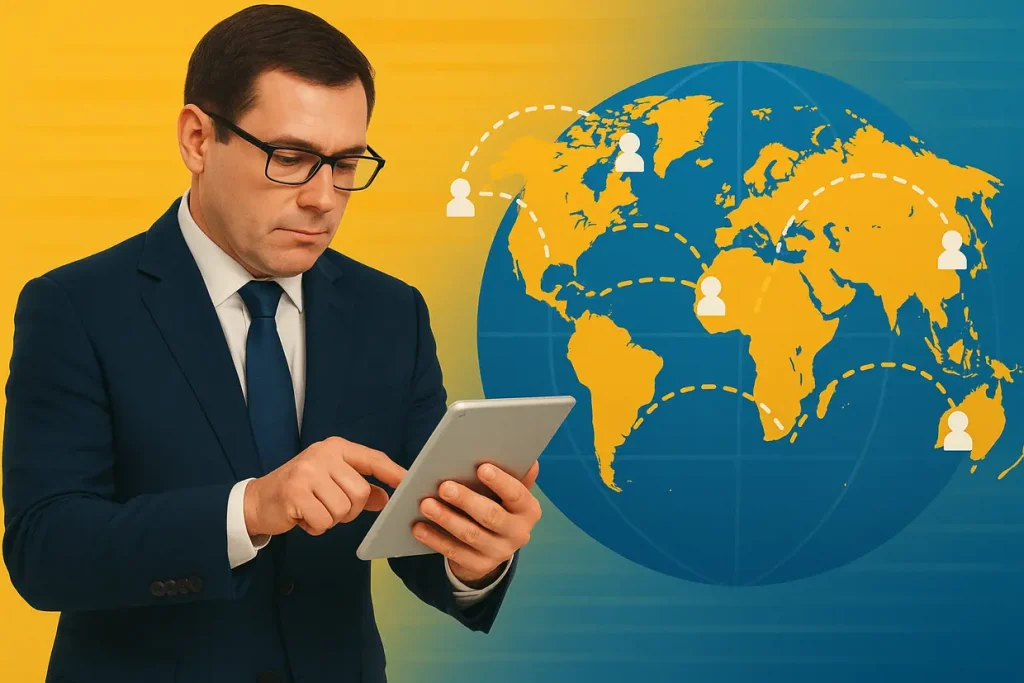
It’s actually quite simple: when you open an account in a foreign bank, you fill out a form indicating your first and last name, date of birth, address, country of tax residence, and taxpayer identification number.
All this information is sent to a unified information system. It also includes:
- the name of the bank,
- the account number and currency,
- and most importantly - the total amount of all funds received over a certain period.
This means that the Ukrainian tax authorities will see not only the fact that you have a foreign account, but also how much money has been credited to it.
And do not try to lie to the bank! In general, Ukrainian and European banks, as well as banks outside Europe, issue questionnaires asking you to indicate your tax residency and tax identification numbers in other countries. Information will be exchanged specifically with the countries where you are a tax resident. If you lie to the bank, you may face a fine of about UAH 864,700. That is why it is better to consult accountants or lawyers than to act at your own discretion and rely on questionable schemes.
Would you like to consult a specialist as soon as possible?
Leave a request, and our expert will contact you shortly.
Which institutions share information under CRS?
Information under CRS is transmitted by so-called “reporting financial institutions.”
These include not only banks but also credit unions, payment systems, e-money issuers (such as Payoneer or Revolut), investment brokers, asset management companies, private pension funds, insurance companies, and even real estate financing funds.
So, if you have an account not only in a bank but also in a payment system or investment company, your data may also be transmitted under the CRS standard.
What happens if the tax authorities find out about foreign accounts?
The tax authorities may take interest in several things.
whether you have a business abroad. If so, you must have a CFC - controlled foreign company registered abroad. And this CFC must be reported in Ukraine.
This should be done as early as possible. By law, CFC reports must be submitted by May 1 (together with the income tax return) if you own a CFC as an individual. For legal entities, the deadlines are even shorter. Our accountants also handle all of this and can take responsibility for maintaining the reporting on your behalf.
the tax authorities may want to know whether the funds in your account can be considered income and whether you have paid taxes on them. Even if you earned income abroad and it was deposited into that account, in most cases, you fall under the double taxation avoidance mechanism. Simply put, if you paid tax abroad, you usually don’t have to pay it again in Ukraine.
However, the rules may differ from country to country.
This issue should be carefully analyzed together with an accountant who can review your situation and provide solid recommendations.
If the tax authorities review your data and find any inconsistencies, they may request additional explanations.
There are two possible outcomes:
- Your explanation satisfies the tax authorities, and the issue is closed.
- The tax office decides to conduct a more detailed inspection.
Fortunately, there is a temporary exemption in effect during martial law. If, as of December 31, the total balance across all your accounts does not exceed USD 250,000, the tax authorities will have no claims against you.
If the State Tax Service of Ukraine (STS) receives information about foreign accounts, is it then obliged to collect data on that person’s accounts in Ukraine and send it back in response?
The answer is no, this does not happen automatically. Under CRS rules, Ukrainian banks transmit information only about non-residents - that is, individuals who are not tax residents of Ukraine. So if you are a Ukrainian citizen and have opened an account in a Ukrainian bank, the STS does not collect or send your information abroad.
Therefore, if you don’t monitor your tax status, there’s a high chance that Germany will share information about your accounts in Ukraine, and Ukrainian authorities may, in turn, send your data back.
The situation is similar in Ukraine: if you haven’t provided documents proving that you’ve become a non-resident, banks will continue to treat you as a resident and include you in the reports for exchange.
Moreover, under CRS regulations, Ukrainian banks are explicitly allowed to involve third-party organizations to help identify clients with non-resident status.
For those receiving social benefits in Germany, this is a serious warning: if the Finanzamt or Jobcenter receives information about assets in your Ukrainian accounts, it could lead to unpleasant consequences - up to and including the loss of your benefits.
Conclusion
- Always check your tax residency status, and make sure to indicate it correctly when opening or using foreign bank accounts.
- Update your information in banks regularly - address, phone number, and country of residence.
- When opening a new account, ask whether the bank reports under CRS and whether it requires confirmation of your residency status.
- Remember that the State Tax Service analyzes CRS data for undeclared income, so expect that any interest, dividends, or profits from selling assets abroad will be checked. If such income should have been declared in Ukraine but wasn’t, taxes and penalties may be added.
- Don’t forget the “worldwide income rule” - Ukrainian tax residents must declare all income, both earned in Ukraine and abroad. Ignoring this rule is risky.
- Keep supporting documents - retain bank statements, invoices, contracts, and receipts for taxes paid abroad. If the tax office makes an inquiry, these papers will be your main defense.
- Consult a specialist before opening an account - before opening or actively using a foreign account, talk to a tax consultant or an international tax lawyer.
If you still have questions, contact us - our team of lawyers and accountants will be happy to assist you!
Would you like to discuss cooperation in person?
Leave a request, and our specialists will call you as soon as possible.