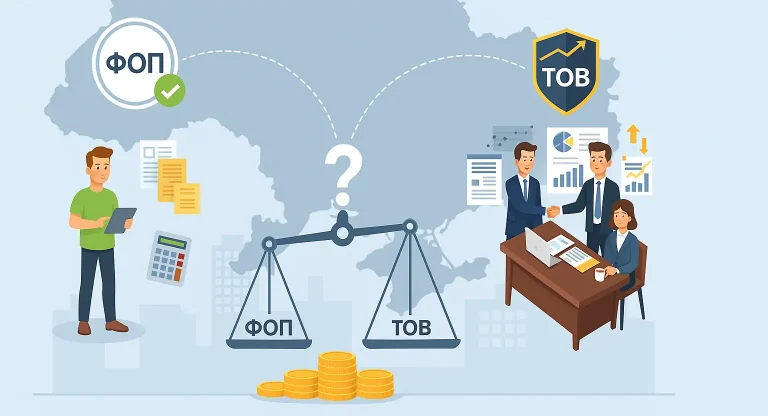
If you are planning to start your own business in Ukraine, one of the most important steps is choosing its organizational and legal form. The most common options are FOP (individual entrepreneur) and LLC (limited liability company), each of which has its own advantages and disadvantages. This article will help you figure out which form of business will be the most profitable for you by comparing them according to the main criteria: ease of registration, tax features, the possibility of attracting investment and the closure procedure.
Contents of the article
Starting a legal business in Ukraine means making the first important choice: register a Sole Proprietorship (FOP) or create a Limited Liability Company (LLC)? This question arises for almost every entrepreneur - from freelancers to startups with partners and investors. Both forms have their own advantages, nuances in taxation, registration, reporting, working with clients, and closing the business. In this article, we will analyze in detail with examples which option to choose for your situation, so you don’t regret it in a few months. Tax aspects and legal details - everything you need to know for a successful start.
FOP or LLC? What to choose?
To start operating legally in Ukraine, you need to choose the appropriate business structure and register it officially. Today, there are two main and most convenient options: a sole proprietor (FOP) or an LLC (limited liability company). These are the business structures chosen by 99% of modern entrepreneurs, regardless of their field of activity. But what if you still have a “PE” — a private enterprise? Please note that since 2025, new private enterprises (PEs) have no longer been registered. Existing PEs may continue operating; the law provides a transition period until August 28, 2028, to bring their charters into compliance. Reorganisation into an LLC is not mandatory — it is voluntary, although it is the most common option.
FOP is an almost universal form for many businesses. There are options to choose from: general taxation or simplified in three groups. To register an FOP, you only need: a passport, a taxpayer identification number, and a completed form (it can be submitted online via CNAP). The easiest way is to apply through "Diia" - without visiting a notary. By the way, we already have a video on our channel where you can see how to register an FOP in just 5 minutes without leaving home. But for LLC, you will need much more:
registration form,
charter,
minutes of general meetings,
document on ownership structure.
Registration takes from 1 to 3 business days. But it is important to note: an LLC is already a legal entity, and it requires more complex reporting.
Which option is better for you? Here is a short guide for choosing:
If you work on your own, your business is small, and your clients are ordinary people or small businesses - choose a Sole Proprietorship (FOP). It’s fast, cheap, requires minimal paperwork, and is easy to close if needed.
If you have partners, plan to attract investments, or your clients are large companies, banks, and international contractors, then it’s better to go with an LLC. Here everything is official: shares, corporate agreement, investment protection, and opportunities for business expansion.
Still hesitating? Contact us for a consultation - we will advise on the best option for your situation and register your business.
Do you want to consult with a specialist as soon as possible?
Leave a request, and our specialist will contact you shortly.
A sole proprietor (FOP) means minimal paperwork and maximum simplicity. A report is submitted once a year for Groups 1 and 2 and for the general taxation system; Group 3 sole proprietors report once a quarter. Hiring an accountant is not mandatory; however, if you do not want to deal with the details yourself, accounting support for a sole proprietor is inexpensive and affordable even at the start. An LLC, however, cannot be managed without an accountant: it requires full accounting records, regular monthly or quarterly reporting, and HR documentation. This is already a job for a professional.
Taxation of FOP and LLC.
FOP or LLC on a simplified taxation system means a fixed tax or a percentage of income. No corporate income tax, VAT - only if chosen voluntarily. But for LLCs on the general system, it includes:
18% corporate income tax,
VAT, if registered,
payroll taxes.
However, if you have a large or complex business, it can be beneficial, since expenses reduce profit and, accordingly, taxes.
In addition, one of the most important criteria that can influence the choice is usually the type of activity. But one unexpected, yet very significant criterion is investments.
An FOP cannot sell a “share” in the business. An FOP is an individual. It has no shares, corporate rights, or statutory capital. Therefore, an investor cannot become a co-owner.
And an LLC is the ideal form for investments.
You can transfer a share to an investor.
You can sign a corporate agreement.
Flexible terms can be set: profit, dividends, business exit.
LLC is most suitable for startups, franchises, and businesses with partners or investors.
What is easier to close: FOP or LLC?
Closing an FOP is like deleting a social media account. A few clicks and it’s done. But don’t forget to check that your case is already “offline” for the tax office. The procedure is as follows: you file an application, and within a few days, you are removed from the register. The only condition - there must be no debts and all reports submitted. Usually, losing FOP status does not mean automatic deregistration from tax accounting, and after termination of activity, an FOP can still be audited by tax authorities.
Be careful and make sure you are officially removed from the register, otherwise taxes may continue to accrue, and you may not even know about it. Fines for late payments will also apply.
The situation with closing a legal entity is significantly different.
Legal entities are closed over months or even years. You need to undergo audits, asset liquidation, and all tax and legal procedures. Often, a lawyer and a notary are required for this process.
Examples of FOP and LLC: practical cases
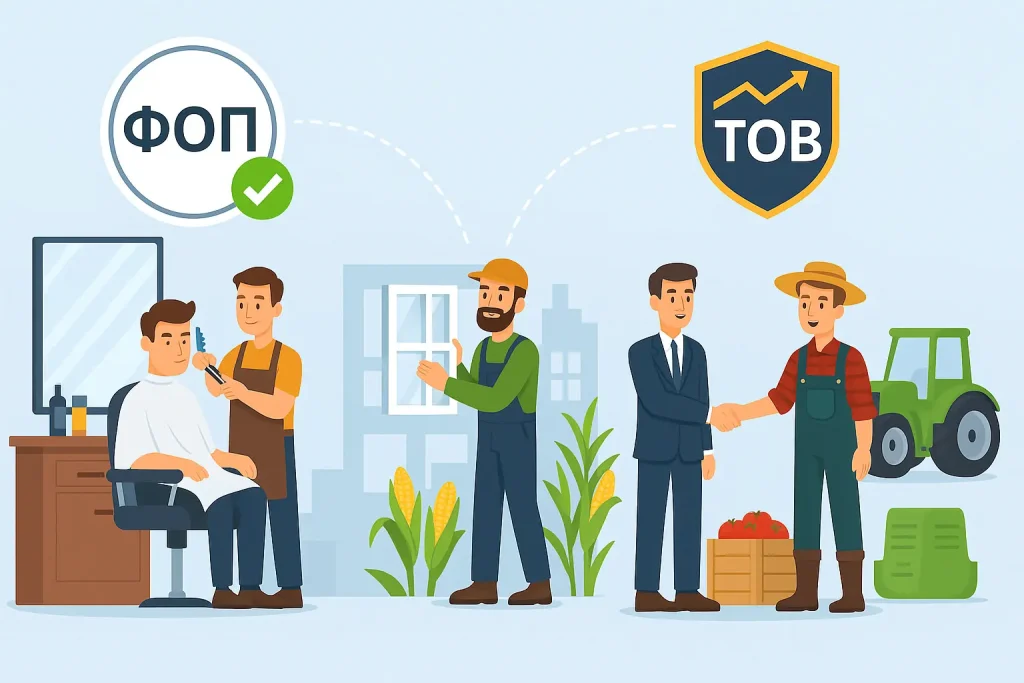
You want to open a hair salon. This is already a business with premises, equipment, and possibly employees. But it doesn’t necessarily have to be large - it all depends on the format.
As a rule, a Group 2 or Group 3 sole proprietor (FOP) will be suitable. However! If you are starting a business together with a partner with whom you will share the profits, then an LLC is definitely the right choice. Even the most flexible Group 3 sole proprietor status has an annual income limit of UAH 10,091,049. If you know that your income will exceed this amount, you will also need to register an LLC.
Here is another example. You own a company that manufactures plastic windows. The production of goods is permitted under both Group 2 and Group 3. However, Group 2 sole proprietors may not provide services to legal entities operating under the general taxation system. Therefore, if you also install windows for such companies, you will need to choose Group 3 or register an LLC.
And the last example. You have a farm where you grow vegetables for sale. FOP group 3 - if you work yourself or with your family. You sell directly to people or through stores. But if you have many employees, plan to attract investors, and sell vegetables to wholesale companies through tenders - then your option is LLC.
By the way, in this case, there is another form called "farm enterprise." But this is a completely different story with its own nuances, so we will leave this topic for a separate article.
Useful video
90% of entrepreneurs make the wrong choice! What to choose in 2025: sole proprietorship or LLC?
Conclusion
Summary: FOP or LLC - what to choose? It all depends on the scale, goals, and format of your business. FOP is simpler, cheaper, and faster to register and manage. It is suitable for those who work alone or with a minimal team, serve individuals, and do not plan to attract investments. On the other hand, LLC is already “serious business”: partners, investors, large clients, expansion. It has more legal nuances, but also more opportunities for growth.
If you are still hesitating - don’t guess. It’s better to consult with specialists: we will help you choose the best option for your situation, and then register your FOP or LLC and keep its books.
Do you want to discuss cooperation in person?
Leave a request, and our specialists will call you shortly.
What to do if your account is subject to financial monitoring and blocked in Ukraine? How can you confirm the origin of your funds? How can you resolve these issues?
How to optimize taxes for developers in Ukraine: TOV, ZhBK, KIF - leveling up of models
Sole Proprietor Unified Tax Reporting: Quarterly Form, Deadlines and Penalties
LLC taxation in Ukraine
Declaration for natural persons in Ukraine
Short-Term Apartment Rentals in Ukraine in 2026: How to Rent Legally and Pay Taxes
Entrepreneur Income Record Book 2026: how to keep it, where to download forms, penalties for absence
Group 1 Individual Entrepreneur in Ukraine in 2026: Taxes and Restrictions
Gig Contract: Features of the Contract, Terms, and Pitfalls
Business Splitting of Sole Proprietors and Tax Abuse: Draft Law 2026