


Sole Proprietor Unified Tax Reporting: Quarterly Form, Deadlines and Penalties


Starting in 2026, Sole Proprietor employers submit consolidated reporting on personal income tax, military levy, and USC quarterly instead of monthly. The form has also been replaced - entrepreneurs and legal entities now use different forms.
The quarterly reporting period for Sole Proprietors has been in effect since January 1, 2026, while the new separate form for entrepreneurs took effect only on July 17. Because of this inconsistency, the first calculation under the new quarterly form is submitted only for the third quarter - and not all three months are completed in it.
This is why the Sole Proprietor Tax Calculation in 2026 has an unusual transitional procedure: quarterly reporting is already in effect, while the new form was introduced later. We will examine the rules: who reports quarterly and who reports monthly, which annexes a Sole Proprietor submits, what exactly they contain, when the first report under the new form is due, and how much late filing costs.
What changed in consolidated reporting for Sole Proprietors in 2026
There are two changes, and they are independent of each other.
The reporting frequency was changed by the Tax Code. The quarterly reporting rule was introduced back in the summer of 2025 and took effect on January 1, 2026.
The form was changed by the Ministry of Finance. Order No. 243 dated May 7, 2026 split the single Tax Calculation into two forms: the "Legal Entity Calculation" for legal entities and the "Sole Proprietor / Independent Professional Calculation" for entrepreneurs and individuals engaged in independent professional activities. The Order took effect on July 17, 2026.
Clarification regarding the second order. Amendments to it were introduced by Order No. 284, dated May 27, 2026. Many news reports and accounting websites state May 26 - this is an error originating from a press release. According to the official text, the correct date is May 27.
Who submits quarterly calculations and who submits monthly calculations
The Code divides tax agents into two groups, and the rule for each is unambiguous.
| Who reports | Period | Filing deadline |
|---|---|---|
| Sole Proprietors and self-employed individuals | quarter, broken down by month | 40 calendar days after the end of the quarter |
| Legal entities and their subdivisions | month | 20 calendar days after the end of the month |
*The deadlines are established by subparagraphs 49.18.1 and 49.18.2 of the Tax Code and are repeated in the new Completion Procedure.
The key phrase is "broken down by month." A Sole Proprietor submits one document for the quarter, but the figures within it are reported separately for each month. This simplifies filing, not accounting.
Sole Proprietors do not submit a separate annual calculation. The Procedure states this explicitly: no calculation is submitted for the calendar year. If the last day of the filing period falls on a weekend or public holiday, the deadline is moved to the next banking business day.
Who this does not apply to. Group 1 Sole Proprietors cannot hire employees at all, so a reporting obligation arises only from other payments to individuals - for example, rent paid for premises.
When a Sole Proprietor first submits the new quarterly form
This is the most confusing part of the entire reform, and the confusion is not the entrepreneurs' fault.
The Order itself states that Sole Proprietors first submit the new form for Q1 2026.
This is impossible to comply with: the Order took effect on July 17, long after the first quarter had ended. This is an inconsistency between the transitional provisions of the Order and its effective date, and the second order did not resolve it.
The Tax Service and the Ministry of Finance published an agreed position, and this is the guidance that must be followed.
- For January-July 2026, Sole Proprietors and self-employed individuals reported using the old form - the one prepared separately for each month. However, the filing deadlines were already quarterly: for Q1 - by May 11, and for Q2 - by August 10, 2026.
- From August 1, 2026, they switch to the quarterly form with figures broken down by month.
- The first calculation under the new quarterly Sole Proprietor / Independent Professional form is for Q3 2026, with a filing deadline of November 9, 2026.
- Only the months for which a monthly calculation has not yet been submitted are completed. In practice, these are August and September.
There is no need to duplicate information that has already been submitted - the Tax Service specifically clarified this.
The date is different for legal entities: the first month under the new form is July 2026, and the filing deadline was August 20. The legal basis for this approach is paragraph 46.6 of the Tax Code: a new form applies from the reporting period following the period in which it was published. The deadlines for other payments and reports are listed in the Sole Proprietor tax calendar.
Which annexes does a Sole Proprietor submit and what do they contain?
Consolidated reporting is not a single document, but the Calculation itself together with its annexes. Sole Proprietors have four annexes.
| Annex | What it contains | When it is submitted |
|---|---|---|
| ФІЗ-4ДФ | income, personal income tax, and military levy for each individual | quarterly, broken down by month |
| ФІЗ-Д1 | USC for each insured person | quarterly, broken down by month |
| ФІЗ-Д5 | registration of insured persons in the register | when required |
| ФІЗ-Д6 | periods of employment and other activities | when required |
*Legal entities use a different set: Д1, Д2, 4ДФ, Д5, and Д6, all submitted monthly.
The most common mistake in third-party materials is stating that 4ДФ includes personal income tax, military levy, and USC. This is incorrect. ФІЗ-4ДФ does not include USC at all. It contains only personalized data on income, personal income tax, and military levy.
USC for each individual is reported in Annex ФІЗ-Д1, while the total contribution amounts are reported in the Calculation itself, in the section on accruals for insured persons, broken down by month of the quarter.
If, during the quarter, a Sole Proprietor did not employ individuals under employment contracts or on other terms provided for by law, Annex ФІЗ-Д1 is not submitted for that quarter at all.
How to properly hire an employee so that the information in the reports matches is explained in the article on how a Sole Proprietor can hire an employee.
Does a Sole Proprietor submit the Calculation without employees?
The short answer is usually no. However, the wording of the law is broader than it may seem, and this is where the risk lies. The Calculation is submitted only if income was accrued to an individual during the reporting period. This is stated both in the Code and in the Procedure. The law does not require an empty "zero" Calculation to be submitted.
But "no employees" does not mean "no reporting obligation". The obligation to submit the Calculation may also arise from other payments made to individuals, including self-employed persons.
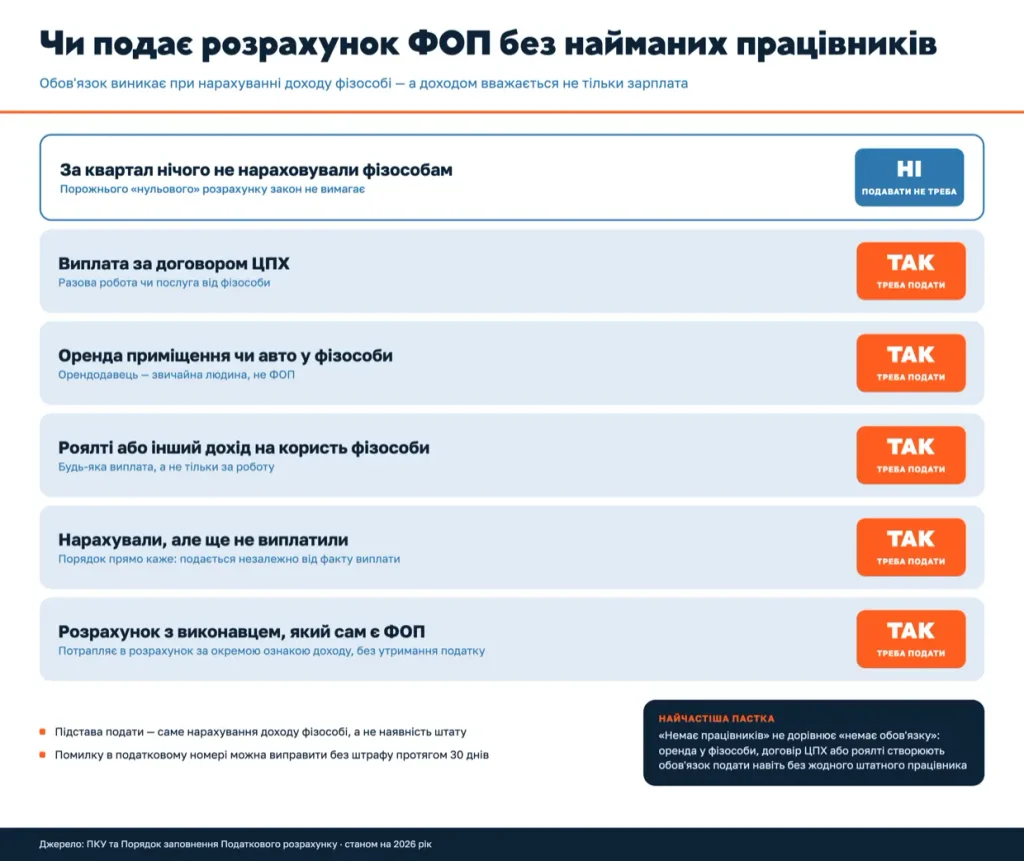
If you make a payment to a contractor who is also an entrepreneur, the payment is also included in the Calculation - but under a separate income code and without tax withholding. The difference between a contract with a Sole Proprietor and an employment relationship is explained in the article on reclassification of a Sole Proprietor as an employee.
What are the penalties for failure to submit consolidated reporting?
There are two types of penalties, and they are no longer doubled.
For the Calculation itself - Article 119 of the Tax Code. Failure to submit, late submission, incomplete submission, or submission with errors carries a penalty of UAH 1,020. If the same violation has already resulted in a penalty within the year - UAH 2,040.
Errors are not always subject to penalties. A penalty applies only if inaccurate information resulted in an understatement or overstatement of tax liabilities or a change of taxpayer. A technical typo that did not affect anything is not subject to a penalty.
Separately - UAH 340 for preparing documents without an individual's tax identification number or with an incorrect number.
An error in a tax identification number can be corrected without a penalty - either independently or within 30 calendar days after receiving notification of the error from the Tax Service.
There is no longer a separate penalty for USC reporting. Since the contribution is now included in the Tax Calculation, the law on the unified social contribution refers to the Code. This means that one penalty is paid, not two.
USC penalties now apply only to payment violations, not to the reporting form: 20% of the amount for non-payment or late payment and 10% for each period when additional contributions are assessed, but no more than half of the total additionally assessed amount.
The rates and payment deadlines for the contribution itself are explained in the article on USC for Sole Proprietors, while the full list of penalties is provided in the article on penalties for late tax payments.
Not sure whether your reports have been completed correctly?
The buh.ua accountants handle HR records and submit consolidated reporting for Sole Proprietor employers: they calculate personal income tax, military levy, and USC, complete the annexes under the new form, and keep track of quarterly deadlines.
Common mistakes in consolidated reporting for Sole Proprietors
1. Resubmitting the quarterly Calculation for the entire quarter. If you already reported July using the monthly form, you do not need to complete that month again in the quarterly Calculation.
2. Using the form for legal entities. There are now two forms, and entrepreneurs have their own - the "Sole Proprietor / Independent Professional Calculation." Its annexes are also different and use the ФІЗ prefix.
3. Looking for USC in Annex 4ДФ. It is not reported there. The contribution for each individual is reported in ФІЗ-Д1, while the total amounts are reported in the Calculation itself.
4. Failing to keep the documents on which income accruals were based. The Calculation is prepared on the basis of primary documents, and these are what will be requested during an audit. What exactly needs to be retained is explained in the article on primary documents for Sole Proprietors.
5. Failing to submit the Calculation because there are no employees. Rent paid to an individual or a payment under a contract is already sufficient to create a filing obligation.
6. Calculating the deadline from the end of the month. For Sole Proprietors, the deadline is 40 days after the end of the quarter, not 20 days after the end of the month.
FAQ: questions about consolidated reporting for Sole Proprietors
How often does a Sole Proprietor submit consolidated reporting in 2026?
Once a quarter, within 40 calendar days after the end of the quarter. The figures in the Calculation are reported separately for each month of the quarter.
For which period does a Sole Proprietor first submit the new quarterly Sole Proprietor / Independent Professional form?
For Q3 2026, with a filing deadline of November 9, 2026. The Order states Q1 2026, which is inconsistent with its effective date: the Tax Service and the Ministry of Finance officially clarified that the transition begins on August 1, 2026.
Does a Sole Proprietor submit the Calculation without employees?
If no income was accrued to individuals during the quarter - no, an empty Calculation does not need to be submitted. However, a payment under a contract, rent paid to an individual, or royalties create a filing obligation even if there are no employees on staff.
Is the unified social contribution included in Annex 4ДФ?
No. ФІЗ-4ДФ includes income, personal income tax, and military levy. USC for each insured person is reported in Annex ФІЗ-Д1, while the total amounts are reported in the Calculation itself.
What is the penalty for failure to submit consolidated reporting?
UAH 1,020, and for the same repeated violation within one year - UAH 2,040. There is no longer a separate penalty for the USC part of the reporting: only one penalty is imposed under Article 119 of the Code.
Does a Sole Proprietor submit an annual Calculation?
No. The Procedure explicitly states that a separate Calculation for the calendar year is not submitted. The final reporting period of the year is the fourth quarter.
What should you do if you made a mistake in an employee's tax identification number?
Correct it independently or within 30 calendar days after the Tax Service notifies you of the error. In this case, no penalty applies.
Conclusion
Consolidated reporting for Sole Proprietors changed twice in 2026: first, the Code moved entrepreneurs to a quarterly reporting period, and then the Ministry of Finance split the form into two - one for legal entities and one for Sole Proprietors.
Two dates worth remembering: 40 calendar days after the end of the quarter is the filing deadline, and November 9, 2026 is the deadline for the first Calculation under the new quarterly form.
The main pitfall is not the deadline, but the content. For the third quarter, only the months for which monthly reporting has not yet been submitted are completed, and USC is reported not in 4ДФ but in a separate annex. The deadlines and forms in this area changed twice within six months, so before filing, it is worth checking the current version of the Procedure and the tax calendar.
The deadlines and forms in this area changed twice within six months, so before filing, it is worth checking the current version of the Procedure and the tax calendar.
Need an accountant for your Sole Proprietorship?
The buh.ua team handles payroll, HR records, and all reporting for employees - from calculating personal income tax, military levy, and USC to submitting the Calculation on time.