

Source Documents for Sole Proprietors: What You Need and How Long to Keep Them


Primary documents for a Sole Proprietor are something entrepreneurs often think about too late: when the tax authorities have already started an audit, the bank has blocked the account and is asking for an explanation of the source of funds, or a buyer demands a document for the goods. Until then, it may seem that a bank statement and receipts are enough. In reality, they are not.
The main misconception sounds like this: "A Sole Proprietor does not keep accounting records, so I do not need primary documents". The first part of this statement is true. The second is not, and it is precisely this mistake that costs entrepreneurs thousands of hryvnias in fines and additional tax assessments. Let us look at which documents a Sole Proprietor is actually required to have, how long they must be kept, who has the right to request them, and what happens if they are missing.
What is a primary document in simple terms
Most entrepreneurs do not even realize that a primary document is required for almost every business transaction - even if they work without an accountant.
A primary document is a document containing information about a business transaction. This definition is provided by Article 1 of the Law of Ukraine "On Accounting and Financial Reporting in Ukraine" No. 996-XIV.
Put simply, it is a paper or electronic record of each of your transactions: what you sold, to whom, for how much, when, and on what basis. A contract, invoice, delivery note, acceptance certificate, commercial invoice, receipt, or bank statement - all of these are primary documents.
Why does a Sole Proprietor need them?
- To confirm income - so the tax authorities do not assess tax on every incoming payment indiscriminately;
- To confirm expenses - critically important for Sole Proprietors under the general taxation system and VAT payers;
- To confirm the origin of goods - otherwise the goods may be treated as unrecorded;
- To explain to the bank where the money came from if financial monitoring is triggered;
- To protect yourself in court or in a dispute with a client who claims that the service was never provided.
The myth: "A Sole Proprietor does not keep accounting records, so primary documents are unnecessary"
Let us break this myth down, because it is actually half true - and that is exactly why it remains so persistent.
True: Accounting Law No. 996-XIV does not apply to Sole Proprietors. Article 2 of this Law lists the entities to which it applies: legal entities established under Ukrainian law, branches and representative offices of foreign legal entities, and budget execution transactions. Sole Proprietors are not included in this list.
Therefore, a Sole Proprietor does not keep accounting records in the traditional sense and does not submit financial statements.
False: documents are not required. The obligation for a Sole Proprietor to keep documents is established not by accounting law, but by paragraph 44.1 of the Tax Code of Ukraine. The rule is strict: taxpayers are required to keep records of income, expenses, and other indicators based on primary documents, while reporting tax figures based on data that is not supported by documents is expressly prohibited.
Conclusion: a Sole Proprietor keeps not accounting records, but tax records. However, primary documents supporting the figures in the tax return are just as necessary as they are for a company. The only difference is that a Sole Proprietor is not required to make accounting entries, prepare a balance sheet, or submit a statement of financial results.
Mandatory details of primary documents for a Sole Proprietor
The tax authorities may refuse to recognize a document that does not contain the required details - and in that case, the transaction effectively "does not exist" for tax purposes. The list of mandatory details is provided in part 2 of Article 9 of Law No. 996-XIV and repeated in paragraph 2.3 of Regulation No. 88. There are six:
- name of the document (form) - "Certificate of Services Rendered", "Delivery Note", etc.;
- date of preparation;
- name of the entity on whose behalf the document was prepared;
- content and scope of the transaction, unit of measurement - in monetary terms and, where possible, in physical units;
- positions and surnames of the persons responsible for the transaction and for the accuracy of its documentation;
- personal signature or other data that makes it possible to identify the person.
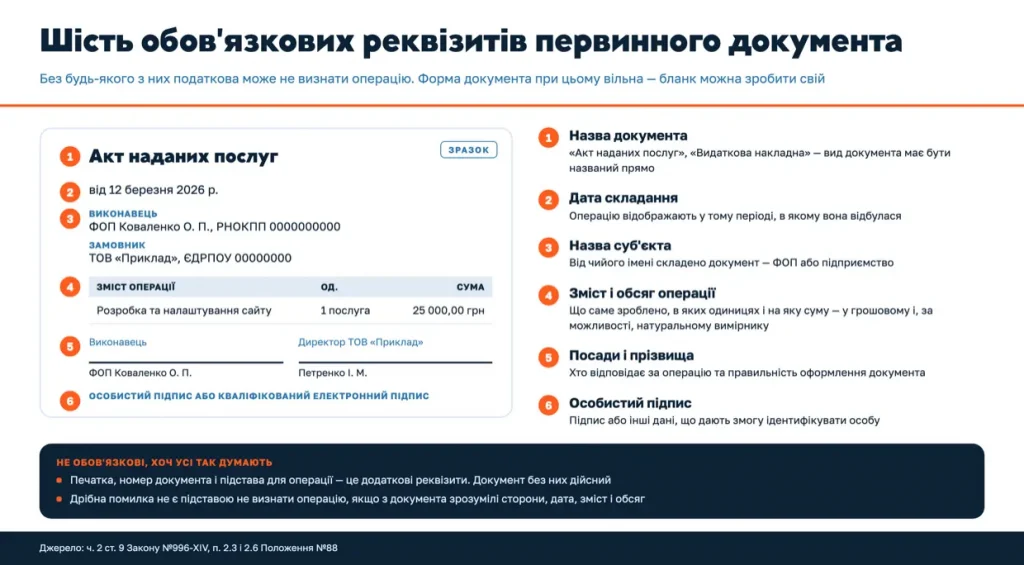
The format is your choice. A document may be paper or electronic - both formats are equally valid. Standard templates are not mandatory: you can create your own, provided that it contains all six required details (paragraph 2.6 of Regulation No. 88).
A common mistake is to assume that a document is invalid without a seal or number. The law explicitly classifies the seal, document number, and basis for the transaction as additional details, not mandatory ones. The same principle applies to minor deficiencies: a small error is not grounds for rejecting a transaction if the document still makes it possible to identify the parties, date, content, and scope of the transaction.
New from April 1, 2026: the customer's signature on an acceptance certificate may no longer be required
This is a recent change that is still rarely mentioned. Law No. 4791-IX dated February 24, 2026 added a new paragraph to part 2 of Article 9 of Law No. 996-XIV:
if a primary document specifies the date or period of provision of services, performance of work, or lease, then the absence of a signature from the customer or tenant does not constitute a violation.
However, this works only if all three conditions are met at the same time:
- the document specifies the date or period of the service;
- this documentation procedure is specified in a written contract;
- the transaction is recorded in the accounting period in which it occurred.
Exception: this rule does not apply to transactions paid for with public funds, leases of state or municipal property, construction contracts, design and survey work, as well as donations, charitable aid, and humanitarian assistance.
What this means in practice: if a client fails to return a signed acceptance certificate for months, you can close the reporting period without their signature - provided that this procedure was specified in the contract in advance. We explained which document is better to use for services in the article "Invoice or Certificate of Completed Work".
Caution: an abolished rule that is still being quoted
Many articles still state that "a primary document must be prepared during the transaction, or, if that is impossible, immediately after it is completed." This rule no longer exists: it was removed from Law No. 996-XIV by Law No. 1724-VIII dated November 3, 2016, and from Regulation No. 88 in 2017.
What applies instead: the transaction must be recorded in the reporting period in which it occurred (part 5 of Article 9 of Law No. 996-XIV), while responsibility for the late preparation of documents lies with those who prepared and signed them (part 8 of the same Article). In other words, "backdating documents for the previous year" is already a risk, not a minor technical issue.
Which primary documents a Sole Proprietor must have
The exact set depends on the type of business you operate. Here are the main categories:
| What is being confirmed | Documents |
|---|---|
| Relationship with the client | Contract, public offer, invoice, commercial invoice |
| Provision of services / performance of work | Certificate of Services Rendered, Certificate of Completed Work, contractor's report |
| Sale of goods | Delivery note, sales receipt, fiscal receipt, consignment note |
| Receipt of payment | Bank statement, fiscal receipt, receipt, payment instruction |
| Origin of goods | Supplier's delivery note, customs declaration, purchase certificate, receipt |
| Expenses (general taxation system, VAT) | Delivery notes, certificates, receipts, VAT invoices, lease agreements |
| Working with foreign counterparties | Foreign trade contract, invoice, bank statement, SWIFT confirmation |
| Employees | Employment orders, employment contracts, timesheets, payroll statements |
Important note on language. Under paragraph 1.4 of Regulation No. 88, documents must be prepared in Ukrainian, while documents in a foreign language that serve as the basis for accounting entries must have an officially arranged authentic translation. For Sole Proprietors working with foreign clients, this means that an invoice in English should be accompanied by a translation. For more information about foreign currency payments, see the article "How a Sole Proprietor Can Accept Payments in Foreign Currency".
What records a Sole Proprietor is required to keep
This is where the key distinction, which is most often misunderstood, comes in. The mandatory Income Register in its old format was abolished in 2021 - it no longer needs to be registered with the tax authorities. However, the obligation to keep records remains; only the format has changed.
| Who | What is recorded | Format |
|---|---|---|
| Group 1 and 2 Sole Proprietors | Income only, monthly | Any format (notebook, Excel, app) |
| Group 3 Sole Proprietor without VAT | Income only, monthly | Any format |
| Group 3 Sole Proprietor with VAT | Income and expenses | Standard form approved by the Ministry of Finance (Order No. 261) |
| Sole Proprietor under the general taxation system | Income and expenses + documents confirming the origin of goods | Standard form approved by the Ministry of Finance (Order No. 261) |
These rules are established by paragraph 296.1 of the Tax Code of Ukraine for single tax payers and paragraph 177.10 of the Tax Code of Ukraine for the general taxation system. The standard form was approved by Order No. 261 of the Ministry of Finance dated May 13, 2021. Records may be kept in paper and/or electronic form, including through the Electronic Taxpayer's Cabinet.
The main trap is that "any format" sounds like "you do not have to do anything." In reality, this applies only to the format used to record income. Paragraph 44.1 of the Tax Code of Ukraine applies to everyone without exception: every amount of income must be supported by a document. In other words, an entry in a notebook is your recordkeeping, while the delivery note or acceptance certificate supporting that entry is the primary document, and one does not replace the other. For more details on income records, see the article "Income Register for a Sole Proprietor".
Inventory records: who must keep them and why this is a separate issue
If you sell goods, another obligation may apply in addition to ordinary primary documentation - inventory records. This requirement is established by paragraph 12 of Article 3 of the Law on Cash Registers No. 265/95-VR.
The law is structured "in reverse": the obligation applies to everyone, and then one category is excluded -
Sole Proprietors paying the single tax who are not VAT payers. Therefore, inventory records must be kept by:
- Sole Proprietors who are VAT payers (any group);
- Sole Proprietors under the general taxation system - even without VAT, because the exemption applies only to single tax payers;
- Sole Proprietors paying the single tax without VAT if they sell: technically complex household goods subject to warranty repair; medicines and medical devices; jewelry and household items made of precious metals; precious stones, stones of organic origin, and semi-precious stones.
What inventory accounting means in practice. It consists of two things together: the Inventory Record Form (a register of goods received and disposed of) plus the primary documents attached to it. The procedure was approved by Order No. 496 of the Ministry of Finance dated September 3, 2021. The Form may be maintained on paper or electronically, and the first entry is an inventory of stock on hand as of the date when the obligation to keep such records arises.
A costly rule: no document - no sale
Order No. 496 contains two rules that entrepreneurs often learn about only during an audit.
First: information about goods received must be entered in the Inventory Record Form before the goods are offered for sale. In other words, the document and the record come first - the sale comes afterward, not the other way around.
Second: the Inventory Record Form and primary documents must be kept directly at the place of sale until the last unit of goods covered by the relevant document has been disposed of. Selling goods for which there is no supporting document or entry in the Form at the place of sale is expressly prohibited.
Relief: if the originals are not available at the place of sale, you may provide the inspector with copies and subsequently present the originals before the audit is completed. This helps when the documents are held by the accountant rather than at the store. We covered cash register compliance separately in the article "Cash Registers for Cashless Payments".
Who can request a Sole Proprietor's primary documents
It is not only the tax authorities - and this often comes as a surprise.
1. Tax authorities. The right to request and examine primary documents during audits is expressly provided for by subparagraph 20.1.6 of the Tax Code of Ukraine. For an explanation of what a tax audit is and how to prepare for one, see the article "Tax Audits".
2. Bank - as part of financial monitoring. Under part 7 of Article 11 of Law No. 361-IX, a bank has the right to request, and the client is required to provide, information and official documents for proper due diligence - including documents confirming the source of funds. This is why a contract and an acceptance certificate can often help prevent an account from being blocked. For more details, see "Financial Monitoring for Sole Proprietors: Account Blocking".
3. Counterparty. A corporate client cannot recognize your service as an expense without a supporting document, so it will require an acceptance certificate containing all mandatory details. The correct payment description works together with primary documentation here.
4. Court. In a dispute over non-payment or poor-quality services, the contract and signed acceptance certificate are the primary evidence.
How long documents must be kept
This is where some of the most common outdated information online appears. There is no longer a single "1,095 days for everyone" rule - in 2023, paragraph 44.3 of the Tax Code of Ukraine was revised to introduce different retention periods.
| Retention period | Who / which documents it applies to |
|---|---|
| 2,555 days (7 years) | Documents related to transfer pricing, controlled foreign companies, and payments to non-residents |
| 1,825 days (5 years) | Primary documents of legal entities, including LLCs paying the single tax |
| 1,095 days (3 years) | All other documents - this includes Sole Proprietors under both the single tax system and the general taxation system |
| 1,095 days (3 years) | Documents required under non-tax legislation supervised by the State Tax Service (cash registers, cash transactions, permits) |
For a Sole Proprietor, the period is 3 years. The logic is simple: Sole Proprietors are not mentioned in the provisions covering 7-year and 5-year periods - those provisions concern legal entities, so the general rule in subparagraph 44.3.3 applies to entrepreneurs.
There are two nuances that make the actual retention period longer. First, the countdown starts not from the date of the document, but from the date the relevant tax return in which the document was used is filed (or, if the return was not filed, from the filing deadline). Second, the retention period is extended for any period during which the statute of limitations was suspended, and during martial law this limitation period was suspended.
Practical conclusion: 3 years (1,095 days) is the minimum, not the maximum, and it is better to keep documents longer.
Separately: if documents relate to the subject of an audit, an administrative appeal, or a court dispute, they must be retained until the case is completed - even if the general retention period has already expired (paragraph 44.4 of the Tax Code of Ukraine).
What happens if documents are missing: fines and consequences
There are three consequences, and the most expensive one is not the fine.
| Violation | Penalty | Provision |
|---|---|---|
| Failure to ensure document retention or failure to provide documents to the tax authorities | UAH 1,020 | Art. 121.1 of the Tax Code of Ukraine |
| The same violation repeated within one year | UAH 2,040 | Art. 121.1 of the Tax Code of Ukraine |
| Failure to provide documents at the request of the tax authorities | 1 minimum wage for each instance | Art. 121.2 of the Tax Code of Ukraine |
| Failure to provide documents upon request on certain specific grounds | 5 minimum wages for each instance | Art. 121.2 of the Tax Code of Ukraine |
| Sale of goods not recorded in accordance with the established procedure | Value of the unrecorded goods at their selling prices, but not less than UAH 170 | Art. 20 of Law No. 265/95-VR |
An important clarification about the inventory penalty. You will often see references to "double the value" of unrecorded goods. This information is outdated: the double penalty was abolished by Law No. 128-IX dated September 20, 2019. The current version of Article 20 provides for a penalty equal to the value of such goods at their selling prices, but not less than 10 non-taxable minimum incomes, which is UAH 170.
Now for the most expensive consequence. Under paragraph 44.6 of the Tax Code of Ukraine, if you fail to provide documents before the audit is completed, regardless of the reason, it is deemed that those documents did not exist at all when the relevant tax reporting was prepared.
The consequence: the tax authorities disallow your expenses or treat incoming funds as unsupported income and assess additional tax, penalties, and late-payment interest. These amounts can be many times higher than UAH 1,020.
But there is a second chance. If you submit the documents together with your objections after the audit but before a decision is made, the supervisory authority is required to take them into account. Another useful rule is paragraph 44.7 of the Tax Code of Ukraine: if an inspector refuses to accept your documents, you can send them by mail with an itemized list of enclosures.
Want your primary documentation handled without your involvement?
The accountants at buh.ua will take care of your income and expense records, prepare document templates, set up electronic document management, and support you during a tax audit or a bank information request.
What to do if documents are lost
Fire, flooding, laptop theft, disk failure, damage caused by shelling - the procedure is set out in paragraph 44.5 of the Tax Code of Ukraine, and its deadlines must not be missed.
- 5 days from the date of the event - notify the tax authority at the place of registration in writing and attach documents confirming the event (a fire certificate, an extract from criminal proceedings, etc.);
- 90 calendar days from the day following the date the notification is received - restore the documents;
- during this period, the audit may be postponed, but for no more than 120 days.
What happens if you do not restore them: the documents will be deemed to have been missing when the tax reporting was prepared - with the same consequences described above. Repeated loss after exercising the right to restore the documents leads to the same result.
A separate point regarding the war. For taxpayers who operated in areas of active hostilities or temporarily occupied territories and cannot produce primary documents, subsection 10 of section XX of the Tax Code of Ukraine provides special rules for confirming tax reporting data as an exception to Article 44. If this applies to you - do not ignore this provision; use it.
Where a Sole Proprietor can obtain primary documents
Most often, documents are missing not because a Sole Proprietor does not want to keep them, but because it is unclear who is supposed to prepare them.
- You - a certificate of services rendered, delivery note, invoice. A standard form is not mandatory: you can create your own template with the six mandatory details and use it on an ongoing basis;
- Supplier - delivery note, invoice, receipt. Ask for the document at the time of purchase, not at the end of the year: later, it may be impossible to find the seller;
- Bank - account statement, payment instructions, SWIFT confirmations;
- Platform or marketplace - reports, invoices, payout confirmations; it is worth downloading them every month because access to older periods is often restricted;
- Customs - customs declaration when importing goods.
Electronic document management makes all of this much easier: a document is signed with an electronic signature, sent to the counterparty instantly, and does not get lost. Electronic primary documents are fully equivalent to paper documents.
5 costly mistakes Sole Proprietors make
1. Treating a receipt or bank statement as sufficient evidence. A bank statement shows that the money was received, but it does not show what it was paid for. Without a contract and an acceptance certificate, the tax authorities may treat the payment as income without a documented basis, while the bank may consider it a suspicious transaction.
2. Collecting documents once a year. By the end of the year, some counterparties no longer respond, platforms have closed access to older reports, and "completing the paperwork retroactively" is risky: those who signed the documents are responsible for their late preparation.
3. Confusing income records with primary documents. An entry in a notebook or spreadsheet is recordkeeping. The document supporting that entry is a primary document. The tax authorities need both.
4. Keeping documents for goods somewhere other than the place of sale. For those required to maintain inventory records, the documents must be kept at the store itself until the last item covered by the delivery note has been sold.
5. Correcting documents "however you can." Erasures and unapproved corrections are prohibited. The proper method is to cross out the incorrect entry with a single line so that the original text remains legible, write the correct text, add the note "corrected", and include the signatures of those who originally signed the document and the date. In documents relating to cash and banking transactions and securities transactions, corrections are not permitted at all - such a document must be reissued.
FAQ: the most common questions about primary documents for Sole Proprietors
Does a Group 2 Sole Proprietor without employees need primary documents?
Yes. The tax group and the presence or absence of employees do not exempt a Sole Proprietor from paragraph 44.1 of the Tax Code of Ukraine: every amount of income must be supported by a document. The only difference is that Group 1 and 2 Sole Proprietors and Group 3 Sole Proprietors without VAT keep income records in any format, while expenses are not recorded at all.
Is a seal mandatory on an acceptance certificate or delivery note?
No. A seal is an additional, not a mandatory, document detail. A document without a seal is valid if it contains all six mandatory details required by Article 9 of Law No. 996-XIV.
How many years must a Sole Proprietor keep documents?
At least 1,095 days (3 years) - this is established by subparagraph 44.3.3 of the Tax Code of Ukraine. The period is calculated not from the date of the document, but from the date the tax return in which the document was used is filed. Because the statute of limitations may be suspended, the actual retention period can be longer, so 3 years is the minimum.
Can documents be stored only electronically?
Yes. Electronic primary documents are legally equivalent to paper documents. The requirement is simple: they must be stored in a form that allows their integrity to be verified and for at least the same period required for paper documents. If a document was originally created on paper, a scan does not replace the original, so the original should also be retained.
The client does not sign the acceptance certificate. What should I do?
From April 1, 2026, the absence of the customer's signature on an acceptance certificate for services, work, or lease does not constitute a violation if the document specifies the date or period, this procedure is set out in a written contract, and the transaction is recorded in the period in which it occurred. Therefore, the simplest solution is to include the relevant clause in the contract in advance.
Does a Sole Proprietor paying the single tax have to keep inventory records?
If the Sole Proprietor is not a VAT payer and does not sell technically complex household goods subject to warranty repair, medicines and medical devices, jewelry made of precious metals, or precious and semi-precious stones - no. In all other cases, as well as for Sole Proprietors under the general taxation system, inventory accounting is mandatory.
What should I do if the tax authorities request documents for a period that was more than 3 years ago?
First, check whether the retention period has actually expired: it is calculated from the filing of the relevant tax return and is extended by any periods during which the statute of limitations was suspended. If the period has indeed expired, there is no longer an obligation to retain the documents, but you still need to respond to the request in writing - otherwise a fine may apply under paragraph 121.2 of the Tax Code of Ukraine.
Conclusion
Primary documentation is not bureaucracy for bureaucracy's sake - it is the only way to prove that your income is legitimate and your expenses are genuine. A Sole Proprietor does not keep accounting records under Law No. 996-XIV, but the Tax Code of Ukraine requires documentary evidence for every figure reported in tax returns - and this is exactly what additional tax assessments during audits are based on.
The minimum set every Sole Proprietor should have is: a contract or public offer, invoice, acceptance certificate or delivery note, bank statement, and documents for goods. Keep them for at least 3 years after filing the relevant tax return. Prepare them on time, with all six mandatory details, rather than "at the end of the year when we finally remember."
The fine for missing documents is relatively small - UAH 1,020. But the real cost is disallowed expenses, additional tax assessments, fines, and late-payment interest, while retailers may also face a penalty equal to the value of unrecorded goods. If you are not sure your documents would withstand a tax audit - it is better to put your records in order in advance than to restore everything within 90 days under deadline pressure.
Want to focus on your business instead of paperwork?
Entrust your accounting for sole proprietors (FOP) to the buh.ua team. We will organize your primary documentation, maintain your records, monitor your reporting, and help you get through audits without unnecessary stress.