

Short-Term Apartment Rentals in Ukraine in 2026: How to Rent Legally and Pay Taxes

Short-term apartment rental may look like a simple way to earn money: list the property on Booking or in an advertisement, accommodate a guest for two nights, and receive payment on your card. Legally, however, this is completely different from renting an apartment to a family for a year.
Most property owners do not even realize that short-term accommodation is legally considered a business activity, not ordinary rental. This means that without registering as a sole proprietor, it is not simply “untaxed income”, but an administrative offense – with a fine of up to UAH 85,000 and confiscation of the income received.
Using 2026 figures, we will explain when you can rent out property as an individual, when short-term rental through a sole proprietorship is required, which tax group and KVED code to choose, whether you need a cash register, and who must collect the tourist tax.
Can you rent out an apartment short-term without registering as a sole proprietor?
Formally, the law does not prohibit an individual from renting out their own property and paying taxes on the income. The real question is whether your activity is systematic.
Renting an apartment to one family for a year under a lease agreement is an ordinary civil-law relationship. Hosting new guests every week, maintaining listings, and keeping the property ready for check-in are already signs of a business activity.
This is why most disputes are not about taxes, but about a different question: whether short-term rental can legally be carried out at all without registering as a sole proprietor.
An important recent legislative change must be taken into account here, and most existing articles have not yet been updated to reflect it. Previously, the definition of entrepreneurship was contained in Article 42 of the Commercial Code. The Commercial Code ceased to be in force on August 28, 2025, pursuant to Law No. 4196-IX.
The definition itself did not disappear – it was moved to Part 1 of Article 20 of the Commercial Procedure Code. Entrepreneurship is described there as independent, initiative-based, systematic activity carried out at one’s own risk for the purpose of making a profit.
The obligation to register is established by Part 2 of Article 50 of the Civil Code: an individual may exercise the right to engage in business activity subject to state registration.
Practical conclusion. If you rent out property occasionally or on a long-term basis, you can remain an individual taxpayer. Short-term rental with a constant flow of guests has all the characteristics of a business activity, so registration as a sole proprietor is required.
What taxes does an individual pay on short-term rental income?
If you rent out property as an individual, the income is taxed under paragraph 170.1 of the Tax Code of Ukraine. The rates are:
- personal income tax – 18% (paragraph 167.1 of the Tax Code of Ukraine);
- military levy – 5%;
Total – 23% of the rental payment.
Who actually pays the tax?
It depends on who rents the property from you.
| Who is the tenant? | Who pays the tax? | What does the owner do? |
|---|---|---|
| Company or sole proprietor | The tenant acts as the tax agent | Receives the amount after 23% has already been withheld |
| Ordinary individual (not a sole proprietor) | The property owner | Calculates and pays the tax quarterly and files a tax return |
For short-term rentals, the second option applies in almost every case: guests are ordinary individuals, so all tax obligations fall on the property owner.
When to pay taxes and file reports
- Quarterly – independently pay personal income tax and the military levy within 40 calendar days after the end of the quarter;
- by May 1 of the following year – file the annual property and income tax return;
- by August 1 of the following year – pay any additional amount due based on the tax return.
How to complete the tax return itself is explained in the article “Property and Income Tax Return”.
Minimum rental payment: when does it apply?
Many articles warn that tax may be calculated not on the actual amount stated in the agreement, but on a minimum rental payment established by the local council. This is only partially true.
The minimum amount is determined under the Methodology approved by Resolution of the Cabinet of Ministers of Ukraine No. 1253. However, paragraph 1 of the Methodology expressly excludes individual tenants who are not business entities from its scope.
This means that if you rent property to an ordinary individual, the minimum rental payment does not apply – tax is calculated on the actual amount received. The rule applies when the tenant is a legal entity or a sole proprietor.
This is the position of the tax authorities rather than a direct provision of the law, so for substantial amounts it is advisable to obtain your own individual tax ruling.
What is the fine for short-term apartment rental without registering as a sole proprietor?
Systematic rental of property without registering as a sole proprietor falls under Article 164 of the Code of Ukraine on Administrative Offenses – conducting business activity without state registration.
| Situation | Fine in 2026 | Additional consequences |
|---|---|---|
| First offense | UAH 17,000 – 34,000 | Confiscation of the income received may apply |
| Repeated offense within one year or income exceeding UAH 1,664,000 | UAH 34,000 – 85,000 | Confiscation of the income received is mandatory |
*The amounts are calculated using the tax-free minimum: UAH 17 for determining the fine and UAH 1,664 for qualifying “income on a large scale” (50% of the subsistence minimum for able-bodied persons under the 2026 State Budget Law).
The fine is not the only consequence. The tax authorities may also assess additional personal income tax and military levy on all identified income, plus a penalty for non-payment and late-payment interest. How can the tax authorities find out? Most often from advertisements and profiles on booking platforms, complaints from neighbors or condominium associations, as well as regular card payments from different people.
In other words, the risk is not limited to the fine: without registering as a sole proprietor, you may also have to pay taxes, penalties, and late-payment interest on income you have already received.
Renting out property short-term and not sure whether you are doing it legally?
The accountants at buh.ua will assess your risks, select the appropriate taxation system for your income level, register you as a sole proprietor with the correct KVED codes, and handle your reporting.
Sole proprietor for short-term rentals: which tax group to choose
The choice of tax group depends primarily on who your clients are, how much income you expect to receive, and whether you work only with tourists or also with companies.
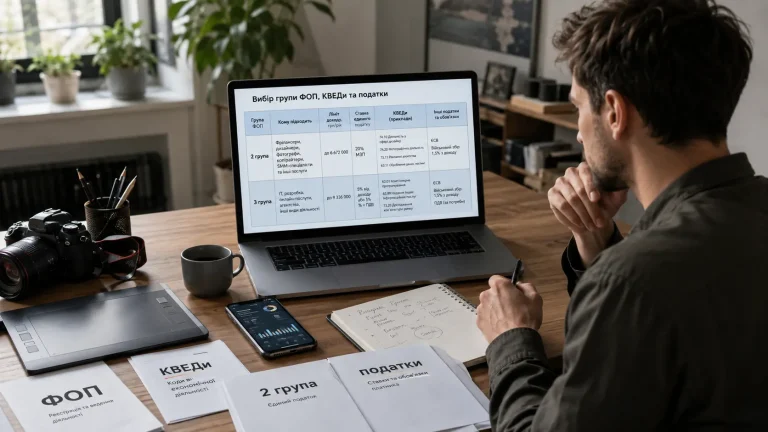
For renting out accommodation, Group 2 or Group 3 of the simplified tax system is suitable. Group 1 is not suitable at all: it only allows retail trade at markets and household services from a closed list.
The difference between Group 2 and Group 3 lies in who you are allowed to provide services to.
| Criterion | Group 2 | Group 3 |
|---|---|---|
| Who you can provide services to | Individuals and single tax payers | Anyone, including companies under the general taxation system |
| Employees | Up to 10 people | No limit |
| 2026 income limit | UAH 7,211,598 | UAH 10,091,049 |
| Tax | Fixed, up to UAH 1,729.40 per month | 5% of income |
| Military levy | UAH 864.70 per month | 1% of income |
Group 2 is suitable if you accommodate ordinary tourists. A tourist is considered part of the general public and does not have to be a single tax payer.
Group 3 is required if your guests include companies that book accommodation for employees on business trips. A Group 2 sole proprietor cannot provide services to a legal entity operating under the general taxation system.
Which KVED code is required for short-term rentals?
This is a key decision that affects both restrictions and risks. Short-term and long-term rentals are covered by two different KVED classes, and the distinction between them is based on the duration of the stay, not the type of property.
Classes 55.20 and 68.20 explicitly exclude one another: the explanation for 55.20 states that long-term accommodation belongs to Section 68, while the explanation for 68.20 states that short-term accommodation belongs to Section 55.
The main rule is simple: KVED 55.20 is used for short-term apartment rentals, while 68.20 is used for long-term rentals. These are the two KVED codes entrepreneurs most often confuse.
If you also provide cleaning, change the bed linen, and serve meals to guests, this is already considered a hotel service, meaning KVED 55.10.
Does the 400 sq. m limit apply to short-term rentals through a sole proprietorship?
Single tax payers are subject to a direct limit on the area of real estate they may rent out. It is established by subparagraph 291.5.3 of the Tax Code of Ukraine.
- land plots – no more than 0.2 hectares;
- residential premises – no more than 400 square meters;
- non-residential premises – no more than 900 square meters.
The limit is calculated based on the area you actually rent out, not the total area you own. An empty apartment that is not being rented out is not included in the calculation. Exceeding even one of the limits completely disqualifies you from using the simplified tax system.
IMPORTANT: if the total area of residential property you rent out under the single tax system exceeds 400 sq. m, you can no longer use the simplified tax system.
A gray area worth knowing about
The restriction in subparagraph 291.5.3 is specifically worded in relation to rental, meaning KVED 68.20. In its guidance, the tax authority confirms that the restriction does not apply to hotel services – but those explanations mention only class 55.10.
There is no direct official answer regarding class 55.20, which is actually used for short-term apartment rentals. Based on the logic of the provision, the conclusion should be the same because it also belongs to Section 55 rather than Section 68.
What to do about it. If the total area you rent out is approaching 400 square meters, do not rely on tax guidance issued to someone else – it only protects the person to whom it was issued. Obtain your own individual tax ruling.
Do you need an RRO cash register for short-term apartment rentals?
This is one of the most common mistakes landlords make: assuming that cash register requirements do not apply to rental activities. There is no separate exemption in the law for rental or hotel services.
Only Group 1 single tax payers are exempt from using a cash register (paragraph 296.10 of the Tax Code of Ukraine), and short-term rentals cannot be operated under Group 1.
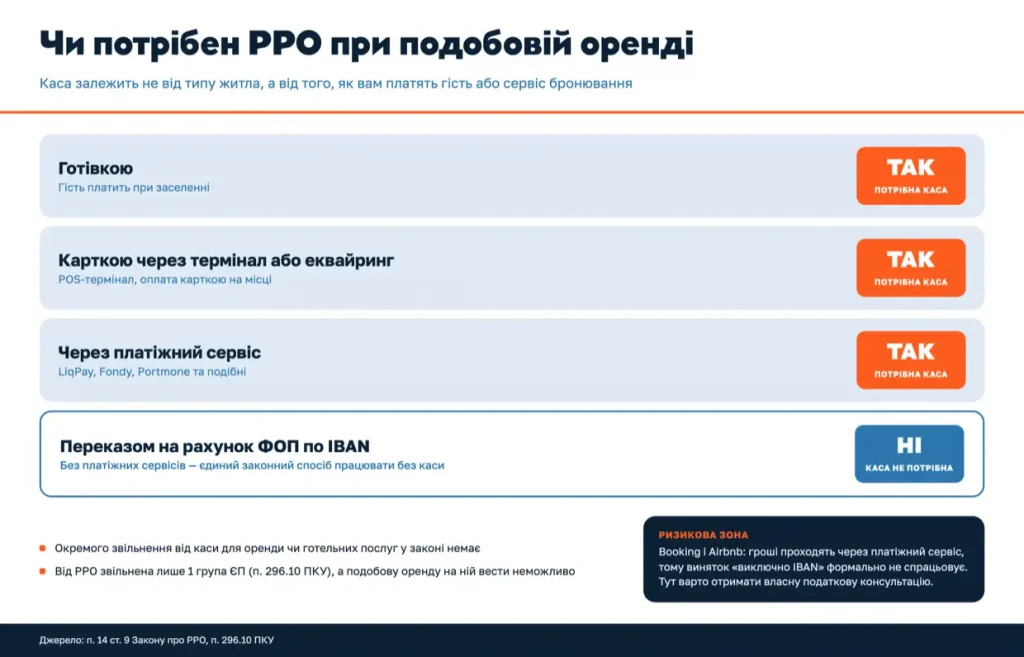
Whether you need a cash register depends on the payment method, not the type of accommodation.
In practice, this means that most landlords who work through Booking, Airbnb, or accept card payments must use an RRO or PRRO. The only legal way to operate without a cash register is to accept payments exclusively by bank transfer to an IBAN. This is provided for in paragraph 14 of Article 9 of the Law on RRO.
Payments through Booking or Airbnb are a risk area. The money passes through a payment service, so the “IBAN only” exemption does not formally apply. This is another situation where it is advisable to obtain an individual consultation.
Who pays the tourist tax on short-term rentals?
Almost no one mentions this, even though the rule is explicit. Under Article 268 of the Tax Code of Ukraine, a property owner who provides accommodation for temporary stays acts as a tax agent for the tourist tax. This means that you do not pay the tax out of your own pocket. Instead, you collect it from the guest in advance at check-in and then transfer it to the local budget.
The provision explicitly covers not only hotels, but also apartments, houses, rooms, cottages, and any other facilities used for temporary accommodation.
*Calculated using the minimum monthly wage of UAH 8,647 as of January 1, 2026. These are maximum rates: the specific amount is set by the local council and may be lower.
The main caveat: the tax does not apply everywhere. The provision repeatedly uses the wording “in accordance with the decision of the village, settlement, or city council.” If your local council has not adopted such a decision, there is no tourist tax at all – check the website of your local council.
Payment is made quarterly, together with the quarterly tax return, or through monthly advance payments by the 30th day of each month. Those exempt from the tourist tax include, in particular, local residents, children under 18, persons with disabilities, internally displaced persons whose certificate lists the relevant address, and close relatives of the property owner.
Which is more cost-effective: short-term rental through a sole proprietorship or as an individual?
An individual pays 23% of every hryvnia of rental income. A sole proprietor mainly pays fixed amounts, so the higher the income, the more advantageous the sole proprietor format becomes. Let us compare the actual 2026 figures.
| Monthly income | Individual (23%) | Group 2 sole proprietor | Group 3 sole proprietor |
|---|---|---|---|
| UAH 20,000 | UAH 4,600 | UAH 4,496 | UAH 3,102 |
| UAH 40,000 | UAH 9,200 | UAH 4,496 | UAH 4,302 |
| UAH 80,000 | UAH 18,400 | UAH 4,496 | UAH 6,702 |
*The sole proprietor calculation includes all three payments: the single tax, military levy, and Unified Social Contribution of UAH 1,902.34 per month. For Group 2, the maximum single tax rate was used; the local council may set a lower rate.
What the table shows. At a monthly income of around UAH 20,000, operating as a sole proprietor already becomes more cost-effective than renting as an individual, while at UAH 80,000 the difference reaches UAH 12,000-14,000 per month. However, savings are not the main argument. An individual who systematically rents out accommodation short-term violates the state registration requirement regardless of whether they pay the 23% tax. Registering as a sole proprietor removes this particular risk. Therefore, short-term rental through a sole proprietorship is not so much about saving money as it is about making the business model itself legal.
What else should you consider when renting out an apartment short-term?
Taxes and sole proprietor registration are not the only issues. There are several practical matters that landlords often think about only after problems arise. Taking care of them in advance helps avoid disputes with guests, banks, or the tax authorities.
- Real estate tax – payable regardless of whether you rent out the property if its area exceeds the tax-free threshold;
- Agreement with the guest – even for a two-night stay, it can protect you in a dispute over damaged property;
- Primary accounting documents – every incoming payment should have a documented basis, otherwise the bank may raise questions during financial monitoring;
- Consent of co-owners – if the apartment is jointly owned.
Which payment descriptions to use for incoming payments is explained in the article “Payment descriptions for sole proprietors”.
FAQ: Frequently Asked Questions About Short-Term Rentals
Can you rent out an apartment short-term as an individual and simply pay 23% tax?
Paying taxes does not replace registration. If the rental activity is systematic, it is considered a business activity and, under Part 2 of Article 50 of the Civil Code of Ukraine, requires state registration. Without registering as a sole proprietor, there remains a risk of a fine under Article 164 of the Code of Ukraine on Administrative Offenses even if the taxes have been paid.
How many apartments can you rent out under the single tax system?
The restriction applies not to the number of apartments but to their total area: up to 400 square meters of residential premises. This may be one large apartment or several smaller ones – the total area of the properties being rented out is counted.
Do you need a cash register if a guest pays by card?
Yes, if the payment is made by card through a terminal, acquiring service, or payment service. A cash register is not required only when the money is received exclusively by transfer to the IBAN of your sole proprietor bank account without using payment services.
Which KVED code should you choose for renting out an apartment through Booking?
55.20 – holiday and other short-stay accommodation activities. Class 68.20 is intended for long-term rental for a month or a year, and it is this class that is linked to the area restriction.
Do you need to collect tourist tax from guests?
Yes, if the local council in your city or village has adopted a tourist tax. In that case, you act as the tax agent and collect it from the guest at check-in: up to UAH 43.24 per day from a Ukrainian citizen and up to UAH 432.35 per day from a foreign national in 2026.
Which sole proprietor tax group is cheaper for short-term rentals?
With monthly income of up to approximately UAH 40,000, Group 3 is usually more cost-effective (5% plus 1% military levy). At higher income levels, Group 2 with its fixed payments becomes more advantageous. However, Group 2 cannot provide services to companies operating under the general taxation system.
Can you rent out an apartment through Booking without registering as a sole proprietor?
If the activity is systematic and aimed at generating profit, it has the characteristics of a business activity and therefore requires state registration. A one-time rental does not create this obligation, while a continuous flow of guests through the platform does.
What happens if the tax authorities find an advertisement for short-term rental?
The tax authorities may assess additional personal income tax and military levy on all identified income, impose a penalty for non-payment and late-payment interest, and for operating without registration impose an administrative fine starting from UAH 17,000, with possible confiscation of the income received.
Conclusion
Short-term accommodation rental in 2026 is a full-fledged business activity, not simply “additional income”. The key criterion is simple: systematic activity. If you rent out one apartment for a year, you can remain an individual taxpayer and pay 23%. If you continuously accommodate new guests, you need to register as a Group 2 or Group 3 sole proprietor with KVED 55.20.
Taxes on short-term rentals depend on the format: an individual pays 23% of every hryvnia earned, while a sole proprietor mainly pays fixed amounts that do not depend on the number of guests. Three things that are most often overlooked: the cash register requirement (it applies to cash and card payments), the tourist tax (collected by the property owner), and the 400-square-meter area restriction for the single tax system. The cost of getting it wrong is significant: fines from UAH 17,000 to UAH 85,000 with confiscation of income, plus additional tax assessments. Legalizing the activity costs far less than dealing with the consequences.
Want to rent out your property with peace of mind and without the risk of inspections?
Entrust your accounting to the buh.ua team. We will select the appropriate tax group and KVED codes for your rental model, register you as a sole proprietor, set up a cash register if necessary, and handle all reporting.