


Received a Tax Notice: What Sole Proprietors Should Do, Response Deadlines and Penalties


A letter from the tax authorities can be alarming even when everything is in order. The first reaction is either to put it aside without reading it or immediately call your accountant and ask, "What did I do wrong?"
Most business owners do not even realize that the costliest mistake here is failing to collect the letter. Under the Tax Code, a document may be deemed served even if you have never seen it: if you have opted to receive correspondence through the Electronic Cabinet - when the document becomes available there, and if not - when the postal service returns the envelope.
Let's look at the rules: what types of letters the tax authorities may send, how much time you have to respond, when a response is not required, and what the real consequences of staying silent can be.
What Documents the Tax Authorities Send to Sole Proprietors
The word "letter" can refer to documents of very different significance: from a routine response to your own inquiry to a demand to settle a tax debt. They should not be confused - each has its own deadlines.
| Document | What It Means | What to Do |
|---|---|---|
| Request for information | The tax authorities are requesting explanations and documents | Respond within 15 business days |
| Request for a cross-check | Your counterparty is being checked, not you | Respond within 10 business days |
| Tax notice-decision | You have been assessed an amount payable | Pay or appeal within 10 business days |
| Tax demand | You already have a tax debt | Settle the debt; your property is subject to a tax lien |
| Individual tax consultation | A response to your own inquiry | Nothing - this is not a demand |
An individual tax consultation carries the least risk - it is simply a response to your own inquiry. A cross-check is not an audit of you either, but it cannot be ignored: you must respond to the request within 10 business days.
The most serious documents are a tax notice-decision and a tax demand. A tax notice-decision means that an amount has already been assessed, while a tax demand means that a tax debt has already arisen and a tax lien has taken effect.
When a Letter from the Tax Authorities Is Deemed Served
Even if you have never seen it. This is the most important part of the issue because this is where people miss deadlines without having done anything wrong.
Electronic Cabinet. If you have submitted an application to receive documents through the Electronic Cabinet, a document is deemed served when it becomes available in the Cabinet. Whether you actually logged in or not does not matter. The date of service is determined by the delivery receipt. If the document arrives after 6:00 p.m., it is deemed served on the next business day; if it arrives on a weekend or public holiday, it is deemed served on the first business day thereafter. You will need an electronic signature to use the Cabinet.
Postal mail. The rule is even stricter here. If the postal service cannot deliver the letter - because you were not at the address, you refused to accept it, or the addressee could not be found - the document is deemed served on the date specified by the postal service in the notice. In other words, the envelope may be returned without you ever seeing or signing for it - yet the deadlines for payment and appeal have already started running.
The only exception is a change of address. If you notified the tax authorities of your new tax address on time, but they sent the document to your old address and it was returned, you are not required to comply with that document.
The simplest and least expensive way to protect yourself is to apply to receive documents through the Electronic Cabinet and make a habit of checking it regularly. You can opt out, but only once a year.
How Much Time You Have to Respond to a Tax Authority Request
The deadlines depend on the type of request and are calculated in business days, starting not on the day of receipt but on the following day.
- standard written request - 15 business days;
- request for a cross-check - 10 business days.
An important note on martial law. The suspension of tax deadlines applied only until August 1, 2023. Materials that still claim that "deadlines do not run during the war" are outdated in this respect - deadlines now run under the standard rules.
When You Do Not Have to Respond to a Tax Authority Request
The Tax Code explicitly exempts you from the obligation to respond if the request has been issued in violation of the requirements. This is a rare case where the law is on the taxpayer's side, and few people know about it.
The request must be signed by the head of the tax authority or an authorized person, bear an official seal, and contain:
- the legal grounds for sending the request from the list provided in the Tax Code - with the information supporting those grounds;
- specific facts that may indicate a violation, rather than a general statement;
- a list of the information and documents that must be provided.
If any of these elements are missing, you are released from the obligation to respond to such a request.
The second situation is when you have already submitted these documents before. In that case, it is enough to provide the date and reference number of the letter used to send them, and your obligation in this respect is also considered fulfilled. But do not rush to celebrate. You should only conclude that a request is defective after reviewing the document itself, preferably together with an accountant: a mistake in assessing the request can cost more than responding to it.
What Happens If You Do Not Respond to the Tax Authorities
There are two consequences, and the second is significantly more unpleasant than the first.
| Violation | Fine in 2026 |
|---|---|
| Failure to provide documents in response to a standard request | UAH 8,647 for each violation |
| Failure to provide originals or copies of documents during tax control procedures | UAH 1,020 |
| The same violation repeated within one year | UAH 2,040 |
| Failure to provide a response or documents to requests issued on the special grounds specified in clauses 6-8 of subparagraph 73.3.1 of the Tax Code of Ukraine (including requests concerning international exchange of information) | UAH 43,235 for each violation |
*The amounts are calculated based on the minimum wage of UAH 8,647 as of January 1, 2026. The fine is calculated using the minimum wage in effect at the beginning of the year and does not change even if the minimum wage is increased during the year.
There is a common misconception here. Many sources state that a fine of five minimum wages applies in all cases. In fact, the increased fine applies only to requests issued on the special grounds specified in clauses 6-8 of subparagraph 73.3.1 of the Tax Code of Ukraine, including requests concerning international exchange of information. For a standard request sent to a Sole Proprietor, the fine is one minimum wage.
Failure to provide explanations and documents in response to a written request is a direct legal ground for an unscheduled documentary tax audit.
In other words, staying silent may cost you not UAH 8,000, but a full-scale review of your business activities. And paying the fine does not release you from the obligation to provide the requested information anyway - the Tax Code states this explicitly.
We explained how to reduce the likelihood of such an audit in general in our guide on tax audit risk, and what exactly the tax authorities examine in our article on tax audits.
Received a request and do not understand what exactly the tax authorities want from you?
The accountants at buh.ua will check whether the request complies with the law, prepare a response with the required documents, and handle correspondence with the tax authorities on your behalf - within the applicable deadline, before it expires.
What to Do If You Receive a Tax Notice-Decision
The most common reasons why a Sole Proprietor receives such a decision are understatement of declared tax liabilities, exceeding the income limit, and errors in or failure to register a VAT invoice.
This is no longer a request, but a decision by the tax authority establishing a monetary liability. If you disagree with it, you have 10 business days after receiving it to file an administrative appeal.
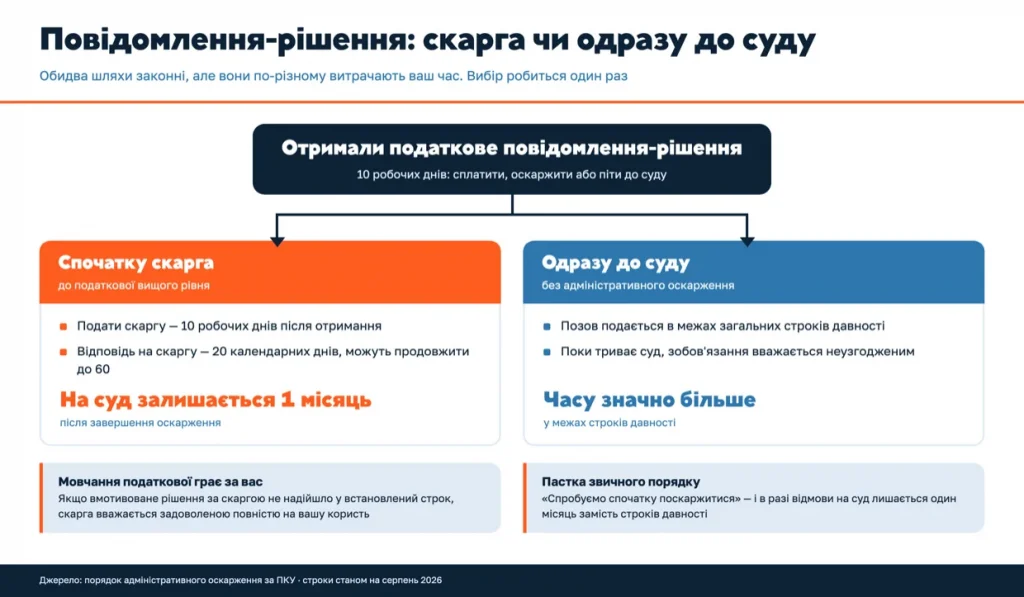
A strong argument in your favor: if the tax authorities fail to issue a reasoned decision on your appeal within the statutory deadline, the appeal is deemed fully granted in your favor.
Now for the catch that is rarely mentioned. If you first file an appeal with a higher-level tax authority and lose, you have only one month left to go to court.
If you go directly to court without first filing an administrative appeal, you have significantly more time - within the general limitation periods. That is why the choice of procedure should be deliberate, rather than simply "let's try filing a complaint first." Another advantage of going to court is that while the court proceedings are ongoing, the monetary liability is considered unagreed until the court decision becomes legally effective.
When a Tax Demand Is Sent and the Minimum Debt Amount
A tax demand is issued when the debt has already arisen, not when it has merely been assessed.
The threshold is UAH 3,060. As long as the total amount of tax debt does not exceed this amount, no tax demand is sent and no collection measures are applied.
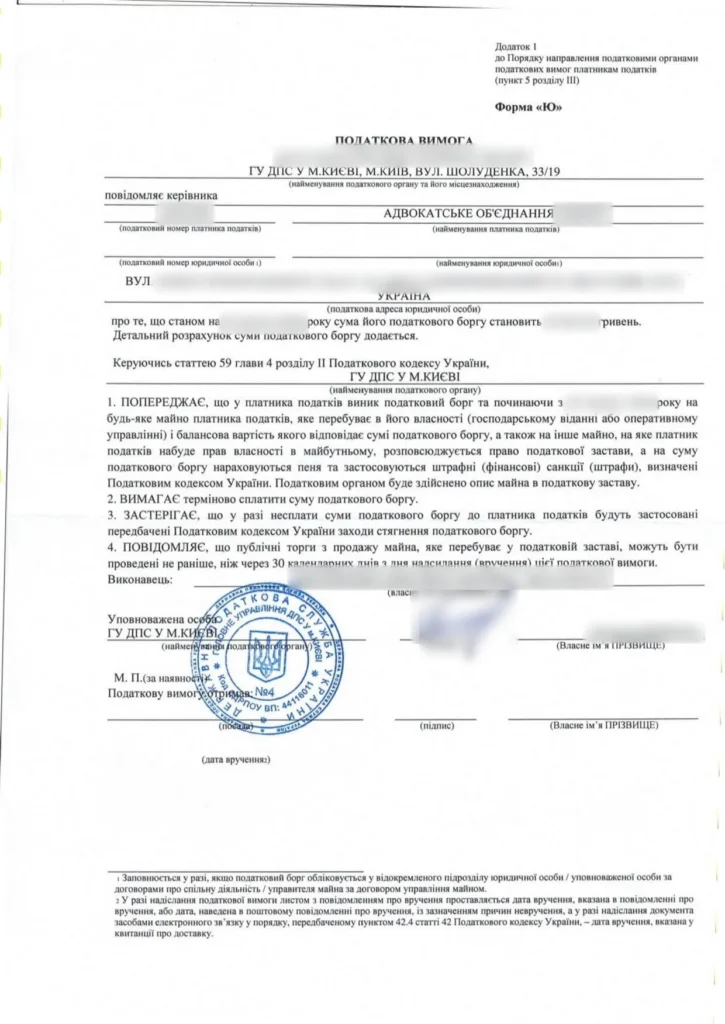
A tax demand can also be issued without a tax notice-decision. If you filed the tax return yourself but failed to pay on time, the demand will be sent without any prior documents. What it may lead to: a tax lien over your property, an inventory of assets and, if the debt remains unpaid, a public auction. All of this is expressly stated in the tax demand itself.
Important detail: if the debt increases, no repeated tax demand is sent. So there is no point in waiting for a "new letter" - the original demand remains in effect.
To avoid reaching this point, keep track of payment deadlines - all dates are collected in the tax calendar for Sole Proprietors, while the penalties for late payment are explained in the article on fines for Sole Proprietors.
How to Protect Yourself in Advance
Most problems with tax letters are solved not through legal action, but through proper organization.
- Apply to receive documents through the Electronic Cabinet and check it regularly - this way, you will see the document on the day it arrives;
- keep your tax address up to date - this is the only ground for not complying with a document sent to the wrong address;
- keep your primary accounting documents and income records - most requests can be resolved with these documents;
- do not ignore even a letter you do not understand - the deadline starts running from the date of service, not from the day you figure out what it means.
Those who maintain transparent records are less likely to attract the attention of the tax authorities. Read about the benefits available to compliant taxpayers in our article on the White Business Club.
FAQ: Questions About Letters from the Tax Authorities
How many days do you have to respond to a tax authority request?
15 business days for a standard written request and 10 business days for a request concerning a cross-check. The countdown begins on the day following receipt of the request.
What happens if you ignore a letter from the tax authorities?
A fine of UAH 8,647 applies for each failure to provide documents, but more importantly, this is a direct legal ground for an unscheduled tax audit. Paying the fine does not release you from the obligation to provide the information.
Is a letter deemed served if I did not receive it?
Yes. A document in the Electronic Cabinet is deemed served when it becomes available there. A paper letter that the postal service was unable to deliver is deemed served on the date specified by the postal service in the notice.
Can you refuse to respond to a tax authority request?
Yes, if the request was issued in violation of the requirements: it lacks the head's signature, an official seal, specific facts indicating a violation, or a list of the required documents. You also do not need to resubmit documents you have already provided - it is enough to specify the date and reference number of the letter used to send them.
How much time do you have to appeal a tax notice-decision?
You have 10 business days to file an appeal with a higher-level tax authority or to pay the assessed amount. You can go directly to court within the applicable limitation periods, but after an unsuccessful administrative appeal, you have only one month left.
At what debt amount is a tax demand sent?
From UAH 3,060. While the debt is below this amount, no tax demand is sent and no collection measures are applied. If the debt subsequently increases, no repeated tax demand will be sent.
Where can you find a letter from the tax authorities in the Electronic Cabinet?
Documents are delivered to the private section of the Electronic Cabinet, in the section for correspondence with the tax authority. You will also receive an email notification stating the type of document and the date and time it was sent to the Cabinet - but the document itself must be opened in the Cabinet.
Can the tax authorities send a request without conducting an audit?
Yes. A written request is a separate legal instrument, not part of an audit. The tax authorities send such requests on the grounds expressly listed in the Tax Code, and it is the failure to respond that may become grounds for an unscheduled audit.
Are tax deadlines suspended during martial law?
No. The suspension of tax deadlines applied only until August 1, 2023. All deadlines for responses, payments, and appeals now run under the standard rules.
Conclusion
A letter from the tax authorities does not necessarily mean there is a problem. What matters is what type of document it is: an individual tax consultation and a cross-check carry relatively little risk, a request requires a response, while a tax notice-decision and a tax demand involve financial obligations.
The key rule: the deadline starts running from the moment of service, and service can occur without your involvement - through the Electronic Cabinet or when an undelivered envelope is returned. You have 15 business days to respond to a standard request and 10 business days for a tax notice-decision. Staying silent may cost you not so much in fines as in the risk of an unscheduled audit.
Don't want to deal with the tax authorities on your own?
Entrust your accounting to the buh.ua team. We monitor the Electronic Cabinet, respond to requests within the applicable deadlines, and prepare documents so that issues are resolved through correspondence rather than an audit.