

White Business Club in Ukraine: Benefits and How to Join


Entrepreneurs are increasingly interested in what the White Business Club is, how to get into the list of taxpayers with a high level of voluntary tax compliance, what benefits it provides - a moratorium on audits, fast VAT refunds, and a personal compliance manager - and what criteria the State Tax Service uses to include businesses in this list in 2026.
The most important thing to understand right away is this: membership in the Club is not a privilege for selected large corporations, but the result of daily accounting discipline. The list may include both legal entities and sole proprietors (FOPs) on the general tax system or in Group 3 of the single tax system, as well as Diia.City residents - but each category has its own criteria for income, salaries, and the level of tax payments.
In this article, we will explain in simple terms what the White Business Club is, who can join it, what specific benefits it provides in 2026, and what criteria the State Tax Service uses to form the list.
What the White Business Club is in simple terms
The “White Business Club” is the unofficial name of the official List of taxpayers with a high level of voluntary tax compliance. It was introduced in 2024 to support and encourage legal businesses: the state decided to distinguish those who operate transparently from those who remain in the shadow economy - and to give “white businesses” a number of privileges.
Legal basis: The Club operates under Law No. 3813-IX of June 18, 2024 (effective from August 1, 2024), while the rules themselves are set out in paragraph 69.41 of subsection 10 of section XX “Transitional Provisions” of the Tax Code.
The procedure for forming the list is defined by Ministry of Finance Order No. 495 dated October 7, 2024.
Number of participants: the first list was published in December 2024 (8,255 taxpayers), and it has been gradually growing. As of mid-2026, the Club includes more than 9,000 entities, the vast majority of which are legal entities, while the rest are FOPs. Members include IT companies, agribusinesses, law firms, educational platforms, and advertising agencies.
How long the Club will operate: currently, this is a temporary mechanism - it operates during martial law and until December 31 of the year in which martial law is terminated or canceled. What will happen next is still unknown, but membership already provides real benefits. That is why businesses should monitor their compliance with the criteria now, not only before the next update of the list.
Who can join the White Business Club
The list covers different categories of taxpayers - and it is not a club only for large companies. It may include:
- legal entities on the general tax system;
- legal entities - single tax payers in Groups 3 and 4;
- FOPs on the general tax system;
- FOPs - single tax payers in Group 3;
- residents of Diia.City.
But the category is only the entry point. Each tax system has its own criteria: the level of tax payments compared with the industry average, employee salary levels, and, for certain categories, an income threshold. In other words, theoretically, almost any transparent business can join the Club - but it must meet all requirements at the same time.
Example: an advertising agency in the form of an LLC on the general tax system pays corporate income tax and VAT at a level no lower than the average for its industry, keeps average salaries above the industry average, and has no debts - such a business is a candidate for inclusion. However, a Group 3 FOP can be included in the list only if their declared income exceeds UAH 5 million and their level of tax payments matches the industry benchmark.
Who is already in the White Business Club: 2026 figures
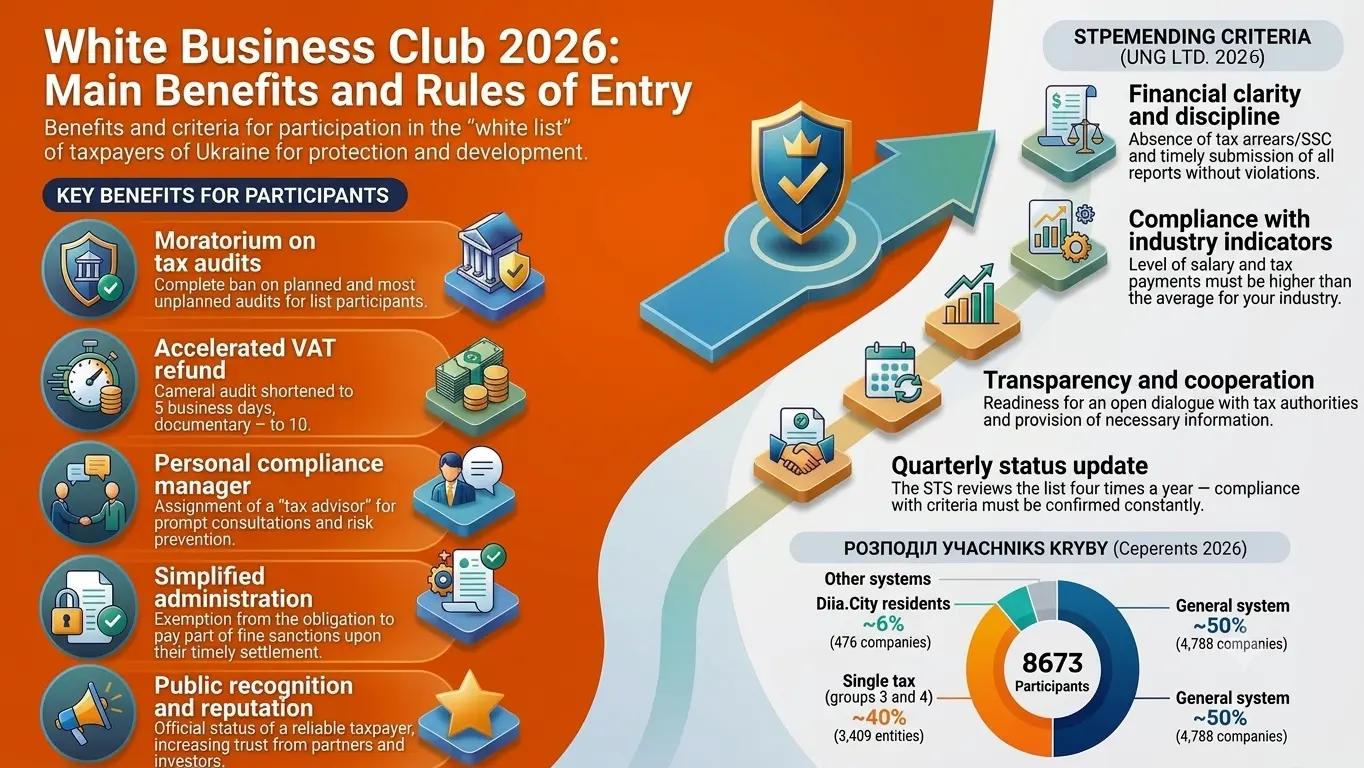
The list consists mainly of companies, not FOPs. According to Opendatabot analytics based on State Tax Service data (mid-June 2026), out of about 9,250 participants, 94% are legal entities (8,673), and only 6% are FOPs (578). Over the quarter, the Club's composition changed by almost a third (32%): 1,490 were added and 1,216 left - meaning it is realistic to get on the list, but also easy to drop out.
By tax system, participants are distributed as follows:
| Tax system | Share in the list |
|---|---|
| General tax system | about 50% (4,788) |
| Single tax, Group 4 (agricultural producers) | about 20% (1,720) |
| Single tax, Group 3 | about 20% (1,689) |
| Diia.City residents | about 6% (476) |
This shows that businesses of different sizes and from different industries can be included in the list. At the same time, the statistics show that compliance with the criteria must be maintained continuously, because the list is updated regularly.
By industry, agriculture is represented the most (about 21%), followed by trade and vehicle repair (20%), then manufacturing (17%), construction, and real estate. Among FOPs on the list, 88% operate in Group 3 of the single tax system, most often in trade.
*The data is based on Opendatabot analytics using the State Tax Service list as of mid-June 2026; the figures change with each quarterly update.
What benefits the White Business Club provides in 2026
Membership in the list is not a status “checkmark,” but a set of very practical benefits. Below are the main benefits currently available to list participants.
- Moratorium on tax audits
The main benefit is the moratorium on audits. For participants in the list, scheduled documentary audits are not initiated, and most unscheduled audits do not start either. This removes a significant part of the stress caused by many hours of document reconciliation.
But there are exceptions. The moratorium does not apply to specific areas: production and circulation of excisable goods, gambling business, provision of financial and payment services, transfer pricing, and currency issues. If your activity is not related to these areas, the moratorium applies in full. We explained how the State Tax Service generally selects taxpayers for audits in our article about tax audits.
- Accelerated VAT refunds
If you claim VAT for refund, the deadlines for Club members are significantly shorter: a desk audit - up to 5 business days, and a documentary audit - up to 10. For businesses with high turnover, this means that cash
is returned much faster. Separately, we should remind you that the status of a risky VAT payer closes the road to the Club, while blocked tax invoices are handled through a separate unblocking procedure.
- Personal State Tax Service compliance manager
A participant in the list receives a personal compliance manager - an assigned official at the tax authority, a kind of “tax nanny.” This is a direct contact who provides advice on fulfilling tax obligations, including remotely - by email or video conference.
- Warnings about tax risks
A Club member can learn about risks in advance: submit a request to the State Tax Service and receive information on whether the authorities have data about possible risks in their activity, along with recommendations on how to eliminate them. In other words, you learn about a problem before it turns into an audit.
- Fast individual tax consultations
Participants in the list receive an individual tax consultation (ITC) within a shortened period - 15 calendar days, and directly from the central body of the State Tax Service, without the request being passed between departments.
Want your accounting to work without unnecessary risks?
The buh.ua team will take care of accounting support, tax control, reporting, and deadlines so you can focus on growing your business.
How to join the White Business Club: 2026 criteria
To be included in the list, a business must meet the requirements - and all of them at the same time. Broadly speaking, they can be divided into general criteria, meaning financial integrity, and industry-specific criteria.
General criteria - financial integrity:
- tax debt - no more than 3,000 non-taxable minimum incomes and incurred no earlier than 30 days ago;
- there must be no unified social contribution (USC) debt at all;
- flawless reporting - all reports submitted on time, without missed deadlines (accumulated reporting fines for three consecutive months must not exceed one minimum wage - UAH 8,647 in 2026);
- the taxpayer does not have the status of a risky VAT payer;
- the taxpayer is not undergoing bankruptcy or liquidation proceedings;
- the taxpayer is not under sanctions and is not linked to the aggressor state;
- the main KVED has not changed during the last 12 months.
Industry-specific criteria depend on the tax system. In general, they are as follows:
| Category | Key requirements |
|---|---|
| Legal entity (general tax system) | Corporate income tax and VAT payments are not below the industry average; salaries are above the industry average; at least 5 employees |
| FOP (general tax system) | VAT and personal income tax payment levels are not below the industry average; salaries are above the industry average |
| Group 3 single tax FOP | Declared income of more than UAH 5 million; tax payment level not below the industry average |
| Group 4 single tax payers (agricultural producers) | Agricultural land area of at least 200 ha; a positive ratio between taxes paid and the minimum tax liability |
*The exact numerical thresholds and industry indicators are updated annually by the State Tax Service, so it is worth checking the current values before applying.
Even if a business meets most of the requirements, failure to meet even one mandatory criterion may be grounds for non-inclusion in the list.
How often the list is updated: The State Tax Service reviews it quarterly - by the last business day of March, May, August, and November. Each time, compliance is checked again: if a condition is violated, the business is removed from the list until the next formation.
How to keep your membership in the list
Getting into the Club is only half the job. The other half is staying in it. Since compliance is checked quarterly, membership effectively depends on what happens in your accounting every month: every tax return, every timely payment, every salary payment either brings you closer to the list or moves you further away from it.
The biggest risks of removal are late reporting, tax or USC debt, being classified as a risky VAT payer, and changing the main KVED. So the same rule applies here as in dealing with banks' financial monitoring: transparent and well-organized accounting is the best protection. In addition, a flawless tax history also reduces the risk of accusations of business splitting.
Frequently Asked Questions (FAQ)
What is the White Business Club?
This is the unofficial name of the List of taxpayers with a high level of voluntary tax compliance. The list was introduced by Law No. 3813-IX and established in paragraph 69.41 of the Tax Code; it gives transparent businesses a number of tax benefits.
Who can join the White Business Club?
Legal entities and sole proprietors (FOPs) under different tax systems. The list may include legal entities on the general tax system and in Groups 3-4 of the single tax system, FOPs on the general tax system and in Group 3 of the single tax system, as well as Diia.City residents - provided they meet the criteria for their category.
What benefits does membership in the White Business Club provide?
Five key benefits: a moratorium on most audits, accelerated VAT refunds (desk audit within up to 5 business days), a personal State Tax Service compliance manager, the right to learn about risks in advance, and individual tax consultations within a shortened timeframe.
Can FOPs join the White Business Club?
Yes. FOPs on the general tax system and FOPs that are Group 3 single tax payers may be included in the list. For Group 3 FOPs, an additional condition applies: declared income of more than UAH 5 million and a tax payment level not below the industry average.
How often is the taxpayer list updated?
Quarterly - four times a year. The State Tax Service forms an updated list by the last business day of March, May, August, and November, checking compliance with the criteria again each time.
Can a business be removed from the White Business Club?
Yes. If, during the next review, a business no longer meets even one criterion - late reporting, tax or USC debt, risky VAT payer status, or a change in the main KVED - it is excluded from the list until the next formation.
How many businesses are in the White Business Club?
More than 9,000. As of mid-2026, the list includes about 9,250 entities - mainly legal entities and some FOPs. The figure changes with each quarterly update.
Conclusion
The White Business Club is a real opportunity to operate with greater peace of mind: with a moratorium on audits, faster VAT refunds, and a personal contact at the tax authority. It is open not only to corporations but also to small and medium-sized businesses - legal entities, FOPs on the general tax system and in Group 3 of the single tax system, and Diia.City residents.
But the main rule is simple: getting into the list and staying there is daily work on your accounting. One mistake, one overdue report, one USC debt - and the door closes until the next quarter. That is why accounting should be kept in order continuously, not “cleaned up” right before the list is reviewed.
Want to work calmly, without problems with the tax authorities?
The buh.ua team will take care of accounting support: reporting, taxes, USC, VAT, deadline control, and help keep your accounting in order.