

How to withdraw money from Patreon in Ukraine 2026: how to create an account and pay taxes


Patreon is an international subscription platform through which creators receive regular income from their audience. For Ukrainian creators, Patreon has become a convenient way to monetize content - videos, podcasts, courses, communities, and educational materials. At the same time, Patreon is a foreign source of income, which raises practical questions: how to withdraw money legally, whether the tax authorities see these funds, whether a sole proprietorship (FOP) is required, and what taxes must be paid in Ukraine.
In this article, we will analyze Patreon specifically from the perspective of Ukrainian legislation - account registration, withdrawal methods, tax implications, and common mistakes that can lead to penalties.
What is Patreon
Patreon is a platform for regular financial support of creators. It allows creators to receive money directly from their audience in the form of monthly subscriptions or one-time payments.
Platform users (patrons) pay the creator a fixed amount each month - for access to content, participation in a community, or other bonuses. The minimum payment can start from $1, and the amount of income depends on the number of subscribers and selected support tiers. One-time donations for specific goals are also possible - for example, for filming an educational video or recording a new track. The platform is used by artists, video bloggers, musicians, cosplayers, designers, programmers, game developers, podcast authors, writers, and other content creators.
For a creator, Patreon is a source of regular income. The platform accumulates payments, withholds its commission, and transfers funds to the creator via payment services (Payoneer, PayPal, etc.).
How Patreon works
As of 2025, creators on Patreon have already exceeded $10 billion in cumulative payouts and collected over 25 million paid subscriptions.
Patreon operates on a model of recurring paid subscriptions. A creator sets up a page, configures support tiers with a fixed monthly fee, and provides access to content according to the selected tier. For example: $3 per month - exclusive texts, $7 - videos and streams, $15 - live sessions and behind-the-scenes content. The higher the tier, the more bonuses.
In addition, Patreon has expanded its functionality - adding video hosting, live streams, free subscriptions, merchandise sales, and gift subscriptions. The free memberships feature is also available: a user can subscribe for free, receive part of the content, and later upgrade to a paid tier. This allows creators to gradually "warm up" their audience toward payment.
In practice, the model looks like this:

Who can earn on Patreon
Technically - anyone. The platform does not restrict creator categories. But there is a nuance: creating a page is easy, while achieving stable income is a completely different story.
Success on Patreon depends on three things:
- Your own audience - people need to know about your paid page and want to support you specifically. If you do not yet have a loyal audience, you will need to invest in advertising.
- Valuable exclusive content - patrons pay money and expect quality, not empty promises. Sometimes Patreon is used simply for donations without bonuses, but this is more the exception than the rule.
- Communication with the audience - for people to remain subscribers for months, you need to build a community: answer questions, share the process, and stay in touch.
If it is difficult, delegate your
accounting to professionals
Our experienced accountants will analyze your business, take into account all nuances, and ensure complete order in your reports and taxes.
How much Patreon costs for creators
From August 4, 2025, a single rate applies for all new creators - 10% of earnings.
Previously, there were two plans: Pro (8%) with basic monetization and analytics tools, and Premium (12%) with a dedicated manager and merchandise production options. Creators who joined the platform before August 2025 remain on their old rates. For beginners, 10% is a fair price for access to the audience and the platform's tools.
How to create a Patreon
Now let's go step by step - from account creation to withdrawing money.
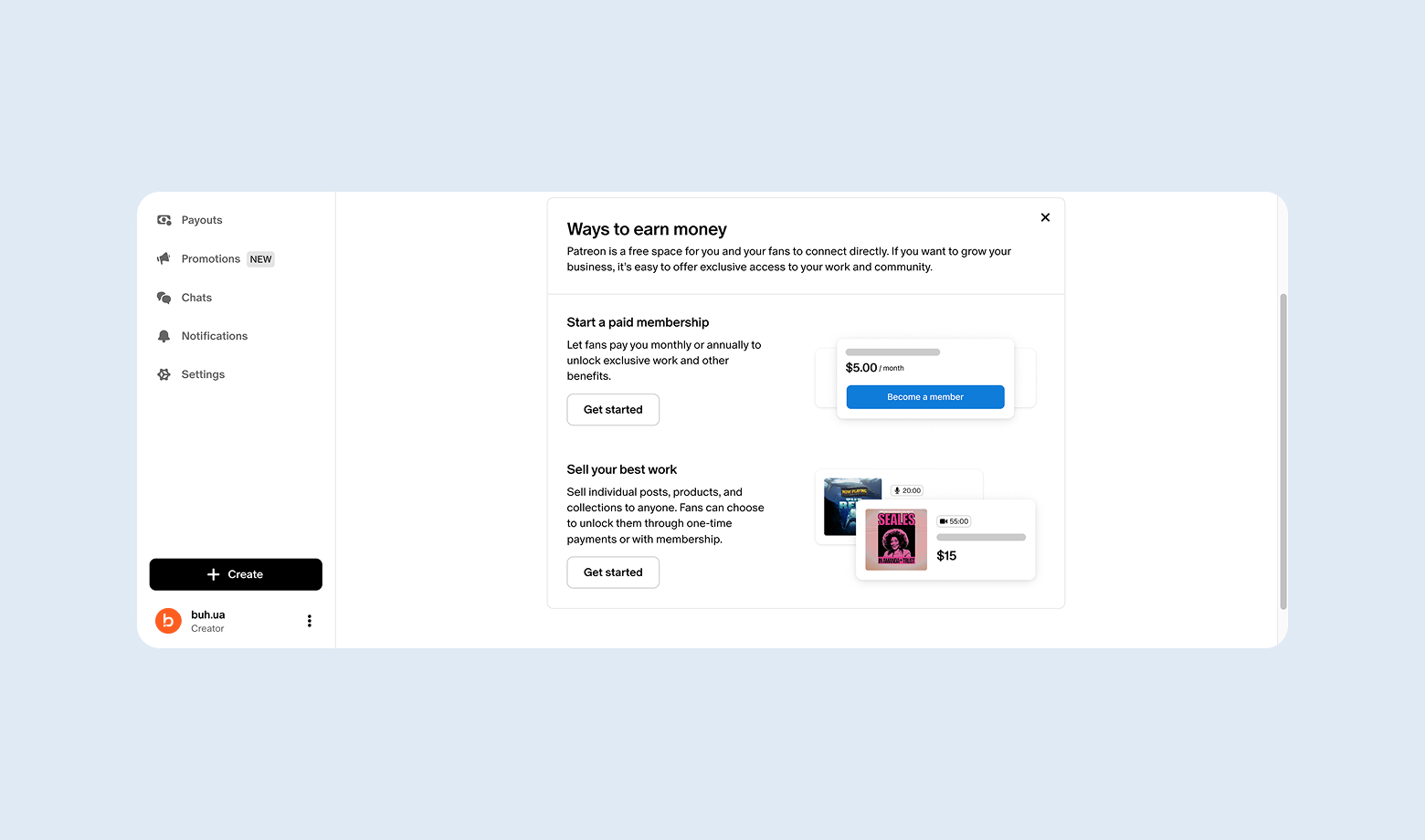
First, go to patreon.com and register an account. After registration, the platform will prompt you to complete several basic settings. You will see the settings panel on the left: Add a profile photo; Describe your page; Social links; Make your first public post; Publish your page; Tell people.
Start by adding a profile photo - this is the first thing potential patrons will see. Then describe your page: tell about yourself, your work, and what content you plan to publish. If possible, record a short welcome video - even a one-minute clip on the front camera works better than text. Connect your social networks so patrons can track your activity on other platforms.
Example of page editing and setup:
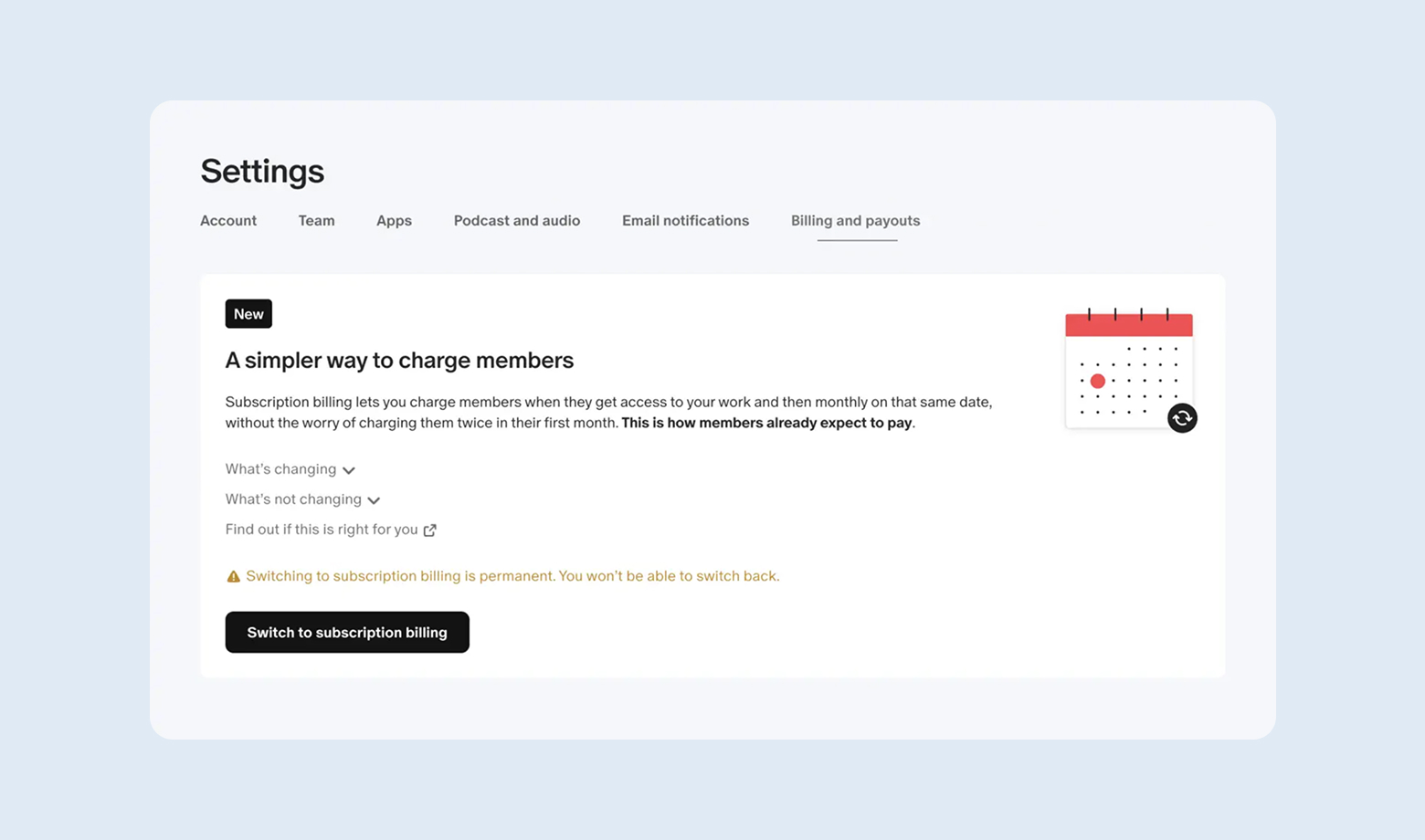
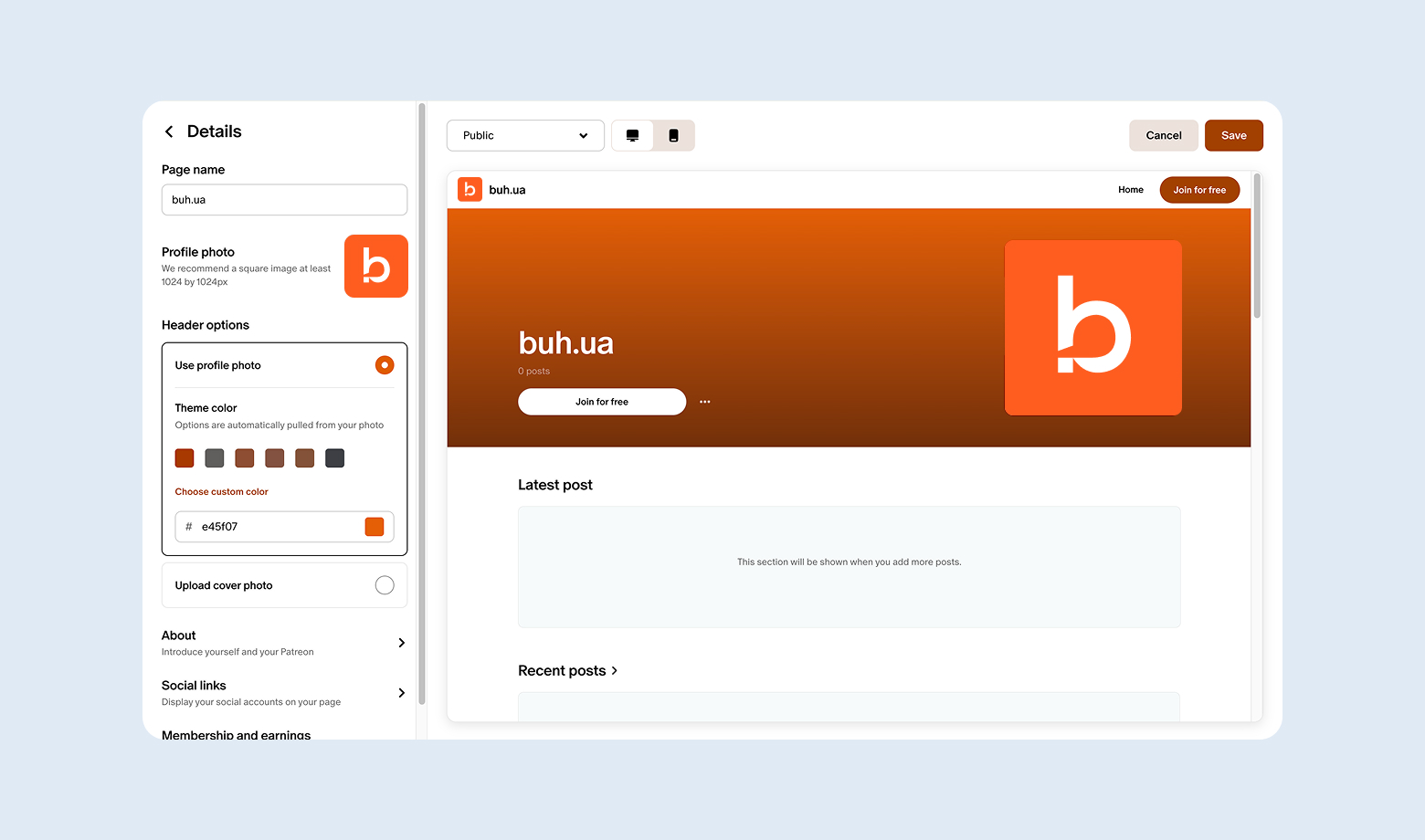
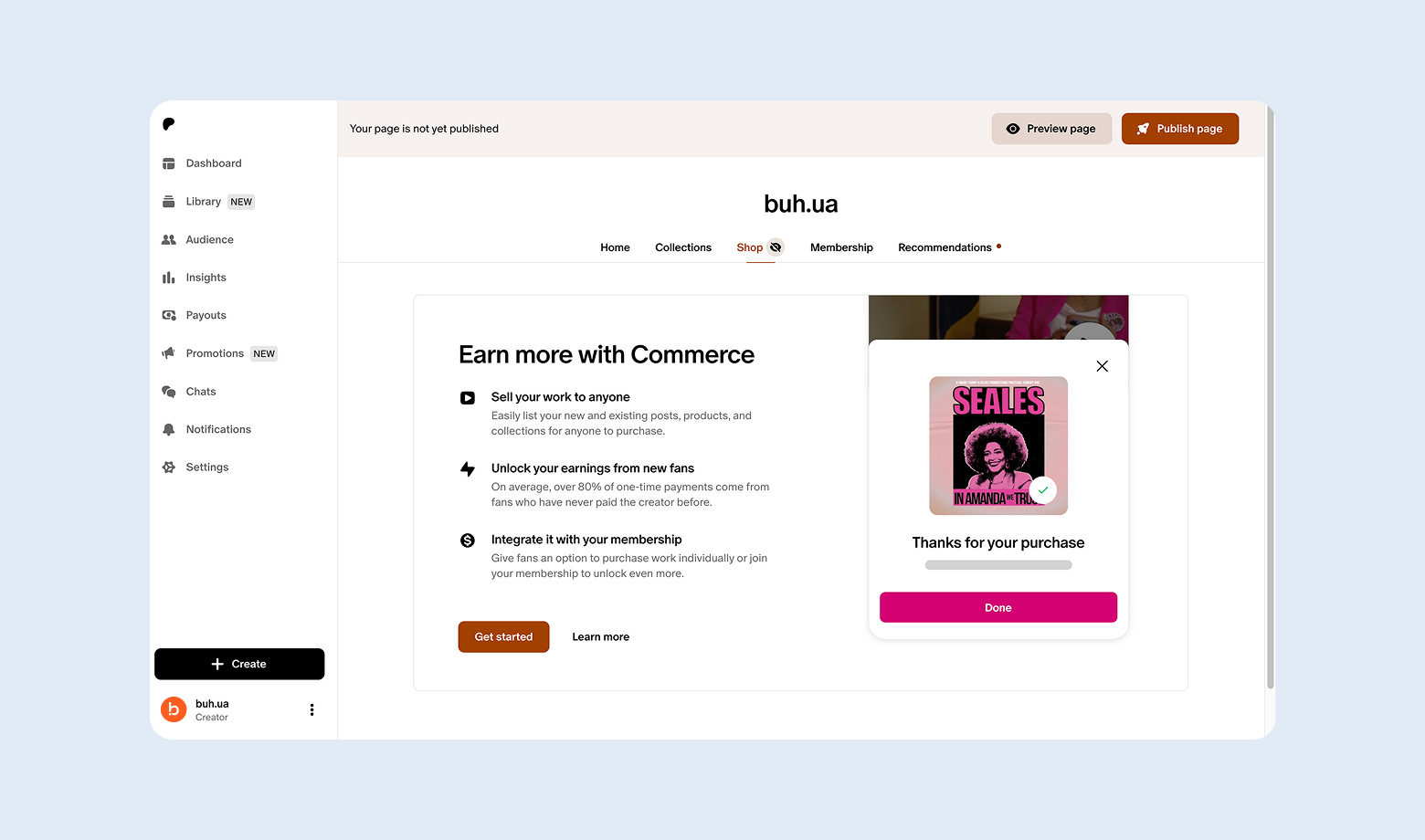
You can run the page in any language, although the interface and examples are mostly in English. Before publishing your first post, you need to enable subscriptions in the settings - otherwise monetization will not work. In subscription settings, we recommend enabling Free trial - the first 7 days for a new subscriber will be free. If you have high-quality content, patrons will stay after the trial period ends. Also activate Subscription billing - this allows automatic monthly charges without any additional actions from subscribers.
An important nuance: if you upload a video, the user will only be able to download the file, not watch it online on the site. Therefore, for video content it is better to use regular posts with an embedded player.
After setup, all that remains is to publish the page and start telling people about it - on social media, on YouTube, and in newsletters. Without promotion, even the best content will not find its audience.
How to withdraw money from Patreon
Now let's move on to the most interesting part. How to withdraw funds from Patreon if you already run your page and sell content.
The first withdrawal on Patreon is somewhat similar to setting up a "financial profile". First, you choose your country and payment system, and then fill out a short form confirming that you are not a US tax resident.
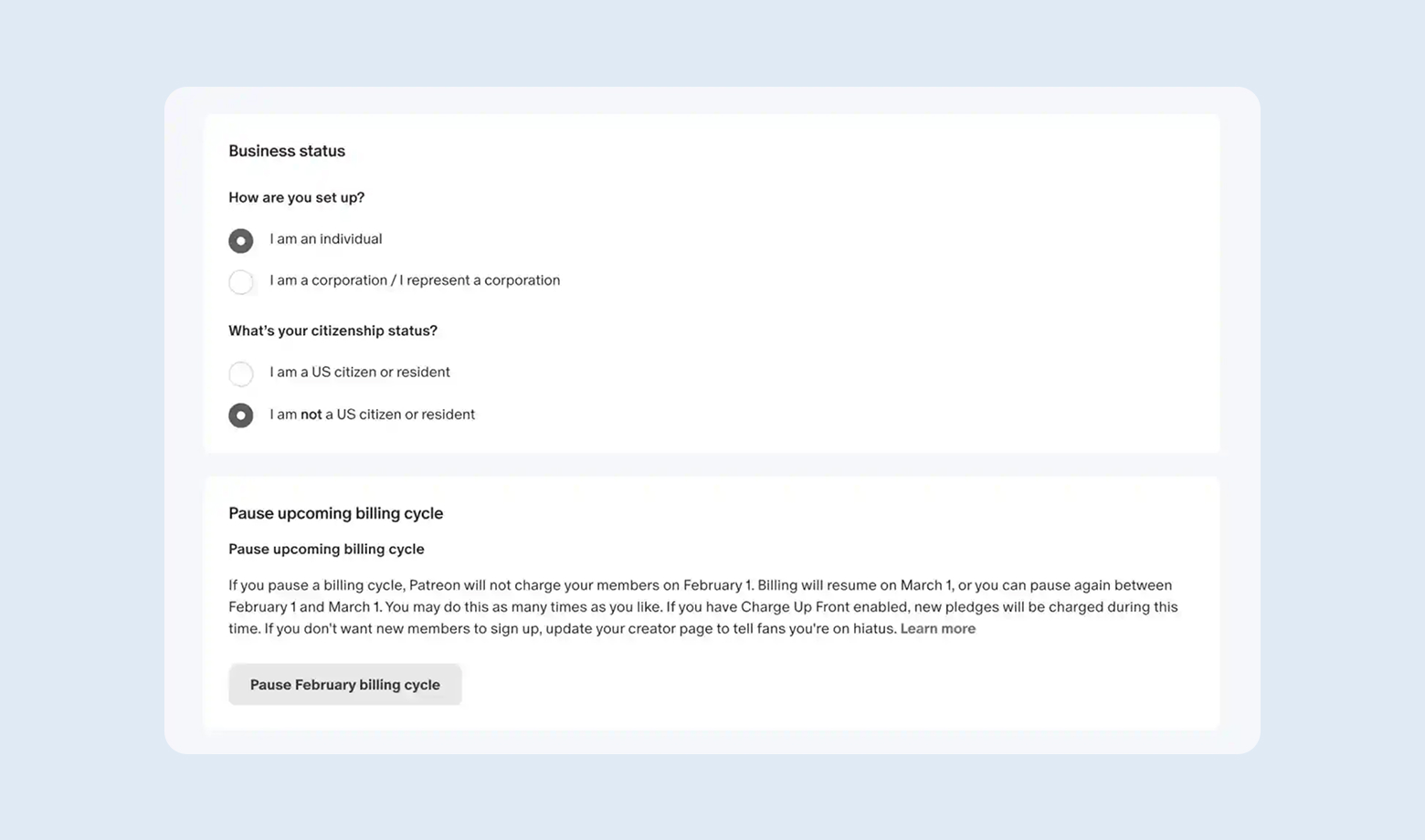
Next, go to "Payout settings".
There, Patreon will ask two important questions:
- Are you an individual or a legal entity?
- Are you a US resident?
In the “Tax settings” section, you complete the W-8BEN form by providing your name, address, country, and confirmation that you do not pay taxes in the United States. The form confirms that you are not a US tax resident. Without it, Patreon may withhold 30% tax on “US-source” income by default. By submitting the form and applying the double taxation avoidance agreement between Ukraine and the United States, you can avoid this withholding and pay taxes only in Ukraine.
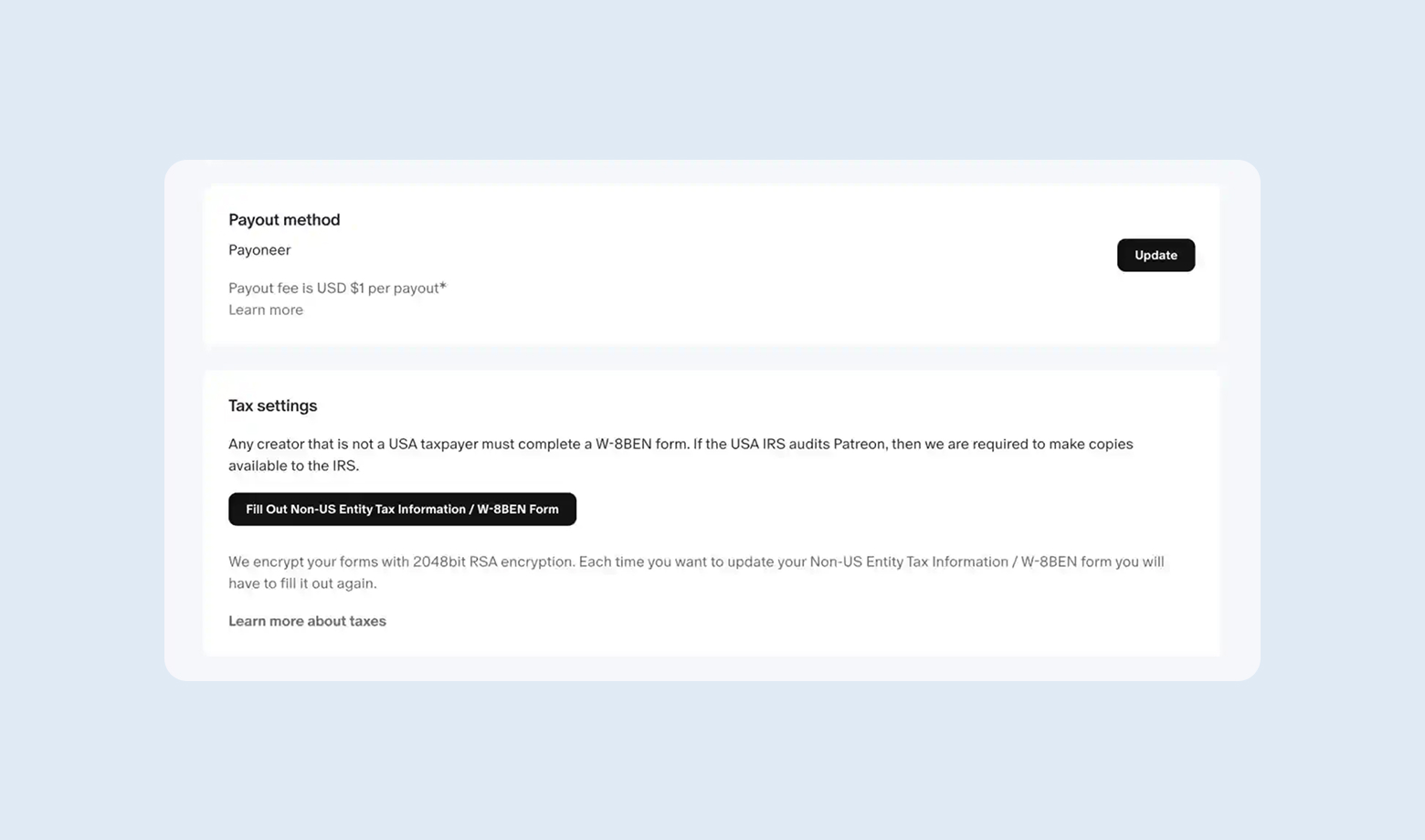
A key advantage: once everything is filled out, you will automatically receive all future payouts to your account without extra steps. Simple, clear, and stress-free.
You can find more details about double taxation on our channel.
How to withdraw money from Patreon
After you specify your country, Patreon will show the available payout options.
For Ukraine, there are two most convenient options.
For Ukrainian freelancers, the most convenient option is a bank transfer via Payoneer. Read more about all rates, fees, and withdrawal methods via Payoneer in our separate article.
Do you need to pay taxes on Patreon income
Technically - yes, any income, even from foreign platforms, is subject to taxation in Ukraine in accordance with the Tax Code of Ukraine.
It is important to understand: according to the position of the State Tax Service, income can be considered received already at the moment of crediting funds to an account in Payoneer or another payment system, and not only after their transfer to Ukraine. That is why you should not consider Payoneer as a way to postpone taxation. In addition, the procedure for accounting for such income and their transfer to a business account has its own characteristics and depends on the specific situation. To avoid tax risks, it is worth agreeing on the procedure with your accountant in advance.
- If income becomes regular and exceeds the declaration threshold, it must be included in a sole proprietor declaration or a FOP tax declaration, depending on your status.
- Using international payment systems does not exempt you from the obligation to declare income, but it allows you to better control inflows and set aside funds for taxes.
- In Ukraine, many Patreon creators now recommend keeping separate income records and saving Payoneer statements so that it will be easier to confirm the source of income for the tax authorities in the future.
Important: using Payoneer does not exempt you from the obligation to declare income. The tax authorities may learn about income through: bank financial monitoring, international exchange of tax information (CRS), public activity on social networks. Consequences if detected: additional tax assessments for the entire period and a fine of 25% of the unpaid tax amount, plus penalties for each day of delay.
There are two legalization options:
Patreon alternatives
Finally, if Patreon is not quite right for you or you want to try something else, here is a list of popular alternatives where creators can earn from their content:
Patreon offers the most powerful range of features, Boosty and Gumroad are convenient for selling digital products and courses, while Ko-fi and Buy Me a Coffee are the most affordable options for getting started.
FAQ: frequently asked questions about Patreon
Do you need to register as a sole proprietor to work with Patreon?
Any income from Patreon is subject to taxation in Ukraine. If income is irregular (a few donations per month), it can be declared as personal income in an annual declaration. If income is regular - sole proprietor registration is required.
Do tax authorities see income from Patreon?
Directly - no, indirectly - yes.
Patreon does not automatically transfer information to the Ukrainian tax authorities. However, the tax authorities may learn about income in the following cases:
- during bank financial monitoring;
- when checking account transactions;
- within the framework of tax information exchange (CRS, requests to payment systems);
- if funds are regularly credited to Ukrainian accounts.
Even if money is withdrawn via Payoneer, this does not mean complete anonymity. For the tax authorities, what matters is not the withdrawal method, but the fact of receiving income.
How to grow your Patreon?
Patreon grows most effectively not on its own, but as an extension of an existing audience. In practice, three main methods work:
1. Your own social networks. The main source of first patrons is your existing audience: YouTube, Instagram, TikTok, X (Twitter), Telegram, a blog, or a podcast. Patreon should be presented not as "donations", but as access to additional value - exclusive content, early access, a closed community.
2. Targeted advertising. Makes sense if you create useful, educational, or niche content and clearly understand your audience.
3. Internal blog and free memberships on Patreon. Patreon allows publishing public posts and using free subscriptions.
Important to understand: Patreon does not replace social networks, but works as the final stage of monetization for an existing audience.
Conclusion
Patreon is a real tool for monetizing creativity that allows creators to receive regular income from subscribers instead of relying on advertising or one-time donations. For Ukrainian creators, the platform is fully functional, and the most convenient way to withdraw funds is via Payoneer.
At the same time, it is important to understand: regardless of the wording "support", "donations", or "subscriptions", under Ukrainian law these funds are income that will be subject to declaration and taxation in the future.
Success on Patreon depends not only on the platform, but also on the audience, the value of the content, and regular communication with subscribers. To increase the chances of stable income, it is worth paying attention to basic page settings:
- use a real name, photo, or recognizable brand - this increases trust;
- fill in all profiles and links to social networks;
- write a clear and understandable page description: what you create and what patrons receive;
- set up several subscription tiers, including a basic one ($1-$3) to attract new users;
- use a free trial to allow users to get acquainted with the content;
- immediately check payout settings and fill out the W-8BEN form to avoid double taxation;
- actively promote Patreon on social networks - without promotion, even high-quality content will not find an audience.
If you plan to earn seriously on Patreon or already receive regular payouts, the correct tax model and income accounting will help avoid problems in the future and calmly scale the project.