

Financial monitoring 2026: how NBU changes affect sole proprietors and how to avoid account blocking

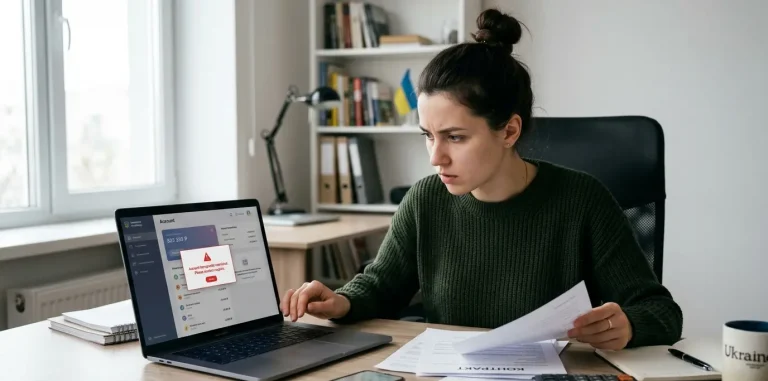
Since October 2025, the NBU has strengthened financial monitoring: banks now see full payer data, transfer chains, and signs of business splitting. In 2026, this leads to more frequent document requests and account blocks for sole proprietors. To avoid risks, it is important to properly structure payments, business activity codes (KVED) and documents.
We break down: what has changed, what banks pay attention to during financial monitoring, how to prepare for checks, and what to do to avoid account blocking.
NBU changes since October 2025: what banks now monitor
Last year, the National Bank updated the requirements for information displayed in bank statements and payment documents. The goal is to increase transparency and fight fraud.
1. Full recipient name
Previously, a strange abbreviation or code could appear in the statement instead of the company name. Now - only the full official name of the payment recipient.
Example:
- Before: "Payment LLC XXX" or "ABC123"
- After: "LLC 'Olena Beauty Salon'"
2. Full name or payer details are always displayed
Regardless of which card you use, documents will always show who made the payment. Anonymous transfers no longer exist.
3. Clear description of online payments
When you pay for something online (goods, services, subscriptions), the statement will now clearly show who you paid and what for.
Example:
- Before: "Online payment 1500 UAH"
- After: "Payment for course 'Design Basics', Online School 'Creative', 1500 UAH"
4. Companies must provide full legal names
All companies processing card payments must provide their full legal name before confirming the transaction. No more "similar" names instead of real ones
These changes give banks more tools to:
- fight fraud, as it is harder to fake a company name
- detect business splitting, as real connections between payers are visible
- ensure payment transparency, every transaction is fully "signed"
What does this mean for you?
Now checking statements is much easier - you no longer have to guess what mysterious "ABC123" or other unclear abbreviations mean. It is easier to control regular payments: utilities, subscriptions, rent - everything is clearly labeled, and you immediately see where the money went. The risk of mistakes decreases - if something goes wrong, you will notice it right away in the statement. For accounting and reporting, it has become easier to match bank statements with invoices and acts. Overall, payment security increases: cases where a "similar" name appears instead of the real one will become rare.
Cons (or rather - reality):
- Banks see EVERYTHING - every payment now includes full information
- Financial monitoring is more active - algorithms analyze transactions even more thoroughly
- More requests from banks - if something seems suspicious, they will ask for explanations
Want to avoid your sole proprietor account being blocked?
We will review your payments, business activity codes (KVED) and documents - and show you how to pass financial monitoring without risks
Open Banking in Ukraine: how it will affect entrepreneurs and sole proprietors
Also, on 1 August 2025, the Regulation on Open Banking came into force (NBU Resolution No. 80 dated 25.07.2025) - this is a system that allows banks and licensed fintech platforms to exchange detailed information about payments.
1. Accurate identification of payers and recipients
Now, both in statements and in the "digital footprint", it is clearly visible who paid and to whom. Not just a card number, but full details.
2. Tracking transaction chains
It is now possible to track how funds move between accounts. If money "travels" through several cards - the bank sees it.
Example: Client A transferred 50,000 UAH → Client B → Client C → Client D (sole proprietor). Previously, this looked like separate unrelated transfers. Now the bank sees the entire chain.
3. Automated data exchange between institutions
Banks can quickly exchange information without manual requests or waiting. This speeds up checks.
4. "Digital footprint" of every transfer
Each transaction now has its own unique "trace" containing all payment details. This fundamentally changes control approaches.
Situation: You are a freelancer receiving payment from a foreign client via IBAN.
Thanks to Open Banking, the bank instantly identifies:
- which country the card is from
- which company is making the payment
- full payer details
This means the payment will immediately appear with full details, and the bank will be able to quickly verify its legitimacy.
"Red flags": what banks look at
Banks are already actively detecting and analyzing "non-standard" transactions. These are so-called "red flags" - signals that raise suspicion and trigger a check.
1. Large or unusual incoming payments
If you usually receive 5,000-10,000 UAH per month, and suddenly 200,000 UAH comes in - it immediately attracts attention.
Example: You are a tutor, usually earning about 2,000 UAH per day from clients in cash, then transferring small amounts to your card. Suddenly, one day you receive two transactions of 50,000 UAH from the same sender - the bank will ask: "What is this money for?"
2. Payment splitting
Instead of one transfer - several smaller ones from the same payer. It looks like an attempt to avoid control.
Example: Instead of one transfer of 100,000 UAH, a client sends you 10 transfers of 10,000 UAH during the day. The bank’s algorithm will instantly detect this.
Why is this suspicious? It looks like intentional "splitting" of a large amount to avoid financial monitoring.
3. Vague or suspicious payment descriptions
"Account top-up", "For services" (without details), "Donation", "Gift", "Financial aid" - these phrases are a reason for additional attention or a request from the bank.
Correct:
- "Payment for design consultation, contract No. 12 dated 10.02.2026"
- "Payment for manicure, act No. 45"
- "Workspace rent for January 2026"
For what to write in the payment description to avoid fines, see on our YouTube channel.
4. Frequent cash transactions
Large cash withdrawals or regular cash deposits raise questions.
Example: You withdraw 20,000-30,000 UAH in cash every day, while only small amounts are credited to your account. The bank will ask: "Where does the cash for withdrawal come from? Where is the income?"
5. Anonymous counterparties
If you regularly receive small amounts from anonymous (or "suspicious") senders, the bank may suspect intentional splitting of a large sum.
Example: You receive 5-10 transfers daily from different individuals of 1,000-2,000 UAH with the description "gift". This looks like a tax avoidance scheme.
6. Lack of typical business expenses
If you are a sole proprietor and have no expenses for rent, utilities, salaries or materials - the bank will ask: how does the business actually operate? Where are the expenses?
Of course, if you are a freelancer working from home without employees - this is normal. But it is better to have at least some expenses (internet, equipment, etc.) that can be confirmed.
Behavioral factors: what else banks check
Banks look not only at numbers, but also at how you behave during the review:
- whether you can explain your activity
- whether you get nervous when the bank makes requests
- whether you provide complete and signed documents
- whether there are any "suspicious" contracts
Do not be surprised if you are asked for additional documents during the review - this is a standard procedure. Your task is to respond calmly, provide complete documents, and explain clearly.
The bank can block your account at any time
We will prepare documents and explanations so you can pass financial monitoring calmly
NBU letter on business splitting
The main document that initiated increased control over sole proprietor and individual accounts is a letter from the National Bank of Ukraine. This letter set clear algorithms and indicators for banks to detect "business splitting" and potential tax evasion schemes.
What is "business splitting"?
This is when one large business is artificially "split" into several small sole proprietors or individuals in order to:
- pay less taxes (stay on the simplified tax system)
- avoid the income limit for the single tax
- hide real turnover
Example: there is one beauty salon with a turnover of 10 million UAH per year. Instead of registering an LLC and paying taxes, the owner registers 10 sole proprietors (each under a different master) with a turnover of 1 million UAH each per year. Formally, all are on the simplified system, and taxes are minimal.
How do bank algorithms work?
Bank systems are already fully automated and operate according to a clear scheme. First, algorithms scan the payment flow in the account: they analyze where the money comes from, where it goes, how often and in what amounts. Then they compare senders and recipients - if the same payer regularly sends money to several sole proprietors with identical business activity codes (KVED), this is suspicious.
Example: the company "Budproekt" transfers 50,000 UAH monthly to three sole proprietors with the business activity code "construction services", and all three are registered at the same address - the algorithm immediately flags: "Looks like splitting". After the algorithm detects a "red flag", it generates an alert for a financial monitoring officer, who then manually checks the transactions: reviews documents, analyzes counterparties, and requests explanations.
Analysis is not manual "scrolling" through statements, but the work of algorithms combined with professional review. So it is no longer possible to "hide" from the bank.
Important: Sometimes someone’s account is blocked for a 30 UAH transfer, while others process hundreds of thousands without issues. Why? Because algorithms look at the context: whether the transaction is typical for you, whether there are other "red flags", and whether supporting documents exist.
How to prepare for financial monitoring: practical tips
Financial monitoring is becoming stricter, and checks will definitely increase. But if you are prepared and run your business transparently - there is nothing to worry about.
What should you keep ready?
1. Contracts, acts, invoices with counterparty details.
This is the foundation. Every payment must be supported by a document. The details in the contract/act must match the payer’s details. If the contract says "Sole Proprietor Ivanov", but the money came from "LLC Petrov" - the bank will ask for an explanation.
2. Tax reporting
Your reported income must match the turnover in your account.
3. Written explanations
Sometimes the bank simply needs written confirmation of the purpose of the transaction.
We have prepared a sample official letter to the bank that you can adapt to your case.
4. Business activity codes (KVED) match your actual activity
If you are a makeup artist, but your business activity code is "wholesale trade of construction materials" - this will raise questions.
Tip: choose business activity codes (KVED) carefully, it is better to add a few "just in case" (if you plan to expand your activities).
How to behave during a review
- Respond promptly and openly. If the bank requested documents - send them within 1-3 days. Do not delay, as this may raise additional suspicion.
- Do not ignore notifications in the app. Banks send requests via the mobile app or email. If you ignore them - your account may be blocked "just in case".
- Provide a complete set of documents. Do not send only a contract without an act, or an act without a contract. If the bank asks - provide EVERYTHING at once.
- Be honest. If something really looks suspicious (for example, you accidentally received a transfer from an unknown person) - explain it honestly. It is better to tell the truth than to make up stories.
Account blocked: step-by-step action plan
If your account has been blocked - do not panic. There is a clear action plan:
- Find out the reason - call the bank or write in the chat
- Prepare documents - contracts, acts, invoices, tax reports
- Send an official letter to the bank - not in chat, but in writing with an explanation of the source of funds
- Wait for review - usually 3-5 business days
- If it does not help - file a complaint with the NBU or contact a lawyer.
Read a detailed step-by-step guide with a template of a letter to the bank in our separate article about account unblocking.
FAQ: financial monitoring, banks and sole proprietors in 2026
Can a sole proprietor account be blocked without a large amount?
Yes. Blocking depends not on the amount, but on the context of transactions. Even a small transfer may trigger a check if it looks unusual or is accompanied by other "red flags".
Has bank secrecy disappeared?
NO. Data exchange occurs only with your consent and through licensed services. Bank secrecy remains. Not everyone will know your balances. But: banks now have more tools to analyze your transactions - if they see something suspicious, they will ask for explanations.
What exactly do banks consider suspicious transactions?
Banks pay attention to large or unusual incoming payments, payment splitting, vague payment descriptions, frequent cash transactions and anonymous counterparties.
These indicators automatically trigger financial monitoring.
How long does a bank review take during financial monitoring?
The review usually takes 3-5 business days after all documents are provided.
If documents are incomplete or responses are delayed, the review may take longer.
Do banks automatically transfer information about sole proprietors to tax authorities?
There is no automatic transfer of every transaction. However, if signs of violations or tax evasion are detected, the bank may transfer information to tax authorities within the law.
What should you do if your account has already been blocked?
You need to find out the reason for the block, prepare contracts, acts and tax reports, and provide written explanations to the bank. If the account is not unblocked - you can file a complaint with the NBU or contact a lawyer.
Conclusion
Financial monitoring is becoming stricter, and this is a trend. Banks have received more tools for control, and tax authorities are checking income more actively. Since October 2025, payment transparency has increased, and in 2026 an increase in tax inspections is expected.
The key point: automatic algorithms do not make final decisions - they generate signals that are reviewed by people. Your task is to make your business transparent and understandable. Clear details, correct payment descriptions, and a full set of documents - this will protect you from blocks and fines.
Prepare for financial monitoring the right way
We will help organize your payments and documents to avoid questions from the bank