


Gig Contract vs Sole Proprietor: What Is Better for IT Specialists in 2026


For an IT specialist who legalizes income, sooner or later there is a choice: a gig contract or sole proprietor (FOP) status. Many still think: “it is almost the same 5%.” But in 2026, this is no longer true - the difference in money, reporting, social guarantees, and responsibility is significant.
The most common questions are what is more tax-efficient, who pays and reports, what social guarantees and pension insurance record a gig contract provides, and who each option suits - a freelancer with several clients or a specialist working with one Diia.City resident. Let’s go through the same four points one by one, and at the end summarize who should choose which option.
The myth of “the same 5%”: how much tax you actually pay
This is where a sole proprietor seems to win at first glance - but the numbers are not what they seem.
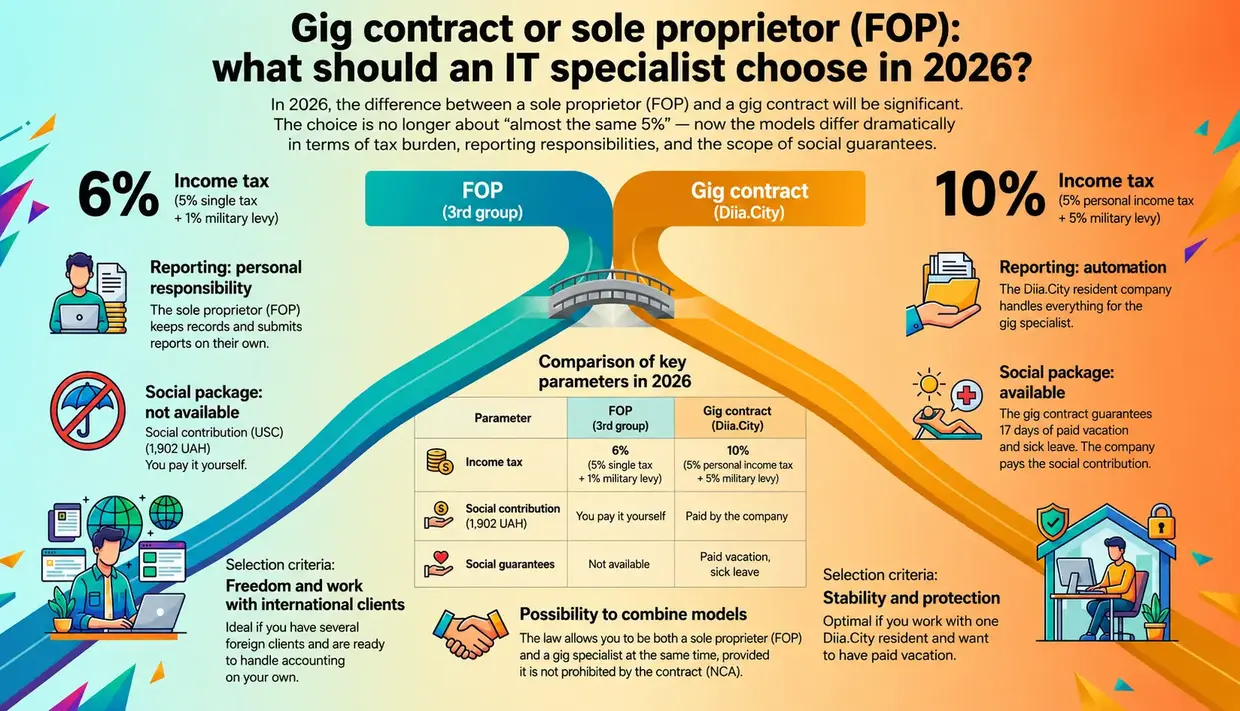
Group 3 sole proprietor: 5% single tax + 1% military levy = 6% of income (plus fixed unified social contribution).
Gig contract: 5% income tax + 5% military levy = 10% of income (plus unified social contribution).
| Parameter | Group 3 sole proprietor | Gig contract (Diia.City) |
|---|---|---|
| Income tax | 5% single tax + 1% military levy = 6% | 5% personal income tax + 5% military levy = 10% |
| Unified social contribution | UAH 1,902.34/month - you pay it yourself | 22% of the minimum wage (UAH 1,902.34) - paid by the company |
| Who calculates and reports | The sole proprietor does this independently | The company (tax agent) |
| Social guarantees | None | Vacation, sick leave, maternity leave, insurance record |
| Clients | Any clients, including foreign clients | Cooperation under a gig contract with a Diia.City resident |
*The unified social contribution amounts are stated for 2026 (linked to the minimum wage).
Important: do not draw a conclusion based only on the rate. Taxes are only one part of the choice. There is also reporting, social guarantees, pension insurance record, and risks - and this is where a gig contract starts to look different for some IT specialists.
Who calculates and reports: the sole proprietor or the company
Here, the advantage is on the side of the gig contract.
A sole proprietor does everything independently: registration, choosing KVED business activity codes, quarterly reports, paying taxes on time, and tracking income limits. If you make a mistake or miss a deadline, the fine is yours.
Under a gig contract, the tax agent is the Diia.City resident company: it calculates, withholds, and pays taxes for you, while you do not file any reports. For many people, this is worth the additional percentage points.
What Diia.City is and how a company can become a resident - we covered this in a separate article about Diia.City taxation.
Social guarantees and pension insurance record
A sole proprietor is responsible for their own vacation and sick leave: if you do not work, you do not earn. The law does not guarantee any paid days off for a sole proprietor.
A gig contract provides what a sole proprietor does not have:
- a paid break (similar to vacation) - at least 17 working days per year;
- sick leave;
- support related to pregnancy and childbirth;
- pension insurance record - it is formed through the payment of the unified social contribution.
This is the “golden mean” between freelance freedom and employment protection. We covered the details of a gig contract (contract form, NDA/NCA, liability) in a separate article about gig contracts.
The scope of guarantees under a gig contract differs from classic employment relations and is determined by the Law on Diia.City and the terms of the specific contract.
A nuance about insurance record: pension insurance record is formed by paying the unified social contribution - and this also applies to a sole proprietor if they pay the contribution for themselves. The difference is that under a gig contract, the company calculates and pays the unified social contribution for you, while a sole proprietor must do this independently and on time.
Risks and nuances: they differ for sole proprietors and gig contracts
Each format has its own “pitfalls.”
Neither format is universally better: it is important to understand your risks and choose the work model that fits your specific situation.
Who each option suits: sole proprietor or gig contract
The choice does not depend only on taxes. It is important to consider who you work with, how important social guarantees are to you, and whether you are ready to handle reporting on your own.
In short: sole proprietor status is usually chosen by specialists with several clients and more work freedom, while a gig contract is chosen by those who work with a Diia.City resident and want to hand over tax and HR matters to the company.
Not sure what is more profitable for you - a gig contract or sole proprietor status?
We will calculate the tax burden for both models and help you understand which option is more profitable in your specific situation.
Can you combine a gig contract and sole proprietor status?
Yes - the law does not prohibit this. You can be registered as a sole proprietor and work as a gig specialist at the same time: this opens up more opportunities for additional income.
But there are two conditions: if this is not restricted by your gig contract and does not create a conflict of interest (for example, you do not provide services as a sole proprietor to a competitor of the resident with whom you signed an NCA).
Common mistakes when choosing between sole proprietor status and a gig contract
- Choosing only by the tax rate. The difference between 6% for a sole proprietor and 10% under a gig contract is important, but it is not the only criterion. You should consider reporting, social guarantees, pension insurance record, audit risks, and how much time you are ready to spend on accounting.
- Thinking that a gig contract is a regular employment contract. A gig contract provides basic guarantees, but it is not classic employment under the Ukrainian Labor Code. Before signing, you should carefully review the working conditions, liability, NDA, NCA, and the contract termination procedure.
- Working as a sole proprietor while actually being an employee of one client. If a sole proprietor has one client, works according to a schedule, and effectively performs the role of an in-house specialist, this may raise questions about hidden employment relations. Especially if the client is a Diia.City resident, for whom a gig contract may be a more transparent model.
- Ignoring restrictions in a gig contract. An NCA, NDA, or conflict-of-interest clauses may restrict additional projects, work with competitors, or the use of your own developments after cooperation ends. It is better to agree on these terms before signing.
- Not calculating the full cost of the model. For a sole proprietor, this is not only 6% in taxes, but also independent accounting, reporting deadlines, income limits, and responsibility for mistakes. For a gig contract, it is a higher rate, but less routine and more guarantees.
Frequently Asked Questions (FAQ)
What is more tax-efficient - a gig contract or sole proprietor status?
By rate, a Group 3 sole proprietor is cheaper: 6% (5% single tax + 1% military levy) versus 10% under a gig contract (5% personal income tax + 5% military levy). But “cheaper” does not always mean “more profitable”: under a gig contract, you receive guarantees and do not keep records yourself.
Is it true that both have the same 5%?
No, this is a myth. For a Group 3 sole proprietor, the income tax burden is 6%; under a gig contract, it is 10%. Only the personal income tax/single tax rate is the same (5%), while the military levy differs: 1% for a sole proprietor and 5% under a gig contract.
Can a gig specialist work with foreign clients?
Yes, they can. The status of a gig specialist itself does not prohibit receiving income from other clients or carrying out additional activities. But you need to check the terms of the specific gig contract: it may include provisions on non-compete (NCA), conflict of interest, or other restrictions on cooperation with third parties. If you also work as a sole proprietor with foreign clients, you should make sure that this activity does not violate the terms of your agreement with the Diia.City resident.
Who pays taxes under a gig contract?
The Diia.City resident company acts as a tax agent: it calculates, withholds, and pays taxes and the unified social contribution, while the gig specialist does not file reports.
What social guarantees does a gig contract provide?
A paid break of at least 17 working days per year, sick leave, support related to pregnancy and childbirth, and a pension insurance record through the payment of the unified social contribution.
Does sole proprietor status provide a pension insurance record?
Yes, if the sole proprietor pays the unified social contribution for themselves. The difference from a gig contract is that a sole proprietor does this independently, while the company pays the unified social contribution for a gig specialist.
Can you be a sole proprietor and a gig specialist at the same time?
Yes, the law does not prohibit this - provided that it is not restricted by your gig contract and does not create a conflict of interest.
Who is sole proprietor status suitable for, and who is a gig contract suitable for?
Sole proprietor status is suitable if you have several clients, foreign clients, and are ready to keep records yourself. A gig contract is suitable if you work with one Diia.City resident, want guarantees and a pension insurance record, and do not want to deal with reports.
Conclusion
“The same 5%” is a myth about “the same benefit.” The real choice is not about the rate, but about what matters more to you: paying less and being your own accountant as a sole proprietor - or receiving guarantees and handing all routine tasks over to the company under a gig contract.
If you have several clients and foreign clients, sole proprietor status is usually more convenient. If you work with one Diia.City resident and value social protection, a gig contract is the better fit. And if you are not sure which option is more profitable for your specific situation, it is better to calculate both before signing a contract or registering as a sole proprietor. If you are choosing between sole proprietor groups, we separately compared Groups 2 and 3.
Do you work in IT and choose between a gig contract and sole proprietor status?
We will review your situation, calculate both options, and help you set everything up correctly. buh.ua has many clients under the Diia.City regime - this is one of our areas of specialization.