


Cryptocurrency Taxes in Ukraine in 2026: How Much to Pay and What Draft Law No. 10225-d Proposes


Cryptocurrency taxes in Ukraine remain one of the most confusing topics. Thousands of Ukrainians trade, invest or receive payments in cryptocurrency but do not understand when a tax liability arises or how to declare the income correctly.
In this article, we explain in simple terms whether cryptocurrency taxes must be paid today, which rates apply, what draft law No. 10225-д proposes, whether cryptocurrency activities are permitted under the single tax system and how to declare income without creating problems with the tax authorities.
Do you currently have to pay cryptocurrency taxes in Ukraine?
Yes. Even though there is no specific law yet, income from the sale of cryptocurrency is already taxable under the general provisions of the Tax Code.
Here is the reasoning. The Verkhovna Rada adopted the Law of Ukraine “On Virtual Assets” (No. 2074-IX) in 2022, and the President signed it. However, this law has still not entered into force: under its final provisions, it will take effect only together with the relevant tax amendments to the Tax Code. This is why a separate legal status and special rules for cryptocurrency do not yet apply.
Since virtual assets do not yet have a clearly defined legal status, the tax authorities apply the general rules. Under the current position of the State Tax Service of Ukraine, the total annual taxable income includes the amount of money received by an individual from the sale of cryptocurrency.
Such income is subject to 18% personal income tax and a 5% military levy, while the specific moment when the income arises and the method used to determine it depend on the circumstances of the transaction and the available documents.
This is an important practical difference from the future tax regime: under the current approach of the State Tax Service, the entire amount of money received from the sale of cryptocurrency is taxable. There is currently no special mechanism that would allow only the net profit to be taxed after deducting the acquisition cost. The income must be declared independently.
What draft law No. 10225-д provides for cryptocurrency taxation
To regulate the market, the Verkhovna Rada is considering draft law No. 10225-д on the taxation of virtual asset transactions. It was adopted as a basis at the first reading on 3 September 2025 and is currently being prepared for the second reading. This means it is still a draft law, not legislation currently in force, and its final provisions may change.
While the general tax rules currently apply, draft law No. 10225-д is intended to introduce a separate taxation regime for virtual assets for the first time. This is why it has attracted so much attention.
The current version of the draft law provides for the following key rules:
- Tax only on profit. Tax would apply not to the entire sale amount but to the difference between the income received and the documented cost of acquiring the asset.
- A rate of 18% + 5%. The basic rate would be 18% personal income tax and a 5% military levy on the profit.
- Tax only when converting into fiat currency. Under the draft law, a tax liability would arise only when cryptocurrency is converted into hryvnias or foreign currency or exchanged for goods and services. Exchanging one cryptocurrency for another, such as Bitcoin for USDT, would not be taxable.
- An exemption for small amounts. Income from sales within the amount of one minimum monthly wage per year would not be taxable.
- A transitional regime for previously acquired assets. For virtual assets acquired before the law enters into force, the draft provides for separate preferential rules, including a reduced tax rate. The final conditions, rate and documentation requirements may change during preparation for the second reading.
As we can see, the logic of the draft law differs significantly from the current approach of the State Tax Service. However, until the document enters into force, the current rules must continue to be followed.
Can a sole proprietor under the single tax system work with cryptocurrency?
Many people think: “I will register as a sole proprietor (FOP) under the single tax system and pay 5% on cryptocurrency income.” Caution is required here because two different situations must be clearly distinguished.
A single tax payer must accept payment for goods, work and services only in monetary form (paragraph 291.6 of the Tax Code). Therefore, receiving cryptocurrency from a client as payment for business activities may be treated as a non-monetary or barter transaction and a violation of the simplified taxation system.
At the same time, FOP status does not deprive a person of the right to own cryptocurrency as an individual. Income from the sale of personal crypto assets should be kept separate from business activities and declared under the rules applicable to individuals.
However, if a single tax payer has accepted payment in cryptocurrency, the consequences may be as follows: income received using a non-monetary form of payment may be subject to a single tax rate of 15% (paragraph 293.4 of the Tax Code of Ukraine), and the FOP must switch to the general taxation system within the period prescribed by the Tax Code. Draft law No. 10225-д explicitly establishes this prohibition for single tax payers, while professional virtual asset service providers will be permitted to operate only under the general taxation system.
How to declare cryptocurrency income
Since cryptocurrency income is declared by an individual, this is done through the annual tax return on property and income. The procedure is as follows:
- file the tax return by 1 May of the year following the reporting year;
- pay the tax (personal income tax and military levy) by 1 August of the same year.
If the deadline falls on a weekend or public holiday, the rules for moving it to the next working day apply.
The tax return must include income from the sale of cryptocurrency. To be able to deduct expenses from the taxable base in the future, once the new law enters into force, you should already retain documents confirming the acquisition of assets: exchange statements, transaction histories and bank confirmations. Without them, it will be difficult to prove the amount of your expenses.
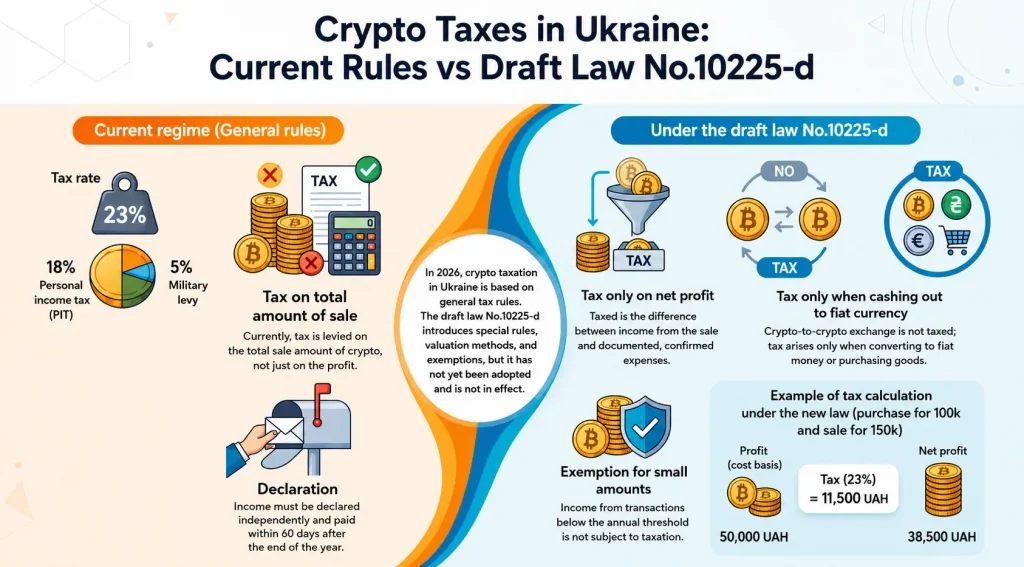
Example of tax calculation under draft law No. 10225-д
Let us consider a simple example under the rules of the future law (draft law No. 10225-д), where tax is calculated on profit.
Suppose you bought cryptocurrency for UAH 100,000, later sold it for UAH 150,000 and withdrew the funds in hryvnias.
| Indicator | Amount |
|---|---|
| Income from the sale | UAH 150,000 |
| Acquisition costs | UAH 100,000 |
| Profit (taxable base) | UAH 50,000 |
| Tax (18% personal income tax + 5% military levy = 23%) | UAH 11,500 |
This means that tax on a profit of UAH 50,000 would amount to UAH 11,500, leaving UAH 38,500 after tax.
*This is an illustrative calculation based on the version of the draft law adopted at the first reading. Until the law enters into force, this procedure does not apply: the general rules remain in effect, under which the deduction of expenses is not guaranteed, so the taxable base may be higher.
Planning to withdraw cryptocurrency and not sure how to declare the income?
The buh.ua team will help you establish a legal framework, comply with financial monitoring requirements and prepare your tax reporting while reducing tax and banking risks.
Risks and common mistakes when dealing with cryptocurrency
- Failing to declare income. Bank transfers and P2P transactions leave a trace. If the tax authorities identify undeclared income, you may face additional tax assessments, penalties and late-payment interest.
- Accepting cryptocurrency through a FOP under the single tax system. This may result in the loss of simplified taxation status and taxation at a rate of 15%.
- Ignoring financial monitoring requirements. Large or regular P2P transfers may attract the bank's attention. For more details, see our article on financial monitoring for FOPs and freelancers.
- Failing to retain acquisition documents. Without them, you will be unable to confirm your expenses and reduce the taxable base when this becomes possible.
- Relying on advice from Telegram or YouTube instead of current legislation. There is a great deal of outdated cryptocurrency advice that no longer reflects the position of the State Tax Service or the wording of the draft law.
Frequently Asked Questions (FAQ)
Is cryptocurrency legal in Ukraine?
Cryptocurrency transactions are not prohibited, but cryptocurrency does not yet have a clearly defined legal status. The Law “On Virtual Assets” has been adopted but will not enter into force until the relevant tax amendments are adopted. Cryptocurrency may therefore be used, but specific regulation is not yet in place.
Do I have to pay tax if my cryptocurrency is simply held on an exchange?
No. Simply owning cryptocurrency does not create a tax liability. What matters is whether income is received from cryptocurrency transactions and which taxation rules currently apply.
How much tax must currently be paid on cryptocurrency?
Income from the sale of cryptocurrency is currently taxed under the general rules at 18% personal income tax and a 5% military levy, for a total of 23%. The income must be declared independently.
Can a FOP under the simplified taxation system work with cryptocurrency?
It is risky for a single tax payer to use cryptocurrency in business activities, particularly by accepting it as payment for goods or services. This may be treated as a non-monetary form of payment and lead to the loss of simplified taxation status. At the same time, an entrepreneur acting as an ordinary individual may own cryptocurrency and declare income from the sale of personal assets under the rules applicable to individuals.
Do I have to pay tax when exchanging one cryptocurrency for another?
Under draft law No. 10225-д, exchanging one virtual asset for another, such as Bitcoin for USDT, would not be taxable - tax would arise only when converting into fiat currency. However, this is a proposed rule. Until the law is adopted, the status of such transactions remains unregulated, so professional advice is recommended in complex cases.
When will the new cryptocurrency tax law take effect?
There is no exact date. Draft law No. 10225-д was adopted as a basis on 3 September 2025 and is being prepared for the second reading. The date of its final adoption and signature by the President is not yet known.
How do I declare cryptocurrency income?
Through the annual tax return on property and income: it must be filed by 1 May of the following year, and the tax must be paid by 1 August. The income is declared by the individual, not by the FOP.
Conclusion
Cryptocurrency taxation in Ukraine is undergoing changes. Income from the sale of cryptocurrency must already be declared and taxed under the general rules at 18% personal income tax and a 5% military levy. These rules are expected to be clarified by draft law No. 10225-д, which provides for taxation of profit only, an exemption for crypto-to-crypto exchanges and a preferential transitional regime. However, until the law is finally adopted, the current rules should be followed.
The key point is to declare your income and retain documents relating to your transactions. This provides legal protection and may also allow you to benefit from future tax relief.
*The information is current as of the publication date. The taxation of virtual assets is expected to be regulated by draft law No. 10225-д, which, as of mid-2026, has been adopted only at the first reading. The final rates and rules may change during the second reading - follow the latest updates.
Need to declare cryptocurrency income?
The buh.ua team will help determine the taxable base, prepare the tax return and collect the documents required by the bank and tax authorities.