

Sole Proprietor and Foreign Currency Income: How to Calculate Income in Dollars and Avoid Overpaying Taxes


Do you receive payments in foreign currency as a sole proprietor (FOP)? Then you already know that along with dollars and euros come dozens of questions: how should these funds be recorded? Which exchange rate should be used to calculate income – the NBU rate or the bank’s rate? Does exchange rate fluctuation affect taxes when the dollar rises and falls? What should you do if the currency was credited today but sold a week later? Is it even allowed to receive foreign currency to a personal card?
The exchange rate can fluctuate by one or two hryvnias daily, and the difference between “selling today” or “waiting” can amount to thousands of hryvnias. The key is to understand exactly how this difference affects your income and taxes. Spoiler: often not the way FOPs think.
In this article, we explain: the main rules for working with foreign currency as a FOP, how foreign currency income is calculated and at which exchange rate, what to do when dollars or euros are credited to your account, how exchange rate differences affect taxes, when it is выгодно to sell currency, and how to properly report foreign currency income.
Main Rules for Working with Foreign Currency as a FOP
Before diving into exchange rates, calculations, and tax returns, you need to understand the basic rules. If you violate them, even the most accurate calculations will not save you from tax issues.
- Foreign clients - what sole proprietors need to know
Working with non-residents depends not only on the single tax group, but also on the type of business activity. Group 3 sole proprietors can work with foreign clients without restrictions and receive payments in foreign currency.
The rules are different for Group 2 sole proprietors. Selling goods to non-residents, including exports, is allowed if the relevant KVED codes are in place. At the same time, providing services to foreign companies or individuals may create risks for staying on the simplified tax system.
Group 1 works only within Ukraine (retail sales at markets and household services to individuals).
Therefore, before starting to work with foreign clients, it is worth checking whether your business model meets the requirements of the selected single tax group.
- FOP income may only be received to a business account
Not to a personal card, not to your wife’s, husband’s or mother’s card, not through Privat24 to a personal account - only to the sole proprietor’s business account. If business income regularly comes into a personal account, this may raise questions during a tax audit and create additional tax risks. Even if you later declare this income and pay taxes, you may be fined for violating accounting procedures.
Important: A FOP may have an unlimited number of accounts in different banks. If you receive USD/EUR, you need a foreign currency or multi-currency FOP account.
- Working with foreign companies is foreign economic activity
All foreign currency settlements must be conducted exclusively through bank accounts – no cash transactions in foreign currency. A foreign economic contract is mandatory. This is not just a formality – it is your protection. The contract must clearly specify: what services you provide, how much the client pays, in which currency, the payment procedure, and the deadlines.
A public offer + invoice are considered equivalent to a foreign economic contract if the invoice contains a clause stating that payment confirms completion of the services.
If you are currently on Group 2 and receive payments from non-residents, you should urgently review your business model. In such cases, we recommend switching to Group 3 FOP or restructuring your business.
How Foreign Currency Income Is Calculated: NBU Rate on the Date of Receipt
Now let’s move to the most important question: how should you correctly calculate income when dollars or euros are credited to your account?
Example: On November 15, you received 1,000 USD. The NBU exchange rate on that day was 41.80 UAH. For tax purposes, you earned 41,800 UAH. This amount is included in your turnover. Taxes are calculated from this amount: 5% single tax, 1% military levy, plus 1,902.34 UAH of social contribution (fixed monthly amount). It does not matter if you later sold these dollars at 42 UAH or 41 UAH. It does not matter if the bank charged a commission and you actually received slightly less. For the tax authorities, income equals 1,000 USD multiplied by the NBU rate on the date of receipt.
The NBU exchange rate is valid from 00:00 of the respective day and is published on the official National Bank website in the “Official Hryvnia Exchange Rate” section.
Exchange Rate Differences Do Not Affect FOP Taxes
This is one of the biggest myths about foreign currency income for FOPs. Many people think that if the dollar rises, they must pay additional taxes, and if it falls, they can reduce their income. In reality – no. Exchange rate differences do not affect your taxable income.
An exchange rate difference is simply the difference between the NBU rate on the date the currency was credited to your account and the rate at which you sold it. However, for tax purposes, only one moment matters: FOP income is fixed in hryvnias at the NBU rate on the date of receipt. Everything that happens afterward does NOT affect taxes.
Bank Commission Does Not Reduce the Tax Base
This is one of the most common mistakes FOPs make when working with foreign currency. Many think: “If the bank withheld a commission, I received less, so I can pay taxes on a smaller amount.” Unfortunately, it does not work that way.
For tax purposes, income is the full amount sent by the foreign client - before deducting the bank’s commission.
Why? Because the bank commission is your business expense, not a reduction of income. Group 3 FOPs under the simplified taxation system pay single tax on gross income without deducting expenses. Therefore, even if you have many expenses - office rent, employee salaries, bank fees, equipment purchases - they do not reduce your tax base. You pay single tax on the total amount credited to your account.
The only exception is the refund of previously paid funds. Such refunds are not taxable because they are not new money - they are your own funds that “went out and came back.” However, it is important: without supporting documents (contract, invoice, payment confirmations, correspondence), the tax authorities will treat it as income and assess taxes.
Example of Income and Tax Calculation
Let’s review a complete example with numbers:
On November 10, 2025, 2,000 USD was credited to the FOP foreign currency account for services rendered.
The official NBU rate on that date was 41.50 UAH/USD.
Income in hryvnias = 2,000 × 41.50 = 83,000 UAH. This is the amount you include in your Q4 2025 tax declaration.
The tax return must be filed within 40 calendar days after the end of the quarter, and the single tax and military levy must be paid within 10 calendar days after the tax return filing deadline.
Taxes:
* The example shows the rates and amounts current as of 2025. The current amounts of taxes and the single social contribution may differ.
The single tax and military levy must be paid within 10 calendar days after the tax return filing deadline.
It does not matter that the bank withheld a 50 USD commission and only 1,950 USD was actually credited. It does not matter that you sold the dollars a week later at 40.80 and received only 81,600 UAH. For tax purposes, your income is 83,000 UAH, and taxes are 6,740 UAH. This is a strict rule, but that is how the taxation system for foreign currency income works under the simplified regime.
Do you work with foreign clients but are unsure whether your FOP group is suitable?
We will help you switch to Group 3, properly open a foreign currency account, and prepare foreign economic documents without the risk of losing your simplified tax status.
Important Nuance for Legal Entities on the Simplified Tax System
If you are a legal entity under the simplified tax system, there is an important difference. According to the tax authorities, single-tax legal entities must include positive exchange rate differences resulting from the revaluation of foreign currency in their taxable income.
What does this mean in practice? If your LLC under the simplified tax system received 2,000 USD at an exchange rate of 41.50 - it recorded income of 83,000 UAH. Later, it sold the dollars at a rate of 42.50 and received 85,000 UAH. The positive exchange rate difference of 2,000 UAH must be included in taxable income. As a result, total income will be 85,000 UAH, and taxes are calculated from 85,000 UAH.
And what if the exchange rate decreased and the company incurred a loss on the difference? A negative value does not reduce the tax base. That means the system is asymmetric for legal entities: gains are counted, losses are not. This is rather unfair, and many lawyers consider the tax authority’s position controversial. However, for now, the tax authorities insist on this approach for legal entities.
What to Do When Foreign Currency Is Credited to Your Account: Step-by-Step Guide
Now let’s review the specific actions you should take when you see that payment from a foreign client has been credited to your foreign currency account. It is not just “money received – everything is fine.” There are several important steps you should take immediately to avoid issues with accounting and reporting later.
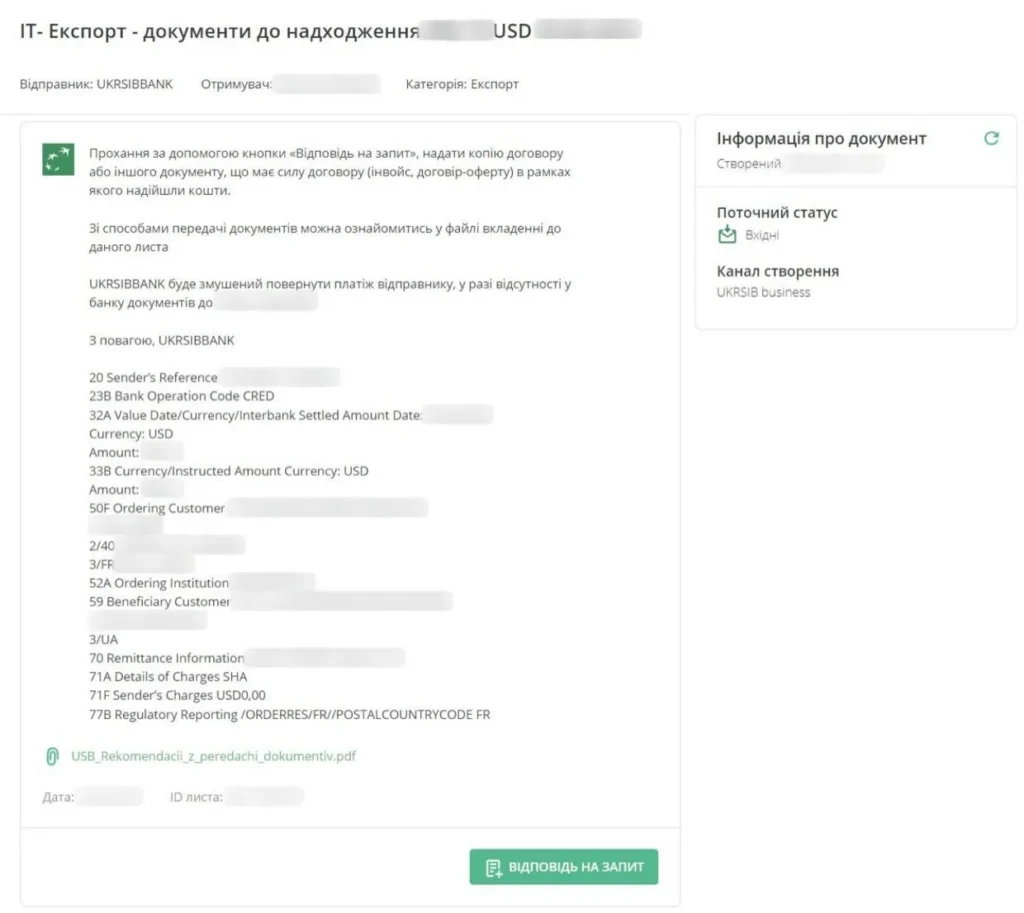
Step 1: Check the Bank Statement
Immediately after receiving the funds, check:
- the transfer amount - whether it matches the invoice/contract;
- the bank commission - how much was withheld (sometimes 2–3 commissions are charged);
- the sender’s details - it is important that this is indeed your client;
- the payment reference - it must clearly state the invoice number, contract number, period, and services.
If the payment reference is “empty” or something general like payment, it is advisable to ask the client to clarify it or provide an explanatory letter. This will protect you during an audit.
Step 2: Record the Date of Receipt
This is a critically important point. The date the funds are credited to your account is the moment when income arises for tax purposes. You must use the exchange rate of that specific day to calculate your income in hryvnias. Not the date when the client sent the payment. Not the date when you issued the invoice. Not the date when you completed the work. But the date when the currency actually appeared in your bank account. The NBU exchange rate on that date must be used.
Step 3: Apply the NBU Exchange Rate on the Date of Receipt
Once you have recorded the date of receipt, the next step is to visit the official National Bank of Ukraine website and check the exchange rate for that date. There is a convenient calendar where you can select any date and see the exchange rate for the dollar, euro, and other currencies on that day. Once you find the rate for your date, record it.
Do not confuse the NBU rate with the bank’s rate! When you sell currency through your bank, the bank will offer its own rate - usually slightly lower than the NBU rate. This is normal, as banks earn on exchange rate differences. However, for calculating taxable income, you must use only the NBU rate on the date the currency was credited to your account, not the rate at which you later sold it.
If funds from a foreign client were first credited not to your FOP account in a Ukrainian bank but to an international payment service - Payoneer, Wise, Paypal - income is considered received on the day the currency was credited to that account. You must convert the amount using the NBU rate on that date. The service commission is not deducted - you include the full amount sent by the client in your income.
In its clarifications, the Tax Service has expressed the position that income may arise at the moment funds are credited to Payoneer or Wise accounts. At the same time, the practical application of these rules has its nuances, so in complex situations it is worth getting individual advice.
If you receive regular payments from one client – for example, a monthly subscription fee – each payment is calculated separately at the exchange rate on the date it is received. You cannot use some average rate for the month or quarter. Each payment is a separate transaction with the rate on a specific date.
When It Is выгодно to Sell Currency: Practical Advice from Accountants
Now you understand how income is calculated and that exchange rate differences do not affect taxes. But the logical question is: when is it better to sell currency so you don’t lose money on the rate? Here are tips that actually work.
- Monitor the exchange rate regularly, not just once a month
Check not only the official NBU rate, but also the interbank rate and what different banks offer for conversion. Also follow economic forecasts and news. There are free Telegram channels and apps that track the dollar rate in real time and send notifications when the rate changes.
- Do not rush to sell if there is no urgent need
If you see that the rate is falling and you do not urgently need hryvnias – keep the money in currency and wait for a more stable situation.
- Use bank “features”: auto-sale at your desired rate
Some banks and financial platforms allow you to set a desired currency sale rate. You specify the target rate, and the system automatically converts your currency into hryvnias when the rate reaches that level. This feature is available at PrivatBank, Monobank, PUMB, and some other banks.
- Compare conditions across different banks
Do not automatically sell currency in the same bank where the money was received. Compare conditions in several banks. Also ask your bank manager about special offers. Sometimes banks run promotions for corporate clients or sole proprietors with high turnover – better conversion rates or canceled fees.
How to Properly Report Currency Income
So, you received currency, correctly recorded the income at the NBU rate, waited for a favorable moment, and sold it. What’s next? You need to properly reflect this income in your tax reporting.
Declaration for Group 3 Sole Proprietors: deadlines and rules
Third-group sole proprietors who are permitted to conduct transactions in foreign currency are required to file a tax return quarterly. The return must be filed within 40 days after the end of the reporting quarter. The single tax and military levy must be paid within 10 calendar days after the deadline for filing the tax return.
In the declaration, you indicate all your income for the quarter in hryvnias. If you received currency – each payment is converted at the NBU rate on the date of receipt and then summed up.
Example:
| Date | Amount | NBU Rate | Income in UAH |
|---|---|---|---|
| 10.10 | $2000 | 41,50 | 83 000 |
| 15.11 | $1500 | 41,80 | 62 700 |
| 20.12 | $3000 | 42,00 | 126 000 |
Total income for the quarter: 271 700 UAH.
Manual accounting or automation?
You can track currency income manually. Create a spreadsheet in Excel or Google Sheets where you record the date of each receipt, the amount in currency, the NBU rate for that day, and the hryvnia equivalent. Add a column with the currency sale date and sale rate – for your own control, to see whether you gained or lost on the exchange rate. At the end of the quarter, sum up all hryvnia equivalents and enter the total amount in the declaration.
It sounds simple, but in practice it is easy to make a mistake. And an error in the declaration is already a reason for a tax audit. To avoid calculating everything manually and risking mistakes, there are automated solutions.
If it’s complicated - delegate your accounting to professionals
Our experienced accountants will analyze your business, take all nuances into account, and ensure complete order in your reports and taxes.
What a Sole Proprietor Must Keep
Sole proprietors who work with currency and receive income from foreign clients are under increased attention from the tax authorities. Therefore, your task #1 is to have a complete set of documents confirming the legality of each receipt. You must store them for at least 3 years, and preferably 7 years, because in some cases the tax authorities may conduct a deeper audit. What documents exactly?
- Contracts with foreign clients;
- Bank statements with all incoming payments;
- Invoices and completion certificates;
- Correspondence with clients (if needed to confirm that this is payment for work and not some other funds).
If some of these documents are missing, a situation may arise where the tax authority says: "You declared income of 500 thousand hryvnias, but did not prove that this is income from entrepreneurial activity. Maybe it is a gift, maybe a loan, maybe something else. Prove that this is income." And if you cannot prove it – you may be assessed additional taxes or fined for incorrect declaration.
Conclusion
Working with currency income for sole proprietors is not as complicated as it may seem at first glance, but it requires attention and understanding of the rules. The main thing to remember:
- currency = income in hryvnias at the NBU rate on the date of receipt;
- exchange rate differences do not change taxable income - neither up nor down;
- bank fees do not reduce income;
- documents must be stored for at least 3 years, preferably 7.
If you record each receipt with the correct date and rate, submit declarations on time, and have all supporting documents - tax risks are minimal. Even during an audit, you will be able to easily prove the correctness of your accounting.
Exchange rates constantly fluctuate, so in addition to proper taxation, it is also important to manage the currency itself wisely: monitor the rate, do not rush to sell at an unfavorable moment, use auto-conversion at a target rate, and compare offers from different banks. Even a few cents of difference can turn into thousands of hryvnias in savings.