

Closing a sole proprietorship (FOP) in Ukraine with or without a tax audit: when the tax office checks and how to pass


Most sole proprietors (FOP) in Ukraine put off closing their business not because of the paperwork but out of fear. The tax office will show up with an audit and charge extra tax for every year they worked.
Few people realize that the moratorium on audits ended back on 1 August 2023, and the one in force now explicitly excludes the FOP closure audit from its protection. The advice "wait until the war is over" no longer works. Below we go through the actual rules. Does the tax office have to audit you when you close, how far back can it look, how long does the audit take, what do you file and what happens to a debt.
You can close a FOP in the register without a tax audit - it is not mandatory. But closing does not write off debts and does not take away the tax office's right to audit your business period later.
Is a tax audit mandatory when closing a FOP in Ukraine
No. The law gives the tax office a right, not a duty.
The ground is written directly in the Tax Code of Ukraine. An unscheduled documentary audit is possible if the procedure for terminating a FOP's business activity has started. The rule names sole proprietors separately, not only companies.
But that is only a ground. The decision is made by the head of the tax office and issued as an order. No order, no audit.
There is no deadline for ordering one either. The State Tax Service (STS) admits this in its own guidance. The Code does not set a period within which the audit must be ordered after the termination record. And the registrar will close the FOP regardless. To register the termination you file one application, and asking for anything beyond that is prohibited. The registrar does not ask for a certificate from the tax office or a reconciliation statement.
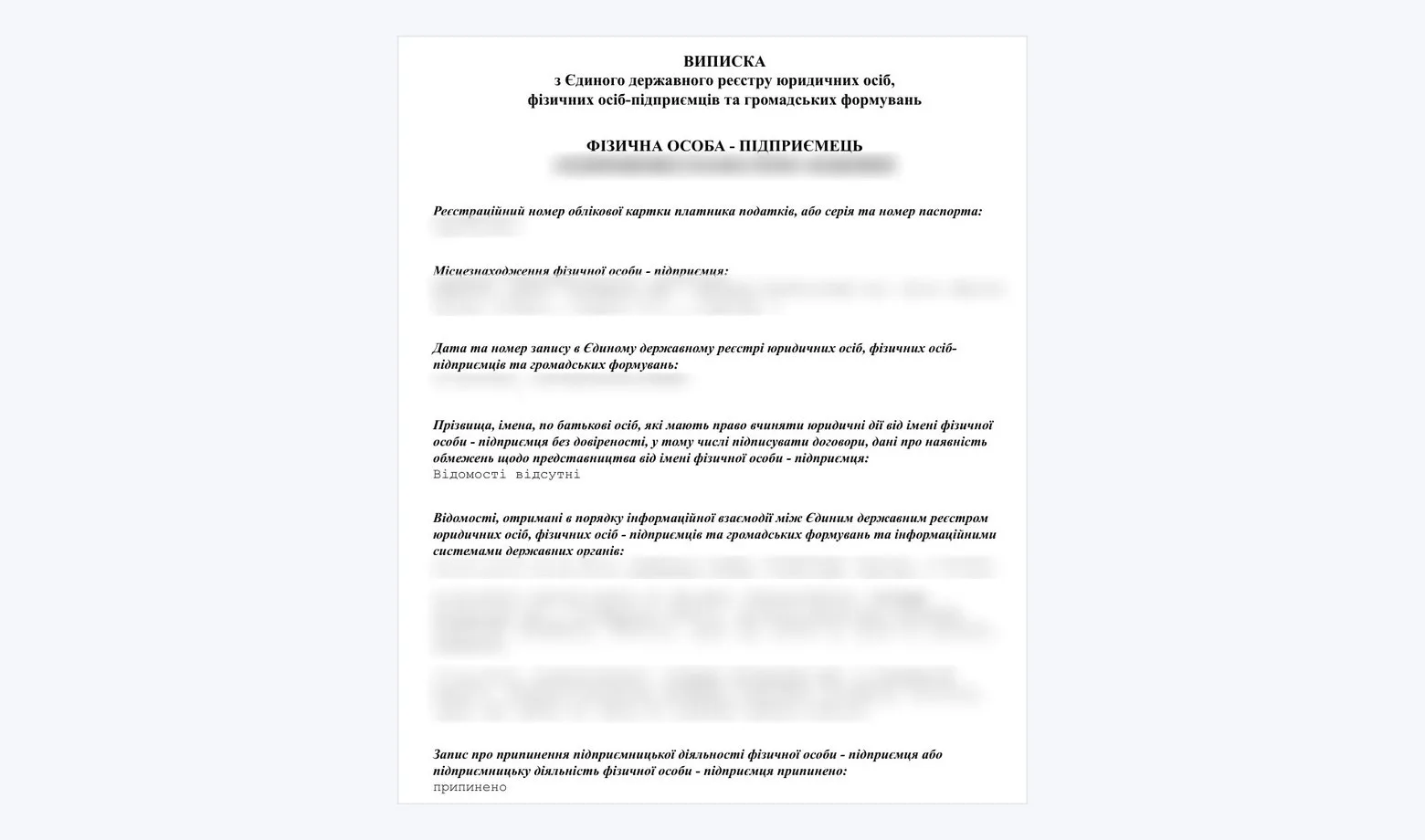
Why the closure record in the USR and deregistration with the tax office are not the same thing
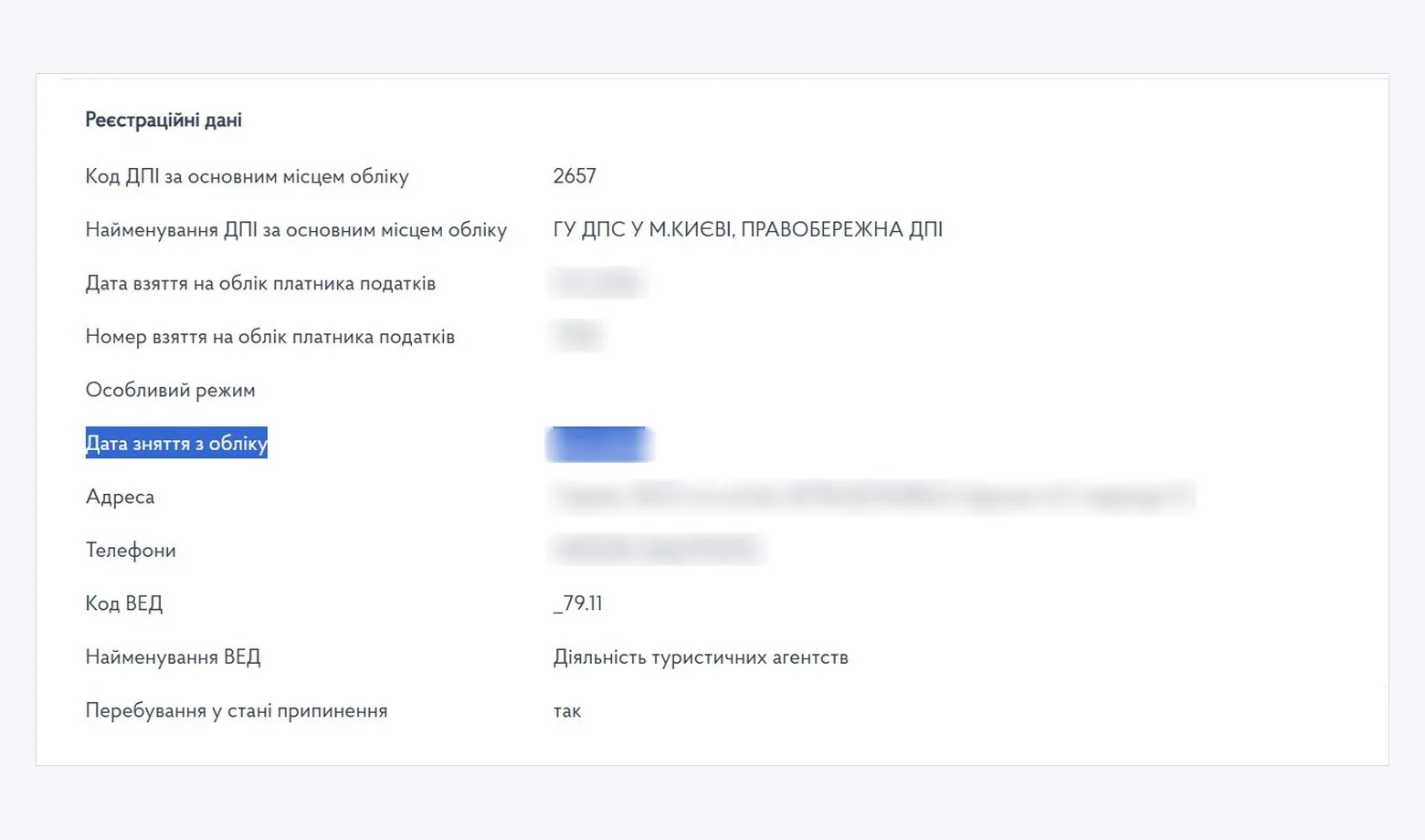
The confusion comes from the fact that you are deregistered twice, under different rules.
The law on the single social contribution does say that a FOP is removed from the register of SSC payers after the audits required by law and the final settlement.
But that is not the same as closing the FOP. You stop being a sole proprietor on the day the record appears in the Unified State Register (USR). As an SSC payer and as a person who still has to settle up with the tax office, you stay on its radar for a while longer. That is what people read as "they wouldn't close me without an audit".
Is the audit moratorium in force in Ukraine in 2026
This is the most common outdated advice online, so let's go through the dates.
| Moratorium | Status in 2026 |
|---|---|
| General wartime moratorium | applied until 1 August 2023, expired |
| Moratorium for single tax Groups 1 and 2 | applied until 1 December 2024, expired |
| Moratorium for occupied and frontline territories | in force, but the FOP closure audit is explicitly excluded from it |
*The rules are given as per the Tax Code of Ukraine in force as of September 2026. The moratoriums have changed several times, so check the current version before you close.
Even while the moratorium for Groups 1 and 2 was in force, audits related to terminating a FOP were carved out of it. In other words, there was never any protection from this particular audit.
The only real limit today is safety. The Code requires safe conditions for inspectors to access premises and documents. If there are none, the audit is suspended by order and resumed later for the unused time.
For an overview of who gets audited and how, see our article on tax audits.
How far back the tax office can check
The basic rule is 1,095 days, or three years. The count starts from the filing deadline for the tax return, or from the day you actually filed it if you filed late.
But "three years" is a simplification, and a dangerous one. This period was suspended twice, for the quarantine and until 1 August 2023. So in practice the tax office can look further back.
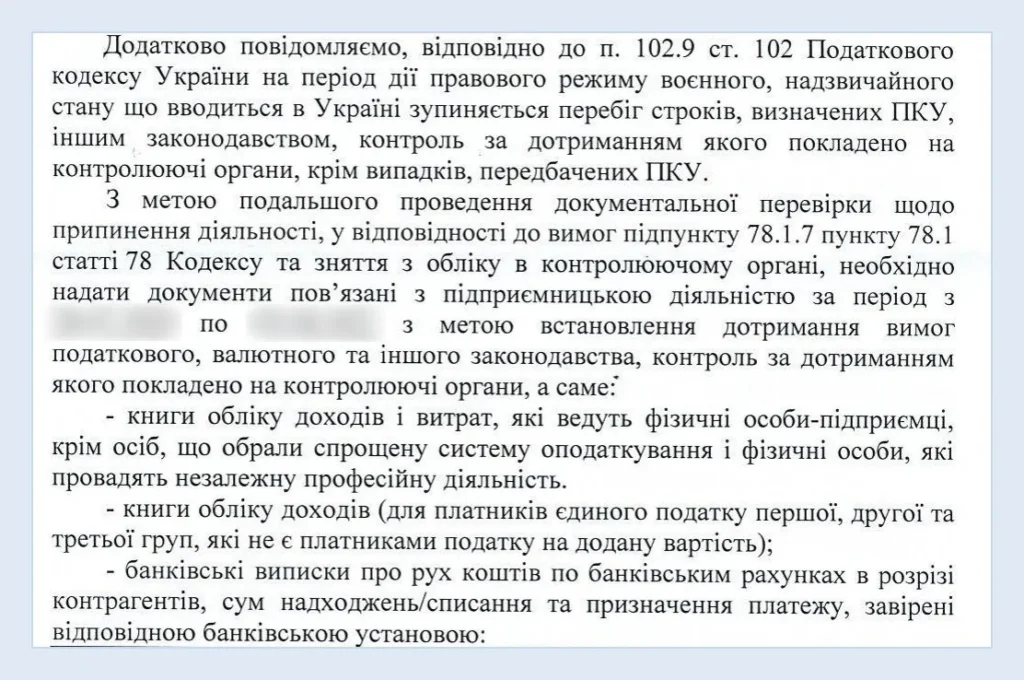
And in one case there is no time limit at all. If no return was filed for a period, the limitation does not apply, and extra tax can be charged for any year.
Seven years (2555 days) apply to transfer pricing and payments to non-residents. That is not about an ordinary FOP.
How long the audit takes when closing a FOP
Shorter than many people think. Thirty days is for scheduled audits of large taxpayers, not for us.
| Who is audited | Duration | Extension |
|---|---|---|
| FOP as a small business entity | 5 working days | up to 2 more working days |
| FOP with no employees, under special conditions | 3 working days | up to 2 more working days |
*The durations are set by paragraph 82.2 of the Tax Code of Ukraine. The shorter period applies if over the last two years the FOP declared no income, was not a VAT payer, had no employees and no open accounts.
There is a terminology catch that almost nobody writes about. The term "small business entity" was defined by the Commercial Code, which ceased to be in force on 28 August 2025. The Tax Code has no definition of its own, so today the five days are more of an established tax office practice than an undisputed rule.
One more detail. If you bring documents less than three working days before the audit ends, it can be extended by another three days.
Closing your FOP and not sure your books are clean?
Our accountants will check your tax returns and payments for recent years, find weak spots before the tax office does, and support you through the audit if one is ordered.
How to close a FOP in Ukraine: what to file and how long it takes
The procedure itself is much simpler than its reputation. For a step-by-step guide with every filing option, see our article on how to close a FOP.
You need one application - Form 1, "Application for state registration of an individual entrepreneur". There is no separate "liquidation" form. The same form covers registration, changes and termination.
You can file it anywhere. FOP registration is not tied to your place of residence, so any state registrar or notary in Ukraine will do.
Or online, with no registrar at all. The Diia portal has an automatic closure service. You sign the application with an electronic signature and it goes to the register without any human involved.
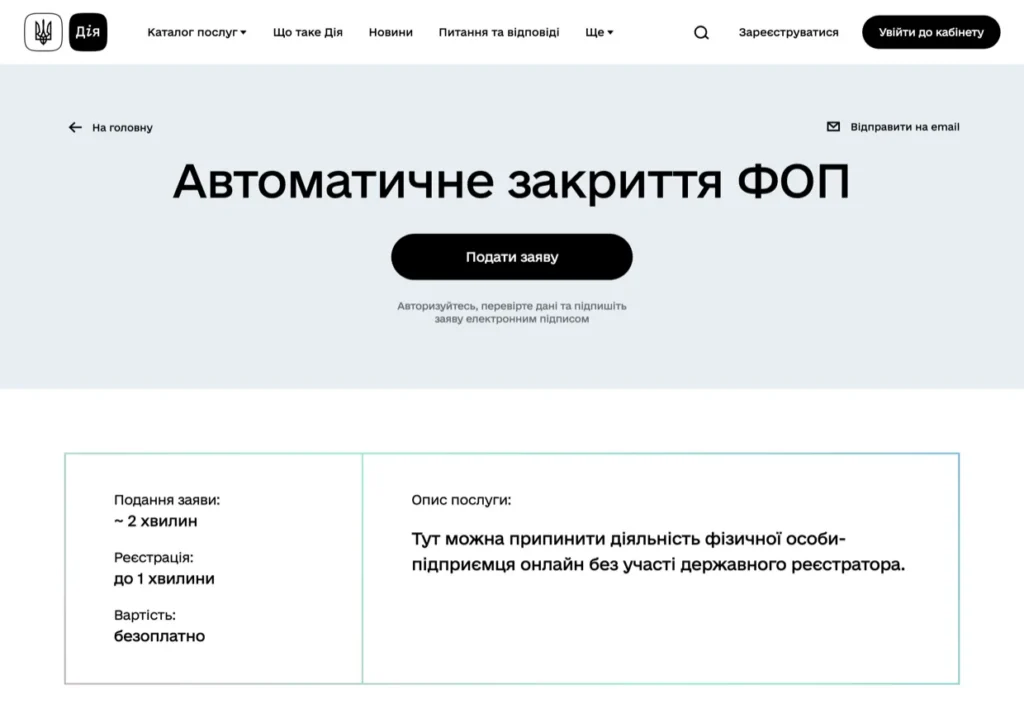
The deadline is 24 hours after the documents are received, not counting weekends and public holidays. Through Diia the record usually appears almost immediately. 24 hours is the legal maximum, not the norm. The law sets no administrative fee for this, so you pay nothing.
Your sole proprietor status ends on the date of the record in the register, not the date you filed the application. This matters when you calculate your last periods.
What reports to file after closing a FOP
This is where people make the most mistakes, and it is the source of fines after closure.
| Tax system | Final report | When to file |
|---|---|---|
| Simplified (Groups 1-3) | single tax return marked as the final period | 40 days after the quarter of closure |
| General | return on property status and income | 20 days after the month of closure |
*For the general system the deadline is set directly by the Code. For the simplified system the forty days are a tax office requirement. By the letter of the Code, Groups 1 and 2 have an annual reporting period, so it is safer to go by the quarterly deadline or file earlier.
An outdated piece of advice people still repeat is "on the general system the return is filed within 30 days after closure". That wording has not applied since 2017. The deadline now runs from the end of the month of closure.
The SSC is not filed as a separate report. The contribution data goes in an annex inside the same return, with the form type "after termination". What the SSC is and how it is calculated is covered in our article on SSC for a FOP.
How to fill in the final return (Group 3): step by step
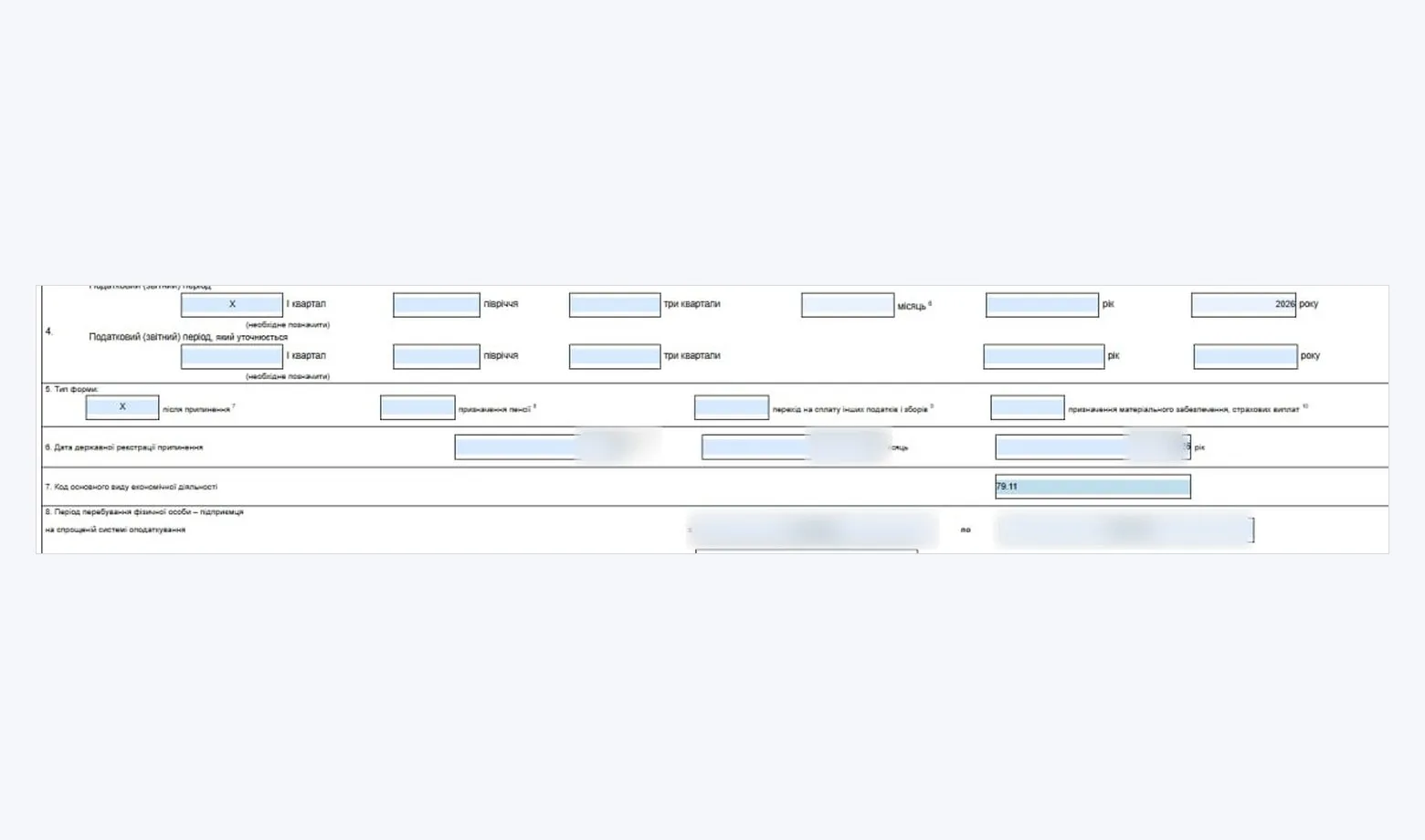
- In the Electronic Cabinet (taxpayer's online account), open "Reporting input" and select the single tax return. The period depends on when you closed. In Q1 choose "Q1", in Q2 "half-year", in Q3 "three quarters", in Q4 "year".
- If you have filed returns before, tick "Fill in based on a report" and the data will be pulled from the previous report.
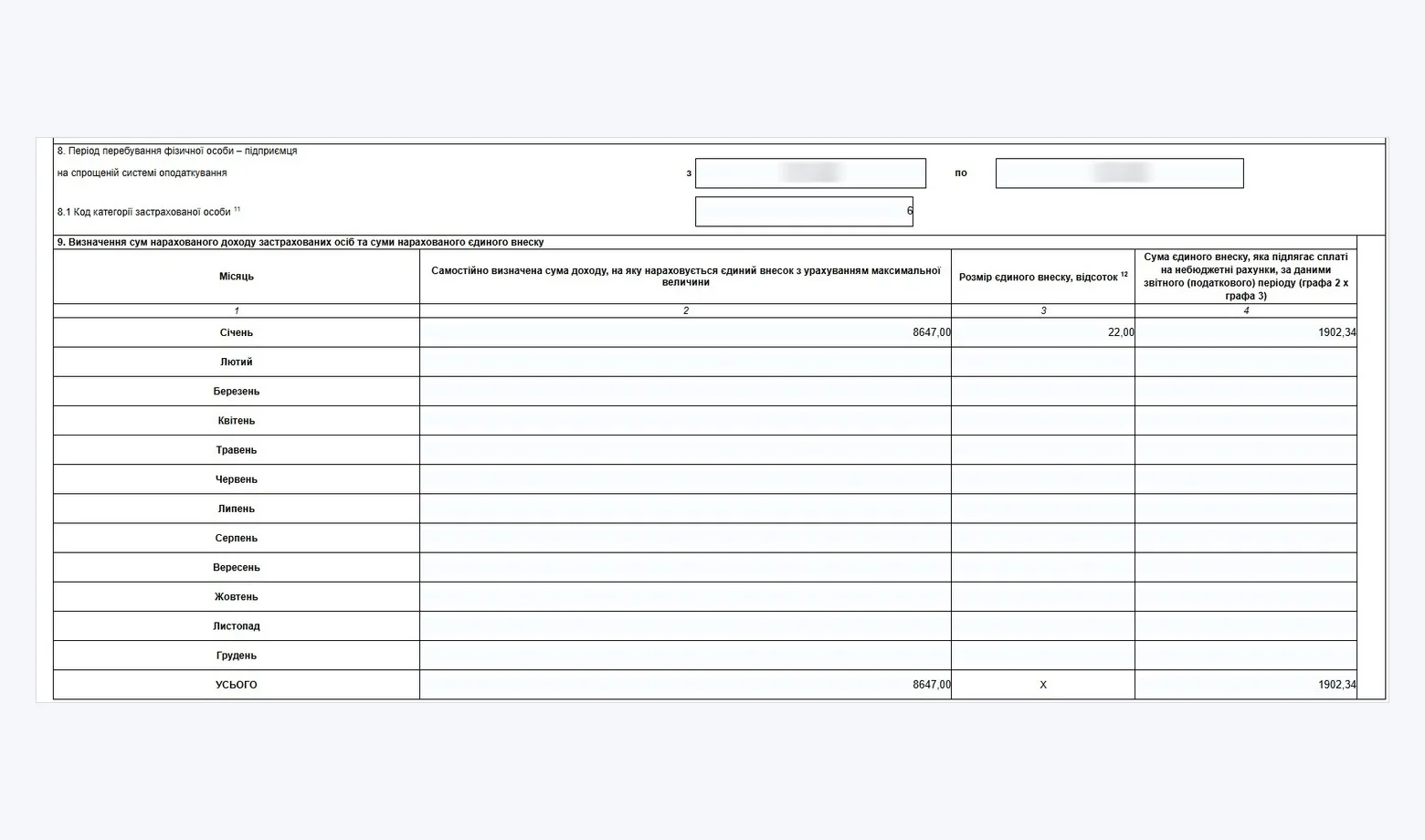
- Select Annex 1 on the SSC right away. It is normally filed once a year, but on closure it must go with the final return.
- In the return itself, tick line 8.1. This marks it as the report for the final period, the one that includes the termination date. At the bottom, mark that Annex 1 is attached to the return.
- In Annex 1, choose the form type "after termination" and enter the termination date. You can see it in the Electronic Cabinet under "Taxpayer registration data".
- The period of activity in Annex 1 always runs from 1 January of the current year to the termination date. The exception is a FOP opened and closed in the same year, where the period starts from the opening date. Fill in SSC amounts only for the months you were a FOP and leave the rest blank.
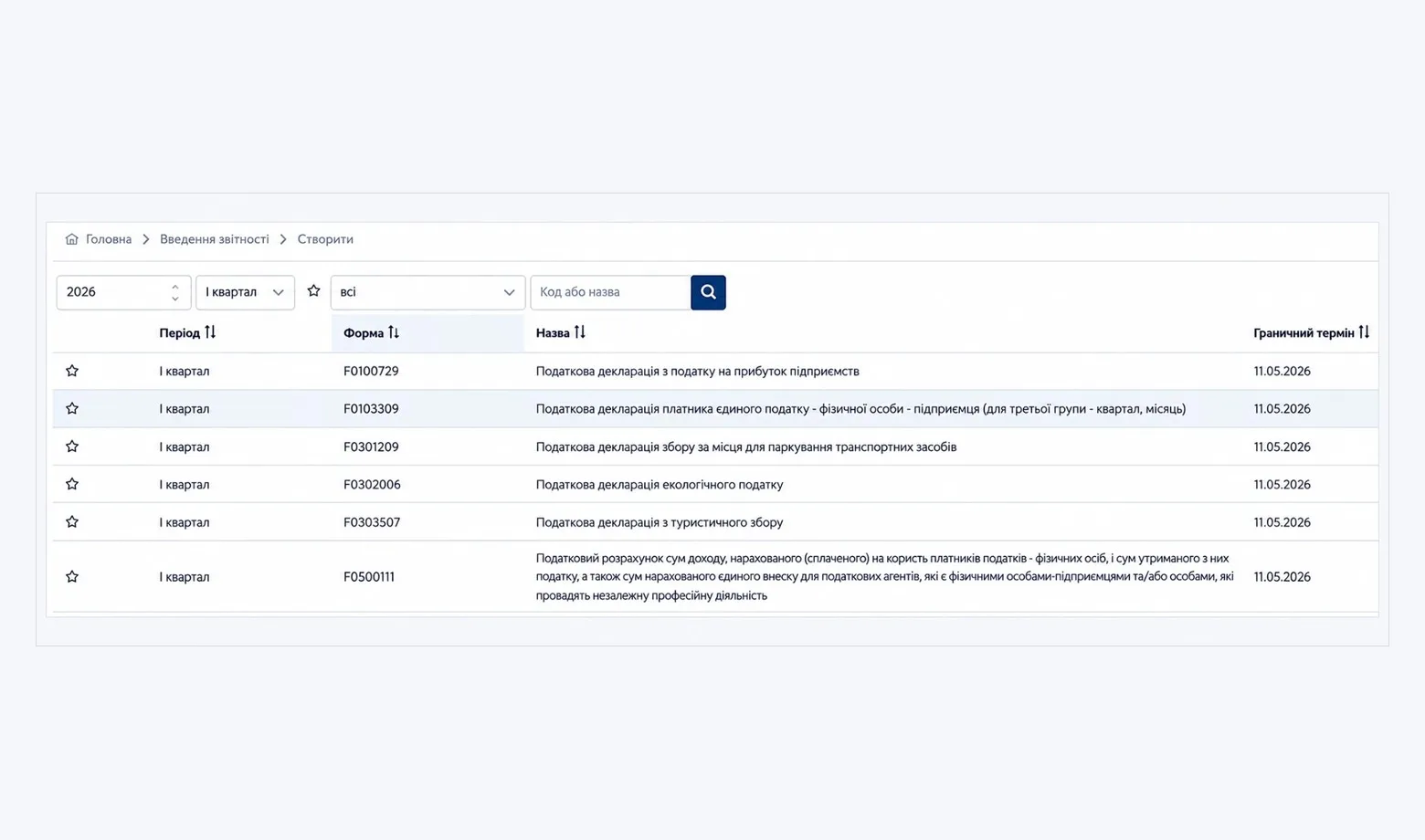
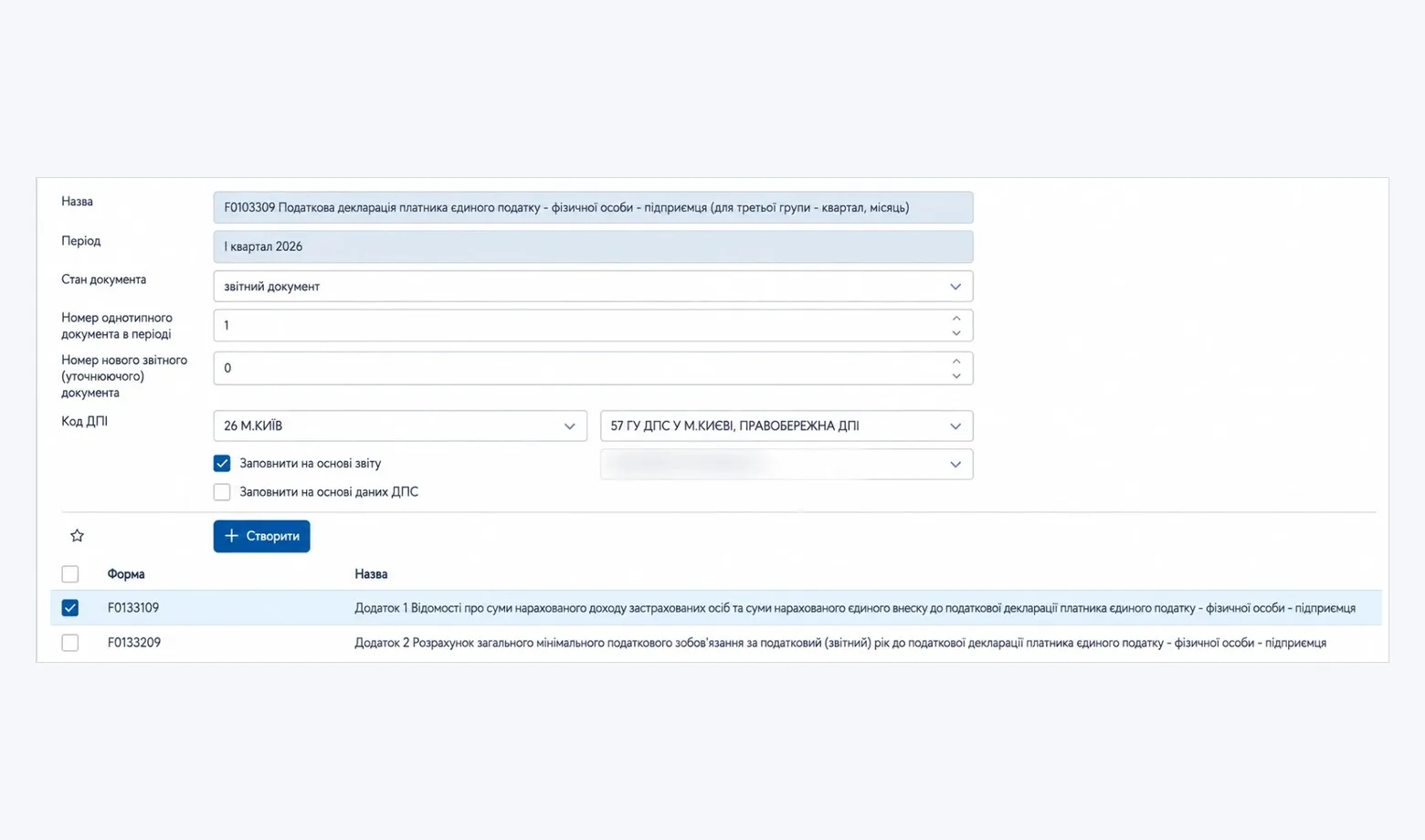
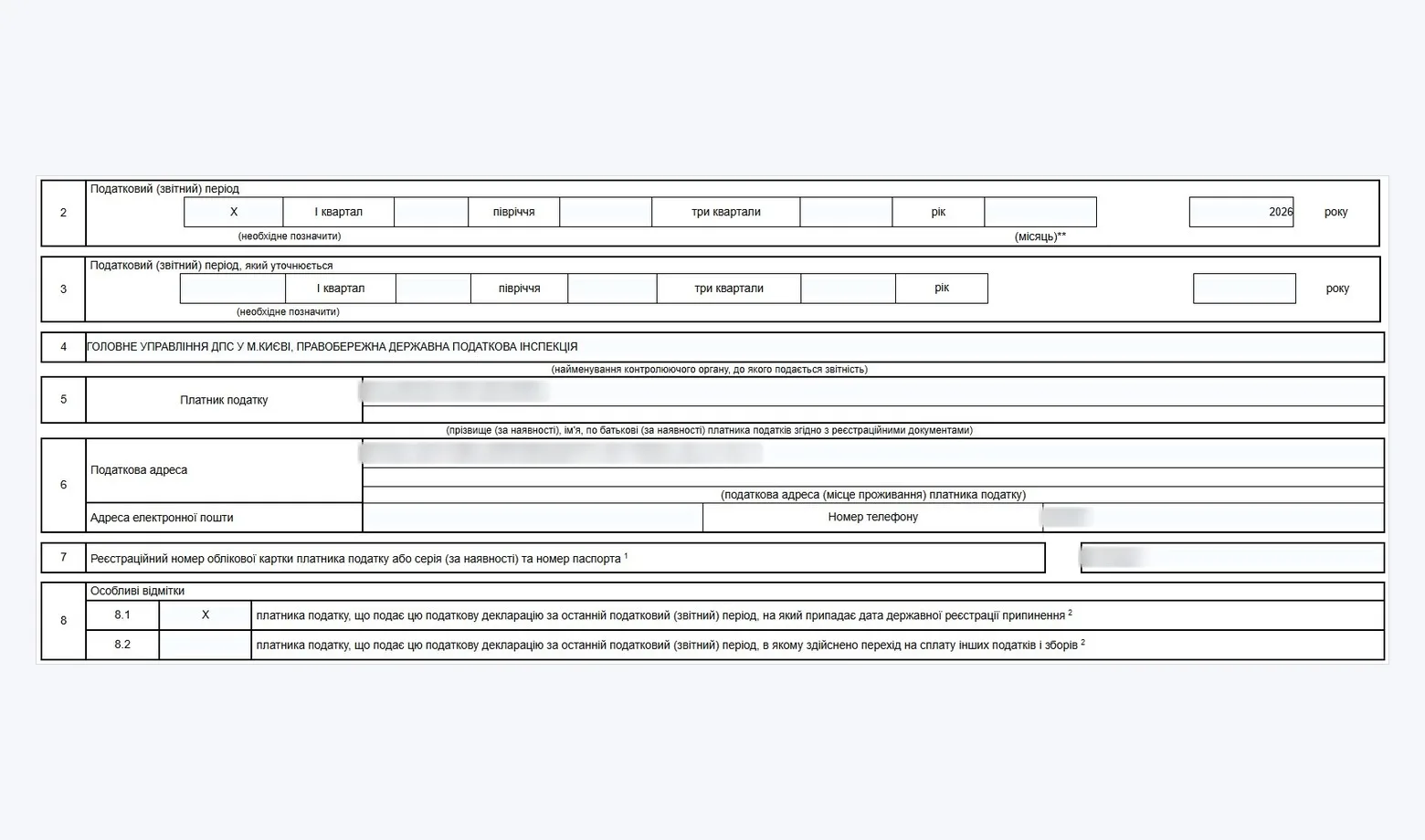
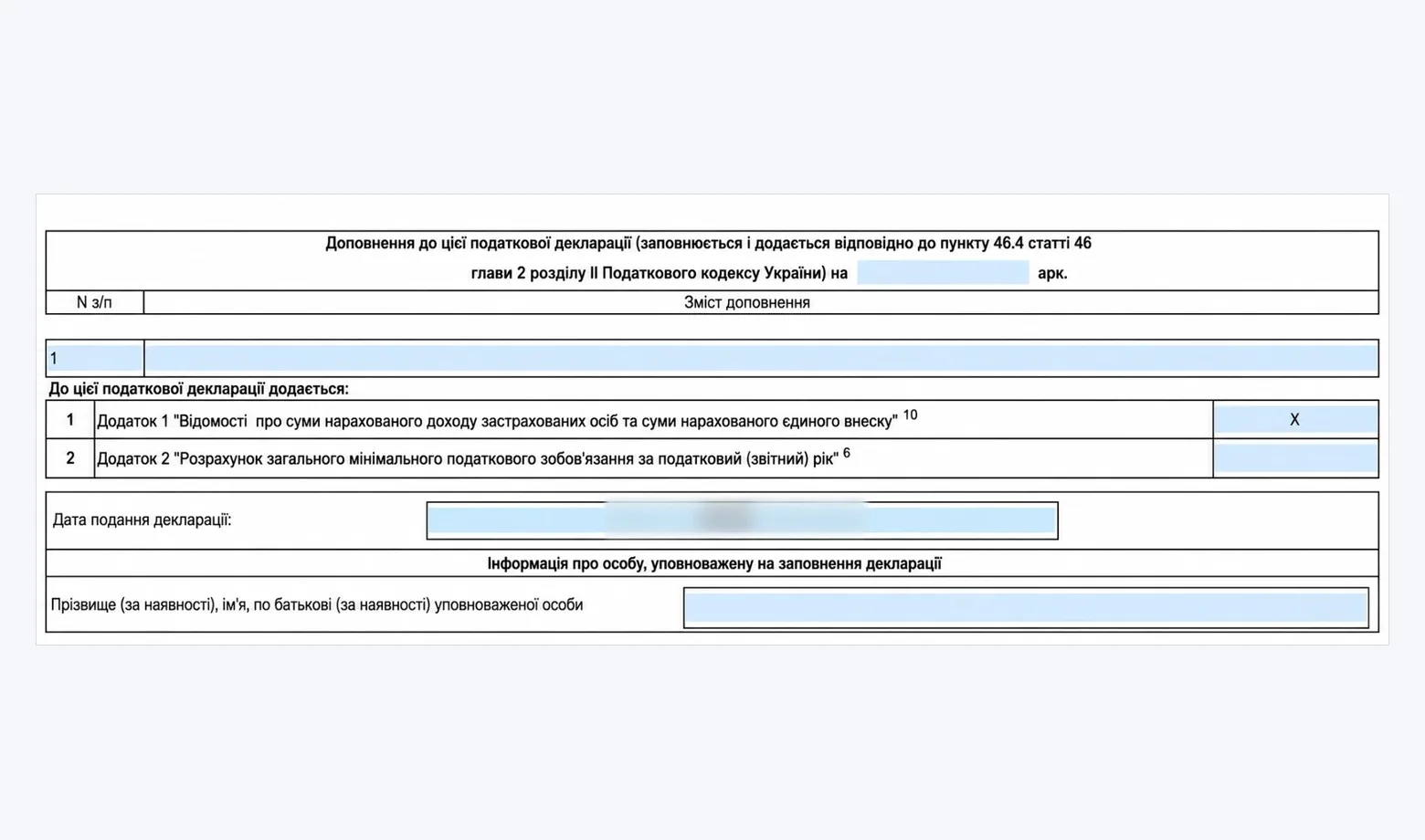
How much tax to pay for the last month
Here the difference between the groups is fundamental, and it costs money.
- Groups 1 and 2 pay the single tax for the whole month of closure, even if they worked only one day of it. The tax accrues up to and including the last day of the month, and the Code does not provide for a pro rata recalculation.
- Group 3 pays a percentage of actual income. No income after closure, no tax. What remains is to pay for the last quarter by the usual deadline.
The practical takeaway for Groups 1 and 2 is simple. If the date is not urgent, it pays to close closer to the end of the month rather than at the start. The tax is the same, and you get more working days.
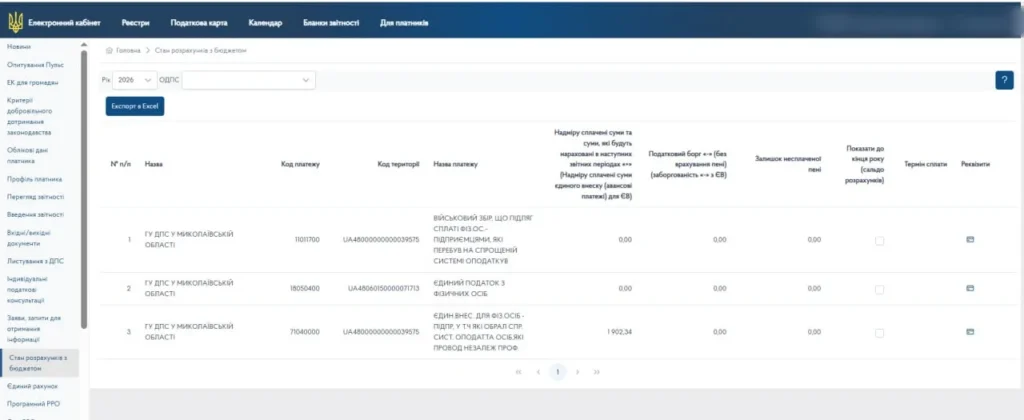
The tax office calculates the SSC up to and including the month of closure. The law says "up to the day" of termination, the STS guidance says "up to and including the month". The discrepancy is real, so budget for the full monthly contribution. That is how it works in practice too. A FOP closed on 14 January had the full SSC for January charged, UAH 1,902.34.
What to do with the cash register, bank account and employees
Some things close on their own, and you do not need to chase them in advance.
- Software cash register (PRRO) - its registration is cancelled automatically as soon as the termination record appears in the register. No application is needed.
- Classic cash register (RRO) - you can deregister it with an application, but even without one the tax office will cancel the registration on its own.
- Bank account - the bank closes the business account if there is money left on it, opens a personal account for you as an individual and transfers the balance there.
You can use the money in the new account once you go to the bank, confirm your identity and sign an agreement. So the money does not disappear, but it does not become available automatically either.
Employees are more complicated. The list of grounds for ending an employment contract has no direct ground "the FOP is terminating its business". This is a known gap in the law. So employees are dismissed separately, either before you file the termination application or in connection with it. The ground, notice period, severance pay and final settlement depend on the ground you choose.
This is the part worth agreeing with a specialist in employment law, because a mistake here costs more than in the tax part. How to hire employees and what follows from it is covered in our article on how a FOP can hire an employee.
Can you close a FOP in Ukraine with a tax debt
Yes. And this is one of the few pieces of news on this topic that favors the business owner.
The ban on closing with a debt is written only for legal entities. For a FOP the law has no such ground for refusal, and the registrar has no right to refuse. But the debt does not go anywhere. Registering the termination does not end obligations that arose while the FOP was operating, and it changes neither the deadlines nor the fines and penalty interest.
You will be liable for it as an individual, with all your property, except property that cannot be seized by law.
Debt write-off does not apply to a FOP. The rule on bad debt covers other cases, and for a sole proprietor the Code says directly that the debt is paid from the individual's property.
What happens if you pay late and how penalties are calculated is covered in our article on fines for a FOP.
What can happen after closing a FOP
Closing does not put you out of the tax office's reach, and this is the main thing people miss.
A closed FOP can still be audited, now as an individual, for the period when you were in business. The tax office confirms this directly in its guidance. So do not throw your documents away.
The basic retention period for a FOP is 1,095 days. For certain transactions, including controlled transactions and payments to non-residents, the Code sets longer periods.
But the basic period is not a ceiling. The Code says directly that retention periods are extended by the time the limitation period was suspended. And if documents relate to an audit or an appeal against its results, they are kept until the audit and the appeal period are over.
Both periods are 1,095 days, so they are easy to mix up. But they run from different events:
- the limitation period (how long the tax office can audit and charge extra tax) - from the filing deadline for the return, or from the day you actually filed it if you filed late;
- the document retention period - from the day you filed the reports these documents were used for.
They are extended together. However long the limitation period was suspended, you keep documents that much longer. So the logic "three years have passed, I can throw the documents away" does not work, and the date you closed the FOP has nothing to do with it.
And separately, about working after closure. If you keep accepting payments for services after the record in the register, this counts as operating without tax registration, with its own liability.
What exactly should be in the folder and how long to keep it is covered in our article on FOP primary documents.
How to prepare for closing a FOP in Ukraine so the audit goes smoothly
Not everyone gets an audit on closure. But prepare as if you will.
- Check the returns you filed for the last three years. An unfiled return removes the limitation period completely.
- Check your balance with the budget, for both taxes and the SSC. Better to see a debt yourself.
- Collect your primary documents: contracts, acts of work performed, bank statements, expense documents.
- Match the income in your returns against the money received on your account. A mismatch is the first thing an inspector looks at.
- Settle matters with employees before you file the application, not after.
What draws the tax office's attention is covered in detail in our article on reducing the risk of an audit. If an audit has already been ordered, you will need tax audit support.
Common mistakes when closing a FOP
1. Waiting for the war to end and counting on the moratorium. The general moratorium ended on 1 August 2023, and the current territorial one does not protect against the closure audit.
2. Filing a regular return instead of the final one. The return needs a mark that it covers the final period. Without it the tax office will not see that this is your last report, and you may face questions and a fine for not filing.
3. Forgetting the SSC for the last month. The wartime relief does not apply in 2026, and the contribution is paid up to and including the month of closure.
4. Throwing documents away right after closing. You can be audited later, and the retention period runs from the date you filed your reports.
5. Assuming the debt will be written off. It passes to you as an individual and is collected from your personal property.
6. Closing at the start of the month while on Group 1 or 2. You will still have to pay the single tax for the whole month.
FAQ: closing a FOP in Ukraine and the tax audit
Is a FOP always audited when it closes?
No. The law gives the tax office the right to order an unscheduled audit when a business is terminated, but does not oblige it to. The decision is made by the head of the tax office and issued as an order, and the Code sets no deadline for ordering it at all.
Is there a moratorium on audits when closing a FOP now?
No. The general wartime moratorium applied until 1 August 2023, the moratorium for Groups 1 and 2 until 1 December 2024. The current moratorium for occupied and frontline territories explicitly excludes the audit on termination of a FOP.
How long does the audit take when closing a FOP?
As a general rule, the Code sets up to 5 working days for a small business entity, with a possible extension of up to 2 more days, and 3 working days for a FOP with no employees under special conditions. At the same time, since the Commercial Code ceased to be in force, the definition of "small business entity" itself needs separate attention. See the section on audit duration for details.
Can you close a FOP with a debt?
Yes. The ban on registering a termination while there is a debt is written only for legal entities. The FOP will be closed, but the debt passes to you as an individual and will be collected from your personal property.
How much does it cost to close a FOP and how long does it take?
The law sets no administrative fee for this, so it is free. The termination is registered within 24 hours after the documents are received, not counting weekends and public holidays.
Which return do you file after closing a FOP?
On the simplified system, the single tax return marked as the final period, roughly within 40 days after the quarter of closure. On the general system, the return on property status and income within 20 days after the month in which the FOP was closed.
How long should you keep documents after closing a FOP?
The basic period for a FOP is 1,095 days, and it runs from the day you filed your reports, not from the closure date. But it is extended by the time the limitation period was suspended, and if the documents relate to an audit or an appeal, you keep them until those are over. For certain transactions the Code sets longer periods.
Can a FOP be audited after it has been closed?
Yes. Registering the termination does not end obligations that arose while the FOP was operating. The audit is then carried out on you as an individual, for the period of business activity, within the limitation periods.
Conclusion
Closing a FOP takes one application and one day. The hard part is not the procedure but what remains after it.
Three things to remember. The closure audit is a right of the tax office, not a duty. The moratorium has not covered it since 2023. Debts and obligations pass to you as an individual.
The main mistake is dragging it out. While the FOP is open, the single tax and the SSC keep accruing, and the limitation period for old periods does not run out any faster. Close your FOP ready for an audit rather than waiting for one. Check your reports, debts and primary documents before you file the application.
Need to close your FOP without surprises?
Our team will check your reports for every year you worked, prepare the final return with the right marks, calculate the SSC and support you through the audit if the tax office orders one.