

How to close a sole proprietor in Ukraine in 2026 - step-by-step guide

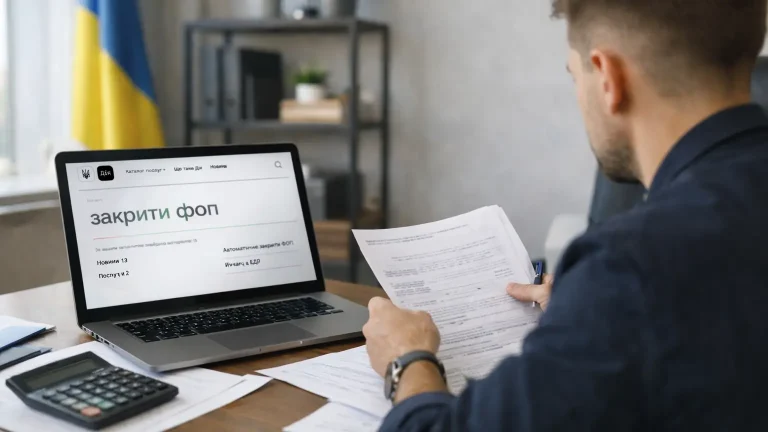
Decided to close a Sole Proprietor - and it seems like just a few clicks in Diia are enough? In reality, registration closure - is only the beginning. After that, you still need to submit a liquidation declaration, pay final taxes and SSC, collect documents and keep them for years. And the tax authority has the right to conduct an audit even after the Sole Proprietor is officially closed.
In this article, we will go through the entire process: what to do before closure, how to properly submit the application, what reports to file afterward, and what mistakes to avoid so that closure does not turn into new debts and penalties.
Is it worth closing a Sole Proprietor?
Before submitting an application - stop and assess the situation. Closing a Sole Proprietor makes sense if you are completely stopping business activity and want to eliminate reporting obligations. If the activity is only temporarily suspended or there is no income - closure may be a premature decision.
Liquidation of a Sole Proprietor is grounds for a documentary audit: the tax authority has the right to send a request and review the entire period of activity. If there are serious violations - unrecorded transactions, missing documents, systematic delays - closure may trigger additional tax assessments.
But there is an alternative: switch to the general taxation system without closing. What does this mean in practice? Under the general system - if there is no income - a Sole Proprietor does not pay single tax and SSC “for themselves”. You will only need to submit a zero declaration once a year. In this case, it reduces formal grounds for an audit, but does not eliminate control.
If the decision to close has been made - let’s move on.
What to do before closing a Sole Proprietor?
Before submitting a closure application, there are several mandatory steps - and each of them is important. Let’s go through everything step by step.
- Check the status of settlements in the electronic cabinet.
Go to the Taxpayer’s Electronic Cabinet and check the section “Status of settlements with the budget”. You need to review all taxes: single tax, military levy, SSC. If there were employees - also PIT and salary contributions.
Please note: next to the records there should be code “17”. This is how accruals and payments of taxes and fees are recorded in the cabinet. Make sure there are no debts and all payments are reflected.
Also check the section “Reporting view”: whether all declarations for the years of activity have been submitted - annual for groups 1–2, quarterly for group 3. An unsubmitted report is a problem that will surface at the most critical moment.
- Organize primary documents
Collect all primary documents in one folder before submitting the closure application. It should include:
- income record book (with printouts of the electronic version for the relevant periods)
- bank statements for the entire period of activity
- contracts, completion certificates, delivery notes, invoices - in chronological order
If some certificates or delivery notes are missing - contact your counterparties in advance. Documents can also be signed in electronic form. This folder is your protection in case of an audit after closure.
- Terminate employees
If you had hired employees - they must be dismissed before closing the Sole Proprietor. Choose the legal basis for termination, follow notice periods, prepare applications and orders, make the final settlement, and issue all required documents on the day of dismissal.
Information about dismissal is reflected in the Tax Calculation (Unified Report) with Annex 5 for the quarter in which the employment relationship was terminated. Important: this calculation must be submitted before the state registration of Sole Proprietor termination is completed.
- Settle with counterparties
Close all financial matters: receive payments from customers, settle with suppliers and landlords, sign final acts.
There are also two important points that are often forgotten.
First: a Sole Proprietor is liable for debts with all their personal property as an individual. In practice, this means that you will have to settle with counterparties using personal funds - regardless of whether the Sole Proprietor is active or closed.
Second: income received after the Sole Proprietor is closed is treated as “civil” income of an individual. Accordingly, it is taxed at standard PIT rates (18%) + military levy - with mandatory submission of a personal asset declaration.
- Close RRO/PRRO and licenses
If you used a classic RRO - first deregister the device at the service center, obtain a certificate, and submit form 4-RRO to the tax authority to remove it from registration.
For a software PRRO - before submitting the closure application, file the cancellation forms: form 1-PRRO, notification form 20-OPP, and form 5-PRRO. You can find these forms on the tax authority website via this link.
Licenses (for example, for retail alcohol sales) must also be canceled before submitting the application. Taxable objects - places of activity, warehouses, cash registers - are closed through form 20-OPP.
- Close bank accounts
The law does not set a mandatory deadline for closing accounts - this can be done either before or after termination. But in practice, it is better to proceed as follows: first obtain full bank statements for the entire period of activity with the bank’s signature (it may be a QES) - and only then close the accounts. The bank will issue a closure certificate - keep it together with other documents.
Closing accounts before termination reduces the risk of unexpected incoming payments after removal from the register, which will have to be declared as “civil” income.
- Pay taxes
Reserve funds in advance for final payments - otherwise a tax debt may arise, which will delay the deregistration process.
Pay attention to the following deadlines:
Sole Proprietor Group 1-2: single tax and military levy for the month of closure are accrued for the full month - regardless of the application date. They are paid in advance, no later than the 20th day of the current month.
Sole Proprietor Group 3: final accruals for single tax and military levy depend on the amount of income up to the termination date. Payment must be made within 10 days after the deadline for submitting the declaration (that is, within 50 calendar days after the end of the quarter).
SSC (all groups): paid in an amount not less than the minimum contribution for each month of activity in the quarter - without proportional reduction. Deadline - until the 20th day of the month following the quarter.
- Prepare a final document folder
Before submitting the closure application, gather everything in one place:
- bank statements with a signature or QES
- income record book with printouts
- contracts, certificates, delivery notes in chronological order
- employment documentation (orders, applications, payslips)
- bank account closure certificate
- confirmation of RRO/PRRO and license cancellation
- forms 20-OPP regarding the closure of taxable objects
Important: after the termination of Sole Proprietor registration, add the following documents to the folder:
- all reports: annual/quarterly declarations for all years of activity, liquidation declarations with attachments
- extract from the Unified State Register on Sole Proprietor termination
This folder is your safety net in case of an audit. The minimum storage period under tax law is 1095 days (3 years). But in practice - keep documents for 4-5 years. Due to audit moratoriums and martial law, limitation periods are effectively longer than provided by law.
Don’t want to deal with the preparation yourself?
The buh.ua team will check your settlement status, organize documents, and prepare your Sole Proprietor for closure - without the risk of additional charges and penalties.
Step-by-step guide to closing a Sole Proprietor in 2026
There are two ways to close a Sole Proprietor: online via the Diia app, or offline through a CNAP. The first option is faster and simpler, especially if you are abroad. However, the “traditional” option with a paper application is also available.
How to close a Sole Proprietor online via Diia
Step 1. Log in to the Diia portal using a QES, Diia.Signature, or BankID.
Step 2. In the services catalog, select “Business” → “Automatic Sole Proprietor closure”.
Step 3. Check personal and registration data - the system will automatically retrieve them from the Unified State Register, no manual input is required.
Step 4. Sign the generated application using a personal QES.
Step 5. Submit the application through the service.
After submission, the application is automatically transferred to the Unified State Register. Information about termination is sent to the tax authority, statistics bodies, and the Pension Fund - without additional visits. This is especially convenient if you are abroad.
How to close a Sole Proprietor offline through CNAP
Step 1. Fill out an application for state registration of business activity termination.
Step 2. Submit it in person to any state registrar, CNAP, or notary.
Keep in mind: if the documents are submitted by a representative - a notarized power of attorney is required.
How to verify Sole Proprietor closure
After submitting the application, the state registrar must enter a record of Sole Proprietor termination within 24 hours.
To track the status:
If 24 hours have passed and the record has not appeared - contact Diia support or the state registrar who accepted the application.
After the termination record is entered:
The extract must contain the entrepreneur’s details, a mark of business termination, and the date of entry. Important: save an electronic copy and print a paper version - this document may be required when dealing with banks, counterparties, or the tax authority.
Finally, check how the status is reflected in tax records. To do this, go to the Taxpayer’s Electronic Cabinet → section “Taxpayer account data”. There should be a record indicating the termination status and the date of cancellation of single tax payer registration.
What to do after closing a Sole Proprietor?
The registration has been terminated - but this is not the end. Ahead are liquidation reporting, document archiving, and a possible tax audit.
Liquidation declaration- how to submit
The liquidation declaration is a key document that records the final performance indicators of the Sole Proprietor up to the closure date. In fact, it is submitted using the same form as the standard declaration, but with a mark indicating a liquidation reporting period. Submit the declaration online via the Electronic Cabinet. It will differ slightly depending on the Sole Proprietor group.
For Sole Proprietor Group 1-2 (simplified system):
submit the final single tax payer declaration on a cumulative basis for the period up to the quarter of termination, with a mark indicating the final reporting period + Appendix 1 on the unified social contribution (USC). Deadline - within 40 calendar days after the end of the quarter in which the activity was terminated (subpara. 49.18.2, para. 294.6 of the Tax Code of Ukraine)
For Sole Proprietor Group 3 (simplified system):
submit a quarterly declaration for the quarter in which the activity was terminated. Mark it as a liquidation report in the form. Attach Annex 1 for SSC with the form type “Reporting”. Submission deadline - 40 calendar days after the end of the quarter.
Sole Proprietor on the general system:
submit a liquidation declaration of property status and income. It covers the period from January 1 to the date of termination. Submission deadline - 20 calendar days after the end of the month in which the activity was terminated (clause 49.18.1 of the Tax Code). Example: closure on March 15 → until April 20 (after March 31).
Important: reports must be signed with a personal QES, since after termination the previous “business” signature is no longer valid.
Don’t forget to store in your folder the liquidation declaration with attachments and the extract from the Unified State Register confirming Sole Proprietor termination.
Not sure how to correctly fill out the liquidation declaration?
We know all the nuances of the liquidation declaration - we will prepare and submit it correctly the first time.
Audits after closing a Sole Proprietor
A closed Sole Proprietor - does not mean protected from audits. The tax authority has the right to initiate a documentary audit within the limitation period - 1095 days (3 years). However, in practice this period may be longer due to suspensions during quarantine restrictions and martial law.
Separately regarding SSC: limitation periods do not apply to it. This means that audits related to the unified social contribution can be initiated without any time limitation.
In case of an audit or request from the tax authority, you may need:
- copies of primary documents: contracts, certificates, delivery notes
- bank statements for Sole Proprietor accounts
- reports for the entire period of activity and the liquidation declaration
And one more thing. You have the right to initiate an audit yourself - by submitting a relevant application to the tax authority. In practice, this is a way to officially close all issues with the tax authority and avoid unexpected requests in the future. However, note that the review period for such applications is not legally limited - in practice, the waiting time may take several months. When the tax office orders an audit on closure and how to pass it is covered in «Closing a sole proprietorship with or without a tax audit».
Do mobilized individuals need to close a Sole Proprietor in 2026?
Mobilization itself is not a basis for automatic closure of a Sole Proprietor. The entrepreneur remains registered and independently decides whether to terminate activity.
If the activity is not actually carried out - no income, no financial transactions - taxes on business income are not accrued. SSC for mobilized individuals may also not be paid if the conditions for the benefit are met. That is, a Sole Proprietor can simply be put “on pause” - without closure and without unnecessary expenses.
However, there is one nuance worth knowing. Certain military positions - unit commanders, company commanders, senior officers of divisions, and others - under anti-corruption legislation cannot simultaneously engage in business activities. If your position falls under this restriction - maintaining Sole Proprietor status may be a violation. In this case, it is better either to close the Sole Proprietor or consult a lawyer regarding the compatibility of the position and business activity.
Common mistakes when closing a Sole Proprietor
Most problems after closing a Sole Proprietor arise not because of the complexity of the procedure, but due to typical mistakes that seem minor. However, each of them can lead to additional charges, penalties, or delays in deregistration.
Mistake 1. Missing primary documents.
Some contracts, certificates, or delivery notes are missing or improperly оформлені. For example, bank statements are not collected for the entire period. As a result - during an audit, the tax authority may not recognize certain amounts as business income and treat them as unconfirmed personal income. This leads to additional PIT charges of 18% + military levy, penalties, and fines.
Mistake 2. Incorrectly completed or late submitted liquidation declaration.
For example, you complete the declaration - but forget to mark it as liquidation. Or simply miss the submission deadlines. The result - the declaration is rejected or considered late, penalties are начислені, and deregistration is delayed.
Mistake 3. Failure to pay taxes and SSC for the closure period.
Entrepreneurs often do not consider: Sole Proprietors in groups 1–2 pay the single tax and military levy for the full month of closure - even if the application was submitted in the first days. Sole Proprietors in group 3 pay the single tax and military levy within 10 days after the deadline for submitting the quarterly declaration. And SSC is paid as a minimum contribution for each month of the quarter without proportional reduction. The result of underpayment - tax debt, penalties, fines - and a blocked deregistration process.
Mistake 4. Funds were received to the account after closure - and no one declared anything.
The accounts were not closed before the Sole Proprietor cancellation, and the counterparty paid with a delay? Then this is not business income, but regular personal income taxed at 18% PIT + military levy. If not declared - there is a risk of additional charges, penalties, and an audit. Plus, you will have to submit a property and income declaration “retroactively” and pay taxes already with penalties.
Frequently asked questions about closing a Sole Proprietor in 2026
Can I close a Sole Proprietor online if I registered offline?
Yes. All information about a Sole Proprietor is stored in the Unified State Register, so the method of initial registration (through an administrative service center, a notary, or online) does not matter. The termination application can be submitted via the Diia portal if you have a qualified electronic signature or Diia.Signature.
Can I simply close a Sole Proprietor through Diia without submitting reports?
No. Registration termination is only the first stage. After closure, you must submit a liquidation declaration (for the simplified or general system - depending on which you used) and pay all taxes and SSC up to the termination date. Otherwise, tax debts may arise, and the tax authority has the right to initiate an audit and additional charges.
Do I need to submit reports if the income was zero?
Yes. The absence of income does not exempt you from the obligation to submit a declaration. Even for a “zero” Sole Proprietor, a liquidation declaration must be submitted - it simply indicates no income and SSC/single tax/military levy payment (or preferential status). Failure to submit a declaration is considered a violation of reporting deadlines and results in penalties.
Can I open a Sole Proprietor again after closure?
Yes. A closed Sole Proprietor cannot be “restored”, but you can register again as an entrepreneur at any time - it will be a new registration with a new start date of activity. The fact of previous closure does not limit future registration.
Can I close a Sole Proprietor if I am abroad?
Yes. You can submit a termination application remotely via Diia without visiting administrative service centers or the tax office. The only complications may arise with license cancellation or closing certain accounts if a bank or licensing authority requires personal presence or a representative with a power of attorney.
Will the tax authority обязательно audit a Sole Proprietor after closure?
No, audits are not automatic or guaranteed. The tax authority has the right to initiate a documentary audit of a closed Sole Proprietor within the limitation period, but does so selectively - taking into account risks, debts, reporting errors, suspicious transactions, etc. In other words, an audit may occur, but there is no rule that every closed Sole Proprietor is обязательно audited.
Conclusion
Closing a Sole Proprietor is not just one click in Diia. It is a process that includes preparation, reporting, final payments, and documents that must be kept for several years after closure. Most problems arise not because the procedure is complicated, but because of haste. And later, mistakes turn into additional charges and penalties even after closure.
If accounting is organized, documents are collected, and settlements with the budget are completed - the closure process goes smoothly. If there are doubts about reporting status or debts - it is better to first resolve this together with an accountant, and only then submit the application. Closing with “loose ends” costs significantly more than a consultation before starting the process.
Want to close a Sole Proprietor without debts, penalties, and unexpected audits?
Entrust the closure process to buh.ua specialists - we will handle preparation, reporting, and final settlements with the budget.