

How Sole Proprietors and Small Businesses Can Legally Reduce Taxes in 2026

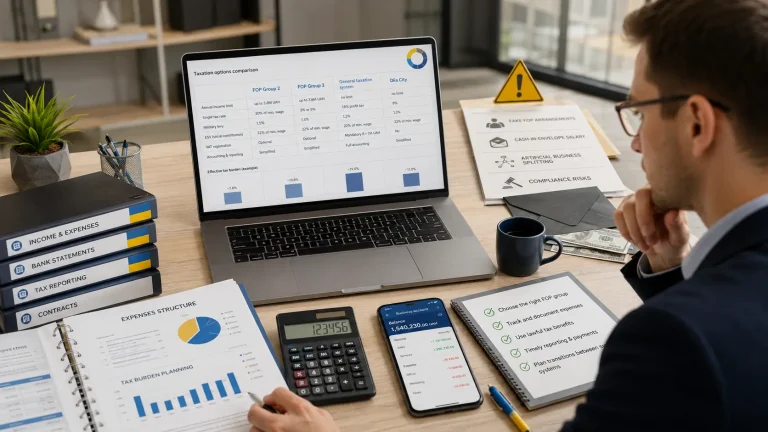
Every entrepreneur wants to pay less tax - and that is entirely normal and legal when permitted tools are used instead of schemes. The problem is that there is a fine but fundamental line between legal tax optimisation and tax evasion.
Tax optimisation means legally choosing the most advantageous tax regime for your actual business. Tax evasion and artificial schemes are violations that may result in additional tax assessments, penalties and, in certain cases, criminal liability. In this article, we will examine legal ways to reduce taxes in 2026 and clearly explain where the line is drawn.
Legal tax optimisation and tax evasion: what is the difference?
The key concept that helps distinguish a genuine business transaction from an artificial scheme is a business purpose. Under Clause 14.1.231 of the Tax Code of Ukraine, it means an intention to obtain an economic benefit as a result of business activity. It is particularly important to demonstrate a business purpose in transactions for which the Tax Code expressly provides corresponding tax adjustments or restrictions.
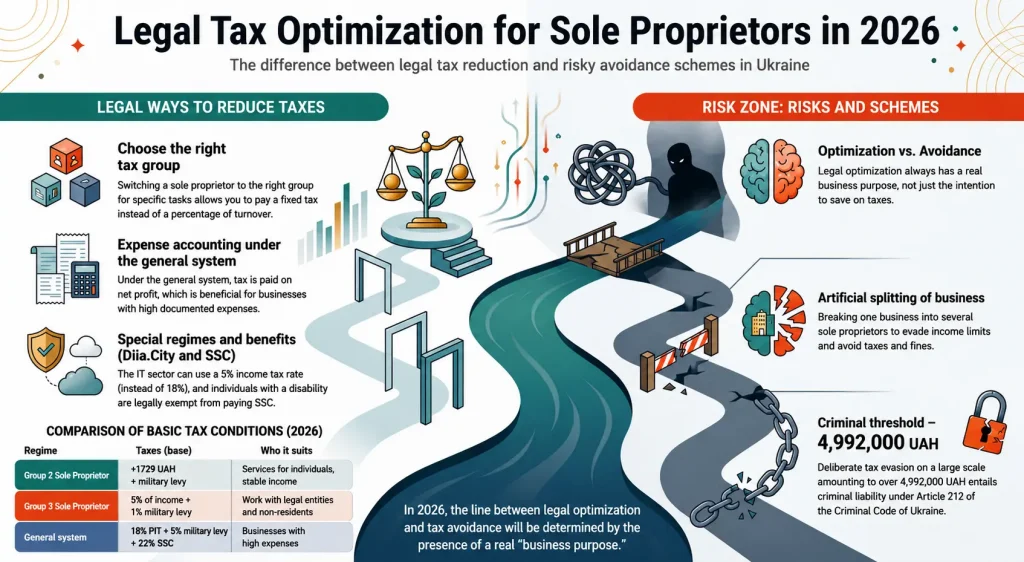
The second boundary is criminal liability. Intentional tax evasion constitutes a criminal offence under Article 212 of the Criminal Code of Ukraine. Liability under Part 1 of this article requires intentional actions that resulted in a significant amount of tax not actually being paid into the state budget. In 2026, the minimum threshold for this amount is UAH 4,992,000. However, the specific legal classification depends not only on the amount but also on the circumstances and intent. This is where the line is drawn: tax optimisation is not tax evasion.
A separate issue is business splitting: a single business is artificially divided among several sole proprietors to remain within the single tax limits. The Tax Code does not contain a separate definition of business splitting. In practice, the tax authorities and courts assess the overall circumstances: the independence of each sole proprietor, separate assets and personnel, management, cash registers, document flow, customers and the economic rationale for the division.
The main principle: tax optimisation is legal when it is based on a genuine business purpose, rather than an artificial arrangement created solely to obtain a tax benefit.
How sole proprietors can legally reduce taxes in 2026
Now let us consider the tools that can be used entirely legally. Tax optimisation is not limited to a single method: for some businesses, choosing the correct single tax group is enough; for others, it may be more beneficial to switch to the general taxation system, deduct expenses or use a special tax regime. Below, we examine the main ways to reduce the tax burden without artificial schemes or violations.
Choose the most suitable tax system and group
This is the main and simplest legal tool. The single tax and the general taxation system impose different tax burdens, and the same applies to the individual groups. Estimated payments in 2026 are as follows (Article 293 of the Tax Code of Ukraine):
- Group 1 - single tax of up to UAH 332.80 + military levy of UAH 864.70 per month;
- Group 2 - single tax of up to UAH 1,729.40 + military levy of UAH 864.70 per month;
- Group 3 - 5% of income (or 3% + VAT) + military levy of 1% of income;
- general taxation system - 18% personal income tax + 5% military levy on net profit and a 22% unified social contribution.
The logic is as follows: if you provide services to individuals or single tax payers and meet the other requirements of the group, Group 2 may be suitable; for services provided to legal entities under the general taxation system and to non-residents, businesses usually choose Group 3. If your business involves the sale of goods, different rules apply, so the type of activity and customer base should be assessed separately. For businesses with substantial expenses, the general taxation system, under which tax is charged on profit, may sometimes be more beneficial. Read more about this choice in our article on whether to choose Group 2 or Group 3 for a sole proprietor.
Deduct expenses under the general taxation system
Under the general taxation system, tax is charged not on total income but on net profit - income minus documented expenses (Article 177.4 of the Tax Code of Ukraine). Therefore, for businesses with substantial expenses, accurate accounting and the retention of primary documents legally reduce the taxable base.
Use Diia.City for IT businesses
Companies that meet the requirements of Diia.City may use its special tax regime. Employees and gig specialists who meet the applicable conditions are eligible for reduced personal income tax rates starting at 5%, but the total tax burden also includes the military levy, unified social contribution and taxation of the company itself. Therefore, the benefit should be calculated for the entire business structure rather than based solely on the 5% rate.
Manage your VAT registration status
Mandatory registration as a VAT payer is required if the value of transactions involving the supply of goods or services subject to VAT exceeded UAH 1,000,000 during the previous 12 calendar months (Article 181 of the Tax Code of Ukraine). However, this rule does not apply to single tax payers in Groups 1-3 while they remain under the simplified taxation system. Voluntary VAT registration may be beneficial when working with VAT payers or using certain export models, but it requires a separate calculation.
Reduce tax administration costs
Being included in the List of taxpayers with a high level of voluntary compliance with tax legislation, unofficially known as the “White Business Club”, does not reduce the tax rates themselves. However, it may lower a business's administrative costs through a moratorium on certain inspections, faster VAT refund procedures and access to a dedicated compliance manager. In addition, sector-specific tax benefits are available and should be used if your business meets the relevant eligibility requirements.
Check your eligibility for a unified social contribution exemption
A sole proprietor may be legally exempt from paying the unified social contribution for themselves - for example, if they are an old-age pensioner or a person with a disability, or if their employer pays at least the minimum contribution for them at their primary place of employment. This is not a scheme, but the direct application of a statutory exemption.
Separate personal and business transactions
Clearly separating personal funds from business income does not reduce the tax rate, but it helps prevent additional tax assessments if the tax authorities treat personal receipts as a sole proprietor's business income.
Plan transitions between tax groups in advance
If you acquire a client or begin an activity that is not permitted under your current group, you should change groups in advance - before receiving the income, not afterwards. This will help you avoid the 15% rate and other violations.
Avoid unnecessary costs from penalties
The simplest way to save money is to avoid overpaying through fines and late-payment interest. Filing reports and paying taxes on time costs less than penalties for late compliance. Therefore, properly organised accounting is also a form of tax optimisation.
Comparison of tax systems for sole proprietors
For clarity, the table below summarises the basic rates under the different tax regimes:
| Tax regime | Taxes in simplified terms | Who it suits |
|---|---|---|
| Single tax, Group 2 | UAH 1,729.40 + UAH 864.70 per month - fixed payments | Services provided to individuals and single tax payers, with a stable low income |
| Single tax, Group 3 | 5% of income + 1% military levy | Working with legal entities and non-residents, with variable income |
| General taxation system | 18% + 5% of profit + unified social contribution | Businesses with substantial expenses or turnover |
| Diia.City | 5% personal income tax + 5% military levy | IT companies and Diia.City residents |
Please note: the table shows only the basic rates. The total tax burden may also include the unified social contribution, VAT, payroll taxes, corporate tax and other payments depending on the business model.
There is no universally “most advantageous” regime: everything depends on your income, expenses and the parties you work with. Choosing the right regime for a specific business is the essence of legal tax optimisation.
Planning to scale your business without overpaying taxes?
We will build a legal structure tailored to your goals, assess its economic rationale and help reduce the risk of additional tax assessments.
Which methods of reducing taxes are illegal?
It is important not to confuse legal tools with tax schemes. Here is what the tax authorities regard as a violation rather than tax optimisation:
- Fictitious sole proprietors instead of employees. If a worker is effectively an employee but is formally registered as a sole proprietor, the relationship may be reclassified as employment, resulting in additional assessments of personal income tax, the military levy and the unified social contribution.
- Cash-in-hand wages. Payments made outside the accounting system constitute non-payment of payroll taxes and may result in corresponding penalties.
- Fictitious transactions and “tax pits”. Recording transactions that never took place is a direct violation and may result in criminal liability.
- Business splitting without a genuine business purpose. Artificially dividing a business solely to remain within the single tax limits.
What all these schemes have in common is the absence of a genuine business purpose. This is why the tax authorities disallow the tax benefit, assess additional taxes and impose penalties. If intentional non-payment exceeds the statutory threshold, Article 212 of the Criminal Code of Ukraine may apply. This is not tax optimisation, but a serious risk.
Frequently asked questions (FAQ)
Is it legal to reduce taxes?
Yes. Choosing the most advantageous permitted tax regime, deducting expenses and using available tax benefits are all legal. Only artificial schemes without a genuine business purpose and the concealment of income are illegal.
How does tax optimisation differ from tax evasion?
Tax optimisation is the use of legal tools supported by a genuine business purpose. Tax evasion is the intentional concealment of income or non-payment of taxes, which, when the amount exceeds UAH 4,992,000 in 2026, may result in criminal liability under Article 212 of the Criminal Code of Ukraine.
Can several sole proprietorships be registered to reduce taxes?
Yes, if each sole proprietor conducts a genuine and separate business activity. However, if a single business is artificially divided among several sole proprietors solely to remain within the single tax limits, the tax authorities may treat this as business splitting and assess taxes as if it were one business.
What is the safest tax optimisation method?
The safest and most effective method is choosing the appropriate tax system and group for your actual business. This does not involve any artificial arrangements and fully complies with the law.
Can a sole proprietor switch to another tax group to pay less tax?
Yes, provided that you meet the requirements of the chosen group and comply with the applicable transition deadlines. The group should be selected not only based on the tax rate, but also with regard to the types of business activity, customers, income limits and payment methods.
Is the general taxation system always more expensive than the single tax?
No. If a business has substantial documented expenses, the general taxation system may sometimes be more beneficial because personal income tax and the military levy are calculated on net taxable income.
Conclusion
Taxes can and should be reduced, but only through legal tools: choosing the appropriate tax system and group, deducting expenses, using the Diia.City regime, managing VAT registration status, applying available tax benefits and filing reports on time. All of these are forms of legal tax optimisation based on a genuine business purpose.
Artificial schemes, such as fictitious sole proprietors, cash-in-hand wages and business splitting without a genuine business purpose, are not tax optimisation but violations that may result in additional tax assessments and criminal liability. The main rule is simple: if a decision is based on genuine business logic rather than tax savings alone, you are on the safe side.
Would you like to check whether your business is overpaying taxes?
We will analyse your tax system, expenses and operating model, recommend legal options and take care of your accounting and reporting.