

EU Memorandum and Taxes for Sole Proprietors in Ukraine: What Is Approved and What Is Still Planned


The Memorandum with the EU on tax reform for sole proprietors has become the main tax scare story of 2026. Social media posts claim that from 2027, simplified tax system taxpayers will automatically become VAT payers, Group 3 rates will increase, and the exemption for parcels will be abolished.
Most entrepreneurs do not even realize how far these headlines are from the actual documents. We checked every claim against the primary sources - and found that out of the entire list of tax changes, only one item has actually become effective law. The good news: most of what is currently being discussed on social media has not become law as of today.
We will explain what the EU - Ukraine Memorandum actually is and how it affects sole proprietors, what specific commitments the state has undertaken, which of them have already become law, which have been adopted but are not yet in force, and which changes for sole proprietors in 2027 remain plans without a specific date.
What is the Memorandum with the EU and why does it affect sole proprietors?
The confusion starts because the word "memorandum" is used to refer to three different documents with different legal force. Let us separate them.
It is the mixing of these three levels that produces headlines such as "The EU forced Ukraine to raise taxes for sole proprietors." In reality, their legal force is completely different.
The key clarification about the EUR 90 billion
The loan under the EU Regulation really does amount to up to EUR 90 billion over two years. However, the tax conditions do not apply to the entire amount.
The Memorandum containing these conditions covers only EUR 8.35 billion in macro-financial assistance - the part provided specifically in connection with reforms. The remainder is allocated to defense and budgetary needs under different rules.
Therefore, the statement that "Ukraine undertook tax obligations in exchange for EUR 90 billion" is incorrect. The correct formulation is: the tax conditions apply to EUR 8.35 billion within the overall financing framework. The Memorandum itself was ratified by law, which entered into force on May 30, 2026. This means that the document creates obligations for the state, not directly for taxpayers: none of its provisions changes your taxes automatically.
The EU Memorandum and taxes: what commitments did Ukraine undertake?
All tax-related conditions are listed in the annex to the Memorandum, in the section on domestic revenue mobilization. Each condition is linked not to a specific date, but to a tranche: until the condition is fulfilled, the funds are not released.
| Condition | What it concerns | Related tranche |
|---|---|---|
| 5% military levy | Extension for 3 years | First - completed |
| Digital platforms | Taxation of marketplace income | First and second |
| International parcels | Removal of the tax exemption | First and second |
| Simplified tax system reform | Business splitting, return to the single tax system, Group 3 rates | Third |
| Simplified VAT administration for sole proprietors | Quarterly reporting instead of monthly reporting | Third |
*The first tranche of EUR 3.2 billion was paid on June 25, 2026 after seven conditions had been fulfilled. The second and third tranches are planned by the end of 2026, with all payments to be completed by December 31, 2028.
The most significant requirements for sole proprietors are in the third tranche, which provides some time to prepare. However, there is an important nuance that is often overlooked: the condition is worded as "submit a legislative proposal to the Rada," not "adopt a law." In other words, the obligation is formally fulfilled simply by introducing a draft law. Whether the Rada adopts it and in what form is a separate question.
Simplified tax system reform: what could change for sole proprietors?
If we look only at the text of the Memorandum, the largest number of potential changes concerns the reform of the simplified taxation system. However, it is important to understand that these are reform directions, not rules that are already in force.
This is the same condition linked to the third tranche. Its objective is expressed in financial terms: the reform must generate at least UAH 70 billion per year for the budget. Four approaches are listed.
- Measures against artificial business splitting - rules aimed at preventing businesses from being artificially divided among several sole proprietors in order to remain within single tax limits;
- Restrictions on repeated switching back to the simplified system after moving to the general taxation system - meaning businesses would no longer be able to move back and forth freely;
- Differentiated rates for Group 3 depending on the type of activity - instead of the current uniform rate for everyone;
- Alignment with the EU VAT Directive - this is the source of discussions about VAT for simplified tax system taxpayers.
The document contains no specific percentages. We checked the full text: the word "threshold" does not appear in it at all, and there are no single tax rates either. Therefore, any publication claiming specific future rates "under the Memorandum" is speculation.
What is genuinely worth doing now is taking an objective look at your business structure. If the business is divided among several sole proprietors, the risks are explained in our article about business splitting.
One condition that benefits sole proprietors
Not all requirements of the Memorandum mean tighter control or new taxes. Some changes could genuinely make life easier for entrepreneurs.
This provision receives very little attention because it is not alarming. The Memorandum requires Ukraine to simplify VAT administration specifically for sole proprietors:
- quarterly reporting instead of monthly reporting;
- one tax invoice per month instead of daily tax invoices;
- a pre-filled tax return prepared by the tax authority;
- a simplified procedure for unblocking tax invoices.
This is a rare case where a lender's requirement could make life easier for small businesses. For those who currently have to choose between a 3% rate with VAT and a 5% rate without VAT, this change could be significant.
What from the Memorandum has already become law, and what is not yet in force
It is important to distinguish between two different situations: a law that is already in force and a law that has been adopted but has not yet entered into force. Confusing the two is behind many of the alarming headlines.
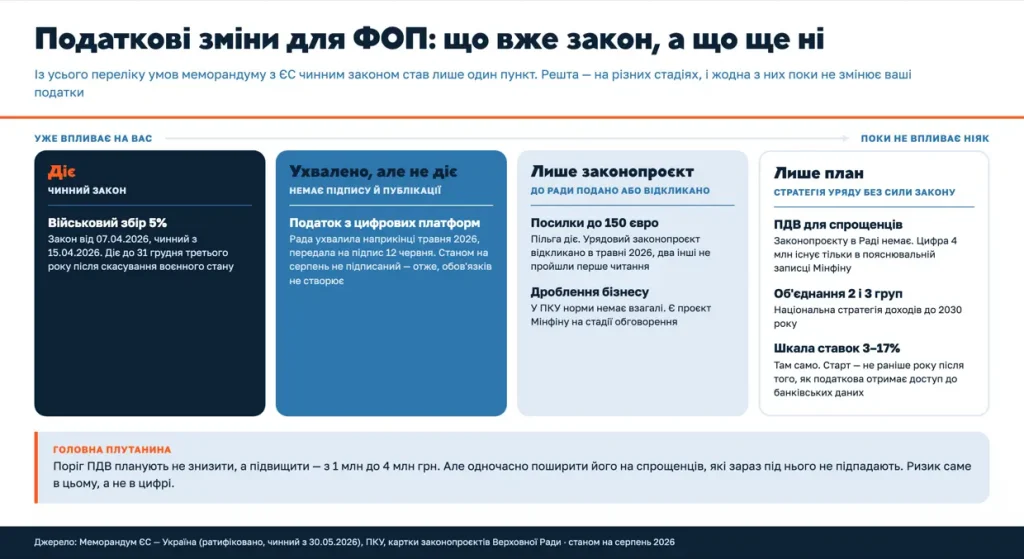
Exactly one item - the military levy. The Law of April 7, 2026 entered into force on April 15, 2026 and extended the 5% levy. However, "for three years" does not mean there is a fixed end date. The rule is linked to martial law: the levy remains in force until December 31 of the third calendar year following the year in which martial law is lifted. Therefore, saying that the "military levy is permanent" is also inaccurate. For sole proprietors under the single tax system, the rule has a clear end point - it simply moves depending on when martial law ends.
Now for the most nuanced part of the issue. The Verkhovna Rada adopted the law on taxation of income from digital platforms at the end of May 2026 and sent it to the President for signature on June 12. As of August 2026, it has not been signed or published. Until the law is published, it has not entered into force and creates no obligations. This is one of the most common cases where news about a parliamentary vote is mistakenly treated as if the law were already effective.
The mechanism itself is based on international automatic exchange of information, following the same logic as the CRS agreement on foreign accounts. We explained what exactly this law provides for and how it could affect marketplace sellers in a separate article about the digital platform tax.
What still remains only a draft law
Despite the dramatic headlines, some of the proposed changes have still not become law. Some initiatives have been withdrawn, while others remain only draft laws.
- Parcels from abroad. The exemption for importing goods worth up to EUR 150 is still in force under both the Tax Code and the Customs Code. Nothing has been abolished. The government draft law on this issue was withdrawn back in May 2026, while two other proposals did not even pass the first reading.
Even if they are adopted, the rules would not take effect before January 1, 2027, and only 45 days after a separate decision by the Cabinet of Ministers. So there will definitely be no immediate changes.
- Business splitting. The Tax Code contains neither a definition of "tax abuse" nor a specific provision on business splitting - we checked the full text and found no mention of either. There is only a Ministry of Finance proposal currently under discussion. This does not mean business splitting is safe: the tax authorities and courts have applied the business purpose doctrine for years. There is simply no separate article in the Code specifically covering it yet.
Will the VAT threshold for sole proprietors be reduced to UAH 4 million?
This is the most common mistake in articles on this topic, and it turns the meaning completely upside down.
The threshold is proposed to be increased, not reduced - from UAH 1 million to UAH 4 million, to bring it in line with the EU Directive. The logic is simple: the UAH 1 million threshold has not been revised for years and is long outdated. The catch is elsewhere. At the same time as raising the threshold, the government wants to extend it to simplified tax system taxpayers, who are currently fully exempt from it. The practical effect for sole proprietors would therefore be the opposite of what the word "increase" suggests: there would be more VAT payers, not fewer.
But this is still only a proposal. We checked all draft law records in the Rada from March through August 2026: there is no draft law on VAT for single tax payers at all. The UAH 4 million figure appears only in an explanatory note from the Ministry of Finance. When the Cabinet of Ministers submitted its package to the Rada, it was split into three draft laws - on the military levy, digital platforms, and e-commerce. The VAT provisions for simplified tax system taxpayers were not submitted to the Rada. We examined the provisions of the proposals concerning platforms, parcels, and VAT in detail in our article on the new tax law for 2027.
What does the National Revenue Strategy through 2030 say?
This is the fourth level - a government plan approved by a Cabinet of Ministers order. It does not amend any rule or create obligations for businesses, but it shows the direction of government policy.
This is where the most dramatic figures come from, which are then presented as if they had already been decided:
- merging Group 2 and Group 3 sole proprietors into one group;
- a rate scale from 3% for trade to 17% for certain services, with a gradual increase over three years;
- for legal entities under the single tax system - increasing the rate to 18% and eventually prohibiting them from using the simplified tax system;
- mandatory cash registers for the merged Group 2;
- abolishing the sole proprietor registration system itself - sole proprietor status would arise automatically when an entrepreneurial bank account is opened.
Key caveat: the Strategy contains a prerequisite. The reform of the simplified tax system will begin no earlier than the year following the year in which the tax authority provides secure access to banking data. There is no date for when this prerequisite will be fulfilled.
Therefore, forecasts such as "the rate will be 17% from 2027" are not based on any law or even on a deadline set out in the Strategy itself.
Not sure how the changes could affect your business?
The buh.ua specialists track the status of every draft law, analyze the consequences for sole proprietors, and help businesses prepare for real changes - without panic or unnecessary risks.
Which rules for sole proprietors remain unchanged today?
While all the changes listed above remain plans, the simplified tax system continues to operate under the same rules. Here is what applies as of August 2026.
| Indicator | Current value |
|---|---|
| Group 1 income limit | UAH 1,444,049 per year |
| Group 2 income limit | UAH 7,211,598 per year |
| Group 3 income limit | UAH 10,091,049 per year |
| Group 3 tax rate | 3% with VAT or 5% without VAT |
| VAT registration threshold | UAH 1,000,000, but Group 1-3 single tax payers are exempt from this requirement |
| Military levy for Group 3 | 1% of income |
*The limits are calculated based on the minimum wage of UAH 8,647 as of January 1, 2026. They are revised annually together with the minimum wage.
These are the rules that remain in force today - regardless of which draft laws are currently being discussed. None of the 2026 versions of the Tax Code changes the simplified tax system in this regard. There are no differentiated rates, no merger of groups, and no mandatory VAT registration for simplified tax system taxpayers. If your income is approaching the limit, the existing rule remains more relevant than the proposed reform - we explain it in our article on exceeding the income limit for sole proprietors.
How sole proprietors can prepare for the 2027 changes
- There is definitely no reason to panic. But using this time to review your business is the right decision. The reform is moving toward narrowing the simplified tax system, and several things can already be checked now.
- Review your business structure. If the business is divided among several sole proprietors who share employees, premises, and clients, this will likely be one of the first targets of anti-splitting rules.
- Calculate a VAT scenario. Even if the threshold remains at UAH 1 million, extending it to simplified tax system taxpayers would make many of them VAT payers. It is worth calculating in advance how this could affect prices and margins.
- Estimate your rate under the future scale. Differentiated rates mean that trade and services would be taxed differently. High-margin services face the greatest risk of a rate increase.
- Review your tax group. If you are close to the boundary between different formats, it is useful to compare the conditions in advance - we discussed this in our article on choosing between Group 2 and Group 3.
- Keep your accounting records in order. The reform increases transparency requirements, while compliant taxpayers already receive certain advantages today - for example, as members of the White Business Club.
- What you should not do - disrupt your business model because of changes that do not yet exist. There is currently no adopted law introducing new rates or mandatory VAT for simplified tax system taxpayers.
FAQ: questions about the EU Memorandum and taxes for sole proprietors
Is it true that all sole proprietors will become VAT payers from 2027?
No. There is no such provision in any adopted law, and the corresponding draft law has not even been registered in the Rada. At present, Group 1-3 single tax payers are expressly exempt from mandatory VAT registration.
Will the VAT threshold be lowered or increased?
It is proposed to be increased - the Ministry of Finance proposal sets it at UAH 4 million instead of UAH 1 million. At the same time, however, this threshold is also intended to apply to simplified tax system taxpayers, who are currently exempt from it, so the practical effect for sole proprietors would be the opposite.
Has the duty-free exemption for parcels worth up to EUR 150 been abolished?
No, the exemption is still in force. The relevant provisions remain effective in both the Tax Code and the Customs Code. The government draft law was withdrawn, the others did not pass the first reading, and implementation would in any case be no earlier than 2027.
What single tax rates will apply under the Memorandum?
The Memorandum itself contains no tax rates at all. It only requires the introduction of differentiated rates for Group 3 depending on the type of activity. The figures of 3% and 17% come from the National Revenue Strategy, which is a government plan without the force of law.
Is this a Memorandum with the EU or with the IMF?
They are often confused. The EU - Ukraine Memorandum concerns the loan supporting Ukraine, and it is this document that contains the tax-related conditions affecting sole proprietors. The IMF Memorandum is a separate document with its own program; the tax changes discussed in this article come from the EU document.
What happens if Ukraine does not meet the conditions of the Memorandum?
The consequence applies to the state, not the taxpayer: the European Commission may suspend payment of a tranche. Taxes do not change automatically as a result - any change requires an adopted and published law.
Is the law on taxation of marketplace income already in force?
No. The Rada adopted it at the end of May 2026 and sent it to the President for signature, but as of August the law has not been signed or published. Until publication, it has no legal effect.
When can the simplified tax system reform realistically be expected?
There is no specific date. It is a condition of the third tranche and is worded as "submit a legislative proposal to the Rada." The National Revenue Strategy adds another prerequisite: the reform will begin no earlier than the year after the tax authority provides secure access to banking data.
Conclusion
The Memorandum with the EU is not a tax law, but a commitment by the state to submit and adopt certain laws. It does not require anyone to start paying taxes differently tomorrow. Of the entire list of tax-related conditions, only the 5% military levy has become effective law. The law on digital platforms has been adopted but not signed. Parcel taxation, VAT for simplified tax system taxpayers, and reform of the tax groups remain draft laws or policy plans.
The main point to remember is this: the VAT threshold is proposed to be increased, not lowered, but at the same time extended to simplified tax system taxpayers - and this, rather than the UAH 4 million figure itself, is the real risk for sole proprietors. The direction of the reform is clear: the simplified system is expected to become more restrictive. Therefore, while the laws have not yet been adopted, it makes more sense to use this time to review your business structure and calculate possible scenarios rather than panic.
Need reliable accounting support?
The buh.ua team will handle your accounting, monitor legislative changes, and help you operate without unnecessary tax risks.