

Card-to-Card Transfers in 2026: When Tax Authorities May Assess Additional Tax

Card-to-card transfers have become a favorite topic for scare stories: claims that "the tax authorities see every transfer," that "you can no longer transfer more than UAH 100,000 per month," or that "you will have to pay 23% tax on a transfer to a friend." Most people do not even realize that the Tax Code does not contain the concept of a "transfer between individuals." What is taxed is not the movement of money between cards, but the basis for the payment: a gift, a loan, or payment for goods.
The good news is that most transfers between ordinary individuals do not create any tax liability at all. Let us look at the rules: when a transfer is tax-free, when it becomes income, how much tax is due, and what the government can actually see.
Do you have to pay tax on a card transfer?
Let us start with the basics. Under Article 163 of the Tax Code of Ukraine, the taxable object is income, not a transaction on a bank account. The Tax Code does not contain separate rules specifically for transfers between individuals. Therefore, there is no separate "tax on card-to-card transfers."
The logic is simple: a bank transfer is only a way to transfer money. The tax consequences depend on what the money was paid for.
The same transfer of UAH 20,000 may be a tax-free gift from a father, a non-taxable loan from a friend, or taxable payment for a service.
When a transfer is not considered income
This is where the main distinction lies. As long as a transfer is not related to payment for goods, work, or services, there may be no tax liability. But if the money is payment for something, it becomes income. There are three common situations in which no tax is due at all. These account for most everyday transfers.
An important detail about relatives. The zero tax rate applies to first- and second-degree relatives, and this list is exhaustive. It does not include parents-in-law, daughters-in-law, sons-in-law, aunts, uncles, cousins, great-grandparents, or an unmarried partner. A different tax rate applies to them.
About loans. If a loan bears interest, the interest received by the person who lent the money is income and is taxable. The loan principal itself does not create a tax liability in any case.
How much tax is due on a transfer: summary table
Now let us look at each basis separately. The rates are shown as a combined amount: personal income tax plus the military levy.
| Basis for the transfer | Tax | Who declares it |
|---|---|---|
| Gift from a first- or second-degree relative | 0% | No tax return required |
| Gift from another individual (aunt, friend, partner) | 5% + 5% | The recipient |
| Gift from or to a non-resident | 18% + 5% | The recipient |
| Loan and its repayment | No tax | No one |
| Payment for services or work | 18% + 5% | The recipient |
| Sale of personal property (except a vehicle) | 5% + 5% | The seller |
| First passenger car, motorcycle, or moped sold during the year | 0% | No tax return required |
| Second sale during the year | 5% + 5% | The seller |
| Third and subsequent sales | 18% + 5% | The seller |
*Rates applicable as of 2026
The key point from the table: tax on transfers between individuals depends not on the amount transferred, but on the basis for the transfer. One million hryvnias from your father means zero tax, while one thousand hryvnias for completed work is already taxable income.
Why the gift tax exemption does not apply to cash transfers
This is the most common mistake in articles on this subject, and it can be costly. The Tax Code does indeed contain a rule under which gifts worth up to 25% of the minimum wage are tax-free. In 2026, this amount is UAH 2,161.75.
However, the same provision contains an explicit exception: "except for cash payments in any amount". In other words, this exemption does not apply to money at all.
The UAH 2,161.75 limit applies only to non-cash gifts - an item, a gift set, or a voucher for goods. The practical conclusion is that there is no tax-free minimum for cash transfers between individuals. The rate is either 0% for a close relative or 5% plus 5% on the entire amount received from anyone else.
When a transfer becomes taxable income
The line is crossed when there is consideration in return: the money was not transferred for no reason, but in exchange for goods, services, or work.
- A one-off transaction. You sell an old bicycle to a neighbor, create a design for someone, or give someone a paid ride - this is income received by an individual. The recipient calculates and pays the tax themselves, while the buyer withholds nothing.
- Regular payments are a different matter. If you sell goods regularly, post listings, and continuously receive payments, this activity has the characteristics of a business.
There is an important recent change that is still missing from most articles. Previously, the definition of entrepreneurship was taken from Article 42 of the Commercial Code of Ukraine, but this Code ceased to be effective on August 28, 2025. The current definition is now contained in Law No. 4196-IX, while the obligation to register is established by Part 2 of Article 50 of the Civil Code of Ukraine.
Not sure whether your sales have become a business activity?
The accountants at buh.ua will assess your incoming payments, calculate the risk of additional tax assessments, and tell you whether you need to register as a Sole Proprietor in your particular situation - before the tax authorities start asking questions.
What is the penalty for regular sales without registering as a Sole Proprietor?
Regular business activity without registration falls under Article 164 of the Code of Ukraine on Administrative Offenses.
| Situation | Penalty in 2026 | Additional consequences |
|---|---|---|
| First offense | UAH 17,000 - 34,000 | Possible confiscation of goods, equipment, and proceeds |
| Repeat offense within one year or income exceeding UAH 1,664,000 | UAH 34,000 - 85,000 | Confiscation |
*The amounts are calculated using a tax-free minimum of UAH 17 for determining the penalty and UAH 1,664 for qualifying "income on a large scale."
The risk is not limited to the penalty: personal income tax of 18% and a 5% military levy will also be additionally assessed on the entire amount identified, along with a penalty for non-payment and late-payment interest. If your sales have become regular, it is cheaper to register as a Sole Proprietor than to calculate the risks. We explained when exactly you should do this in a separate article about Sole Proprietor registration.
We compared which tax group to choose for regular sales in our article on choosing between the second and third tax groups.
Can the tax authorities see your card-to-card transfers?
It is important not to confuse two different things here: banks' financial monitoring procedures and the powers of the tax authorities. These are different mechanisms that work in different ways.
Financial monitoring and the UAH 400,000 threshold
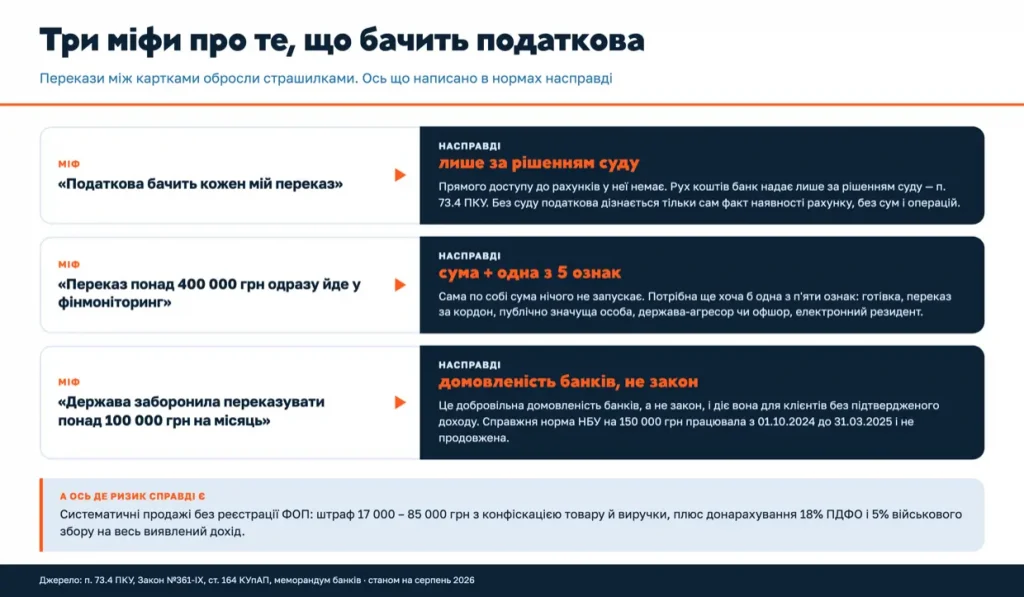
The UAH 400,000 threshold does exist - it is established by Law No. 361-IX. However, the amount alone does not trigger anything. A transaction becomes subject to mandatory financial monitoring only if the amount is accompanied by at least one of five criteria: cash, a cross-border transfer, a politically exposed person, an aggressor state or offshore jurisdiction, or an e-resident.
An ordinary transfer between two Ukrainians within the country does not meet any of these criteria - it is not subject to mandatory financial monitoring even if the amount is large. A separate rule also applies: a bank may classify a transaction as suspicious regardless of the amount. In that case, it reports the transaction to the State Financial Monitoring Service of Ukraine - a different authority, not the tax authorities.
We explained how this works in practice in our article on financial monitoring.
The UAH 100,000 monthly limit is not a law
This is the most common misunderstanding on this topic. The limit does exist, but it is a voluntary agreement between banks, not a statutory requirement.
Banks signed a memorandum and agreed to impose limits on customers without documented proof of income: up to UAH 100,000 per month for customers with a standard risk level and up to UAH 50,000 for high-risk customers.
The limit does not apply to customers with verified income - payroll customers and those who can document the source of their funds are not subject to it. Transfers between a customer's own accounts are not counted either.
There was, however, an actual NBU restriction, and it has already expired. The UAH 150,000 monthly limit applied from October 1, 2024 to March 31, 2025, and the National Bank of Ukraine did not extend it. Therefore, the statement that "the government has prohibited transfers of more than UAH 100,000" is incorrect. The government introduced no such prohibition.
What makes a bank consider a transfer suspicious
A bank looks not only at the amount, but at transaction behavior. The list of indicators is approved by an NBU resolution, but each bank sets its own specific thresholds.
- transactions do not match the customer's risk profile - age, occupation, or declared income;
- money passes through the account "in transit": it comes in and is immediately transferred out, while the balance at the beginning and end of the day remains minimal;
- many small incoming payments are aggregated and then transferred to another person as one large amount;
- the volume of transactions is more than twice the amount the customer declared when opening the account;
- the customer cannot explain where the money came from or what it was received for.
This is why trigger thresholds vary from bank to bank. One bank may request documents for UAH 30,000, while another may not react even to UAH 200,000. What to do if your account has already been blocked is explained in our article on bank account blocking.
Selling your own used items: the inconvenient truth
This needs to be stated clearly because it is almost always presented incorrectly online. The Tax Code contains no provision exempting the sale of your own used items from tax. Formally, income from the sale of any movable property - clothing, furniture, electronics, children's items - is taxed at 5% plus a 5% military levy, and the seller must declare the income independently.
The only real exception applies to vehicles: the first passenger car, motorcycle, or moped sold during the year is tax-free, the second is taxed at 5%, and the third and subsequent sales are taxed at 18%.
An important nuance to understand. When someone sells an old item for less than they originally paid for it, there is no economic gain. However, the Tax Code refers specifically to "income from the sale," not the difference between the purchase and sale prices, and it contains no explicit exemption.
How to declare income from a transfer and the applicable deadlines
If a transfer turns out to be taxable income and the payer is an ordinary individual rather than a company, all tax obligations fall on the recipient.
- by May 1 of the following year - file an annual tax return on property and income;
- by August 1 of the following year - pay the tax due under that return.
When you do not need to file a tax return: if the income is tax-exempt or taxed at a zero rate. This means you do not need to report a gift from your parents or the first passenger car sold during the year. We explained how to complete the annual tax return on property and income step by step.
State the basis for the payment in the payment reference: "gift," "loan repayment," "daughter's tuition." This can prevent many questions from both the bank and the tax authorities. We discuss appropriate wording in our article on payment references.
If you are already registered as a Sole Proprietor, it is especially important not to mix personal receipts with business income - we explained when your own funds deposited into a business account become taxable income in the article "Your Own Money in a Sole Proprietor Account".
FAQ: questions about card-to-card transfers
Do I have to pay tax on a transfer from my parents?
No. Money received from parents, a husband or wife, children, siblings, grandparents, and grandchildren is taxed at a zero rate, regardless of the amount. You do not need to file a tax return for such a transfer.
How much can I transfer without paying tax?
For transfers between individuals, the law does not establish a tax-free amount. Tax depends not on the size of the transfer but on its basis. The Tax Code does not set any general limit on the amount. A transfer from a close relative is taxed at 0% regardless of the amount, while a gift from an unrelated person is taxed at 5% plus a 5% military levy on the entire amount, with no tax-free minimum.
Does the UAH 100,000 monthly limit apply?
This is not a law, but a voluntary agreement between banks. It applies to customers without documented proof of income. The NBU did impose a regulatory limit of UAH 150,000, but it was in force only from October 1, 2024 to March 31, 2025 and was not extended.
Can the tax authorities see my card-to-card transfers?
No. The tax authorities do not have direct access to bank accounts. A bank provides information about the movement of funds only under a court order. Without a court order, the tax authorities can only find out that an account exists.
Do I have to pay tax on a loan to a friend?
No. The principal amount of a loan is not income for either the person lending the money or the person receiving and repaying it. Only interest is taxable if the loan bears interest.
What happens if I regularly sell items on OLX?
Regular sales have the characteristics of business activity and require registration. Operating without registering as a Sole Proprietor is an administrative offense: the fine starts at UAH 17,000, with possible confiscation of goods and proceeds, plus additional tax assessments on all identified income. It is also worth keeping track of future rules for marketplaces - we discuss them in our article on the tax on digital platforms.
Is the sale of my own used items taxable?
Formally, yes. The Tax Code contains no exemption for such sales, and the rate is 5% plus a 5% military levy. There is one exception - the first passenger car, motorcycle, or moped sold during the year is tax-free.
Conclusion
A card-to-card transfer between individuals does not itself create a tax liability. Tax arises only when the income behind the transfer is taxable. The Tax Code does not recognize the transfer itself as a taxable object, and this is the main point to remember. The basis for the transfer matters: a gift from a close relative - 0% regardless of the amount, a gift from an unrelated person - 5% plus 5%, a loan - no tax, payment for goods or services - 18% plus 5%.
The government does not monitor every transfer. The tax authorities can access information about movements of funds in an account only under a court order, and there is no general requirement for banks to report individuals' transfers to the tax authorities. The real risk lies elsewhere - in regular sales without business registration. This is where both a fine starting at UAH 17,000 and additional tax assessments on all income may arise.
Not sure whether you need to declare your incoming payments?
The specialists at buh.ua will review the basis for your transfers, calculate what is actually taxable, and prepare your tax return if necessary - without unnecessary taxes and without the risk of additional tax assessments.