


Diia City Startup in 2026: Requirements and Differences from Regular Residents


The requirements for Diia.City residents may seem out of reach for a young team: nine people on staff and monthly remuneration of at least EUR 1,200 per person. This is where most companies stop without reading the law to the end.
However, the law includes Part 3 of Article 5 - a preferential regime for startups that temporarily waives these two requirements. Most companies do not realize that it works quite differently from what is commonly described: the preferential period does not last 24 months, and its actual duration depends on the month in which you submit your application.
Let's examine the rules: how the startup regime differs from standard residency, how long it actually lasts, how much a mistake when leaving the regime can cost, and which model is more beneficial in each case.
Who can become a Diia.City resident: four requirements
The law sets four conditions, and they must be met simultaneously, not one after another.
- An eligible type of business activity. The KVED (Ukrainian Classification of Economic Activities) code must be included in the list specified by law and stated in the company's charter or the state register.
- Average remuneration of at least EUR 1,200. It is calculated monthly using the official National Bank of Ukraine exchange rate as of the first day of the month.
- At least nine people. This is the average headcount of employees and gig specialists for each month.
- 90% qualifying income. The income must come specifically from eligible activities on the statutory list - for the first three months and then for each year of residency.
An important detail about timing. The remuneration and headcount requirements do not apply from the date the application is submitted. They begin to apply from the month following the month in which resident status is obtained. The first partial month is excluded from the calculation.
Tax debt is a separate issue. A company cannot become a resident if, for more than 30 days, it has tax debt exceeding ten minimum monthly wages. In 2026, this amounts to UAH 86,470.
Foreign legal entities, non-profit organizations, companies in which the state or a territorial community holds a stake of 25% or more, bankrupt companies, and companies that have not disclosed their ultimate beneficial owners are also ineligible. The full list of requirements and the procedure itself are covered in the article on registering as a Diia.City resident.
Only a legal entity can become a resident. A Sole Proprietor cannot join Diia.City - for them, the regime is available only as an option for working under a gig contract. Which option is more beneficial for the specialist is explained in the articles Sole Proprietor for freelancers and IT professionals and gig contract or Sole Proprietor.
How much does it cost to meet the Diia.City requirements?
Let's calculate the absolute minimum below which a company cannot go.
The requirement is formulated in terms of average remuneration, so nine is the minimum. If the team has fifteen people, the remuneration fund is calculated for all fifteen. This figure is what makes the standard requirements unattainable for many young companies. That is precisely why the law provides a separate regime for them.
What the Diia.City startup regime offers and who is eligible
The startup regime waives exactly two of the four requirements - EUR 1,200 in remuneration and a minimum of nine people. The other two remain fully applicable. The eligible type of business activity and the 90% qualifying income requirement must be met from day one. This is one of the most common mistakes in third-party materials: they say that "the requirements do not apply to startups," and companies assume they do not need to comply with them.
Instead, the law introduces three specific eligibility conditions.
- Company age. The company must have been registered no earlier than 24 calendar months before the application date.
- Income limit. Income must not exceed the threshold for Group 3 of the simplified tax system. In 2026, the limit is UAH 10,091,049; in 2025, it was UAH 9,336,000.
- Startup designation in the application. Without it, the Ministry of Digital Transformation assesses the company under the standard requirements.
The limit is checked over four years, not just one: the year before the application, the year of application, the year in which resident status is obtained, and the following year. If you exceeded the limit last year, you are already ineligible for the startup regime, and you will find out when your application is rejected.
Another advantage that few people know about. A startup does not need an independent auditor's opinion for its initial compliance report - the law expressly exempts companies admitted under Part 3 of Article 5 from this requirement. For a standard resident, this represents a real upfront cost.
However, this exemption is neither unconditional nor permanent. If the Ministry of Digital Transformation identifies discrepancies between the initial compliance report and the financial statements, it will send a request, and the auditor's opinion must be submitted within 60 days. An independent auditor's opinion must also accompany the annual compliance report for all residents without exception, including startups.
How long does the preferential regime for startups actually last?
This is where the main confusion lies. The 24-month figure that keeps appearing from one article to another refers to the age of the company, not the duration of the preferential regime.
The law defines the period differently: the preferential regime remains in effect until December 31 of the year following the year in which resident status is obtained. The end date is fixed, so the actual duration depends on the month in which the company enters the regime.
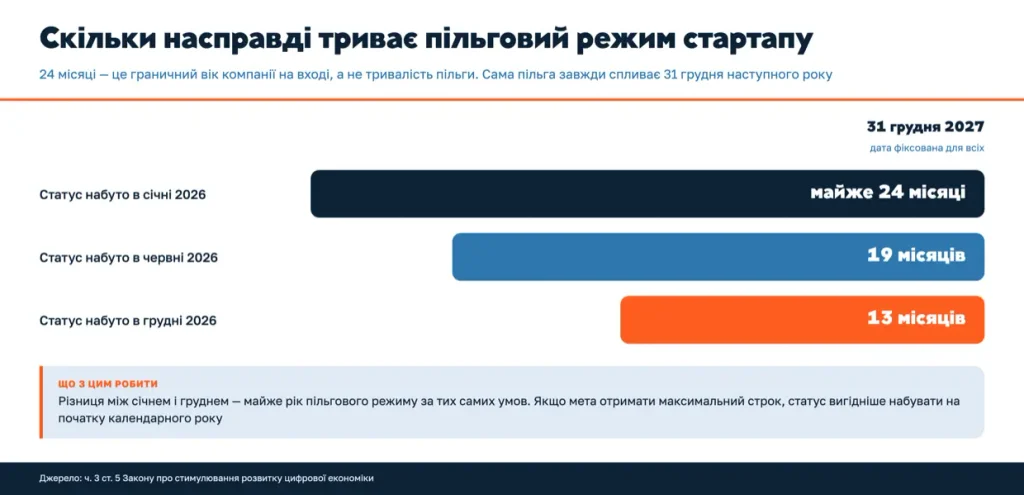
*Calculated under Part 3 of Article 5 of the Law on Stimulating the Development of the Digital Economy. The end date of the preferential period does not depend on the month of entry - only its duration does.
Practical takeaway: if your goal is to obtain the longest possible preferential period, it is more advantageous to obtain resident status at the beginning of the calendar year. The difference between January and December is almost a full year of preferential treatment under exactly the same conditions.
What happens when the preferential startup period ends?
There is no automatic removal from the register. There are two possible scenarios, and the second one costs money.
This is where retroactive tax adjustments come into play. They are governed by two different laws and are therefore calculated separately. Both additional assessments apply to the last three months of the preferential year.
- Personal income tax - under the Tax Code. Acting as the tax agent, the company calculates the tax at the standard 18% rate and pays it at its own expense, less the amount already paid at the preferential 5% rate.
- Unified Social Contribution - under the law governing the Unified Social Contribution. The company independently recalculates it at the full rate based on the actual contribution base, less the minimum contribution already paid. The deadline is one month.
The company pays these amounts out of its own pocket rather than withholding them from specialists' income - the Tax Code expressly states that the additional amount assessed is not included in their income. For a team of six or seven people receiving substantial remuneration, this can be a significant expense that arises suddenly and all at once.
One piece of good news. The law governing the Unified Social Contribution does not impose penalties specifically for this additional assessment - the relevant sanctions provision does not apply to it.
That is why the question "will we manage to reach nine people?" should be asked not in December of the preferential year, but at least six months earlier.
Not sure whether you qualify for the startup regime?
The accountants at buh.ua will check whether you meet the requirements, calculate the tax burden, and help you prepare for entry - so you do not lose the preferential conditions because of a missed criterion.
Startup or standard resident: a quick comparison
Let's summarize the differences in one table - the tax rates are the same in both cases; only the requirements differ.
| Requirement | Startup | Standard resident |
|---|---|---|
| Remuneration of at least EUR 1,200 | not applicable | monthly |
| Nine people on the team | not applicable | monthly |
| 90% qualifying income | mandatory | mandatory |
| Eligible type of business activity | mandatory | mandatory |
| Annual income limit | UAH 10,091,049 in 2026 | none |
| Company age upon entry | up to 24 months | any |
| Auditor's opinion for the initial compliance report | not required | required |
| Duration of the conditions | until December 31 of the following year | indefinite |
*The income limit for startups is tied to the threshold for Group 3 of the simplified tax system and is recalculated annually based on the minimum wage.
The table should be read this way: the startup regime does not mean different taxes - it is a deferral of two requirements in exchange for an income cap and a limited period.
What taxes does a Diia.City resident pay in 2026?
The rates do not depend on whether you are a startup or a standard resident. The only difference is which corporate income tax model you choose.
Two models for the company. Either the standard 18% corporate income tax or 9% under the special rules for Diia.City residents. Under the second model, tax is not charged on accounting profit but only when transactions expressly listed in the Tax Code are carried out: dividends, payments to a shareholder upon withdrawal, gratuitous transfers, certain payments to non-residents, and interest on debt obligations.
The second model is beneficial for companies that reinvest profits in growth. If money is distributed to owners every year, the advantage disappears.
For individuals, the rates are the same under both models: 5% personal income tax and 5% military levy.
The military levy benefit has been abolished. Until the end of 2024, Diia.City specialists paid 1.5%; now the rate is 5%, the same as for everyone else. The old figure can still be found in outdated materials.
The Unified Social Contribution is fixed: UAH 1,902.34 per person per month in 2026, regardless of how much the person earns. This is the main cost-saving benefit of the regime for high remuneration.
The preferential 5% rate has an annual cap - the equivalent of EUR 240,000 per specialist at the National Bank of Ukraine exchange rate as of January 1. The amount exceeding this threshold is taxed at 18%. The additional tax is paid by the specialist, not the company. The Tax Code requires the specialist to include the excess in their annual income, file an annual property and income tax return, and pay the tax independently. A detailed breakdown of the rates is available in the article on taxation in Diia.City.
A company can switch to the 9% model once per calendar year by submitting an application no later than 15 calendar days before the beginning of a quarter. A return to the 18% model is possible only from January 1, with at least 10 calendar days' prior notice.
How to apply for Diia.City resident status
The application is submitted electronically to the Ministry of Digital Transformation - through the city.diia.gov.ua portal or to the ministry's official email address. The startup regime must be specifically indicated in the application. The government resolution is explicit: without this indication, the company is considered to be applying under the standard requirements.
The review period is 10 business days. If the Ministry of Digital Transformation does not issue a refusal or return the application without consideration within this period, the decision is deemed approved. Silence in this case means consent. The entry must be added to the register no later than the eleventh business day, and the company acquires resident status on the date the entry is made, not on the date the application is submitted.
The application for the tax model is submitted together with the main application. If this is not done, the company will still be entered in the register but will be taxed under the standard 18% corporate income tax regime.
The first compliance report must be submitted no later than the last day of the sixth calendar month following the month in which resident status was obtained. Startups do not need an auditor's opinion for this report.
Can you switch from the startup regime to the standard regime and vice versa?
It is important to distinguish between two different mechanisms that are often confused.
From startup to standard resident - the transition happens automatically. The preferential period expires on December 31, and if the company meets all four requirements, it simply continues operating. No applications are required.
From standard resident to startup - there is no such procedure. The startup designation can only be made in the initial application. The law contains no provision allowing a company to switch to the preferential regime after obtaining resident status.
Therefore, the decision to use the startup regime is made once and before the application is submitted. You cannot change your mind later.
The tax model, however, can be changed. Switching between 18% and 9% is governed by separate rules and deadlines, which are described above.
Does Diia.City provide employee military service deferment?
Not directly, and this is another common misconception about the regime. Diia.City residency is only one criterion. To obtain critical enterprise status, a company must meet three or more criteria from the applicable list. Diia.City residency provides one of them.
However, this criterion does not apply immediately. It is confirmed by tax calculations for the previous six calendar months. In other words, the company must first operate for six months while meeting the EUR 1,200 threshold and only then apply for critical enterprise status.
There is a simplified alternative for startups. Instead of providing six months of tax calculations, a startup may submit its initial compliance report together with documents confirming income, grants, or investments of at least EUR 20,000 during the first three full months after obtaining resident status.
The main benefit concerns salaries. Critical enterprises are required to pay employees who receive military service deferment at least three minimum monthly wages, while Diia.City residents are expressly exempt from this requirement. The Diia.City remuneration threshold applies to them instead.
Applications for critical enterprise status are reviewed within 10 business days. The conditions and list of criteria are covered in the articles on critical enterprise status and the new military service deferment rules.
FAQ: questions about startups in Diia.City
How long does the preferential regime for startups in Diia.City last?
Until December 31 of the year following the year in which resident status is obtained. It is not 24 months - that figure refers to the maximum age of the company on the application date. The actual duration of the preferential period depends on the month of entry and ranges from 13 to almost 24 months.
Which requirements does the startup regime waive?
Only two: average remuneration of at least EUR 1,200 and a minimum of nine people. The requirements for an eligible type of business activity and 90% qualifying income remain mandatory from day one.
What is the income limit for a Diia.City startup in 2026?
UAH 10,091,049. This is the income threshold for Group 3 of the simplified tax system, and it is recalculated annually based on the minimum wage. The limit is checked over four years, including the year preceding the application.
What happens if a startup does not reach nine people by the end of the preferential period?
The company loses its resident status and must independently recalculate personal income tax for the last three months of the preferential year at the 18% rate instead of 5%, as well as the Unified Social Contribution at the full rate. The company pays these amounts at its own expense.
Can a standard resident switch to the startup regime?
No. The designation for applying under Part 3 of Article 5 can only be made in the application for resident status. The law contains no provision allowing a company to do this later.
Does a startup need an auditor's opinion?
Not for the initial compliance report - the law expressly exempts startups from this requirement. An independent auditor's opinion must accompany the annual report for all residents. In addition, the Ministry of Digital Transformation may request an auditor's opinion for the initial report if it identifies discrepancies with the financial statements.
What taxes does a Diia.City startup pay?
The same taxes as a standard resident: 5% personal income tax and a 5% military levy for specialists, a Unified Social Contribution of UAH 1,902.34 per person per month, and for the company either 18% corporate income tax or 9% under the special Diia.City rules, where tax arises only on transactions listed in the Tax Code.
Does a Diia.City startup provide employee military service deferment?
Not by itself. Diia.City residency provides only one criterion for critical enterprise status, while at least three criteria are required. However, Diia.City residents are exempt from the requirement to pay employees who receive military service deferment at least three minimum monthly wages.
Conclusion
The Diia.City startup regime does not introduce separate taxes. Instead, it provides a temporary exemption from two of the most costly requirements in exchange for an income cap and a limited duration.
Three things to check before submitting your application: the company is less than 24 months old, its income for the previous year is within the Group 3 limit, and 90% of its income comes from eligible activities on the statutory list. If any of these conditions is not met, the company cannot enter the startup regime.
The main risk is not a penalty but a sudden additional tax assessment. A company that fails to reach nine people by the end of the preferential year must pay personal income tax at the 18% rate and the full Unified Social Contribution for three months out of its own pocket. That is why the entry date matters too. Entering in January provides almost two years of preferential treatment, while entering in December provides just over a year, even though the requirements are the same.
Planning to join Diia.City?
The buh.ua team will check whether your company meets the requirements, calculate the tax burden, and provide full accounting support for your residency - from joining Diia.City to preparing compliance reports.