

New tax law 2027 in Ukraine - VAT for Sole Proprietors from UAH 4M, platform income taxes and new parcel rules


The Ministry of Finance has prepared a large-scale draft law that will change the rules of the game for Ukrainian businesses starting from 2027. The main goal is to make income more transparent, align Ukraine’s tax system with European standards, and close loopholes that previously allowed businesses to "optimize" taxes. The changes will affect Sole Proprietors (FOPs) with high turnover, those earning through marketplaces or foreign platforms, and anyone ordering goods from abroad.
Update (as of July 2026): the situation has changed since this material was prepared. The taxation of income earned through digital platforms has already become LAW (No. 15111-d dated 09.06.2026, effective from 2027, with a 10% rate). Mandatory VAT registration for sole proprietors with a threshold of UAH 4 million has been POSTPONED: in April 2026, the government and the IMF decided not to introduce it. The rules concerning parcels and the permanent military levy are still draft laws (No. 15112 and No. 15110). Below is an overview of the reform areas and their current status.
VAT for sole proprietors: UAH 4 million threshold (postponed proposal)
The Ministry of Finance proposed raising the threshold for mandatory VAT registration for sole proprietors from UAH 1 million to UAH 4 million in annual turnover.
However, it is important to note: in April 2026, the government and the IMF decided NOT to introduce mandatory VAT registration for sole proprietors from 2027. The proposal was deemed sensitive, and an alternative source of budget revenue is being sought. Therefore, below is a description of the original proposal, which has currently been postponed.
At first glance, this looks like relief - the threshold is higher. But at the same time, the approach to control is changing.
Detailed provisions of the draft law and the logic behind the changes can be found in the Ministry of Finance explanatory note.
The draft law also provides that the tax authority will be able to automatically determine the obligation to register for VAT based on submitted reports.
Simplifications for entrepreneurs are also being discussed:
- the possibility of quarterly VAT reporting
- a simplified procedure for issuing VAT invoices for retail transactions
- mitigation of liability for first violations
* the final version of these rules may change before the law is adopted.
Example: if a Sole Proprietor (FOP) exceeds the установленный turnover threshold, the tax authority may automatically register them as a VAT payer. In this case, the entrepreneur will have to switch to new accounting and reporting rules.
Taxation of income from digital platforms in 2027 - what the tax authority will see
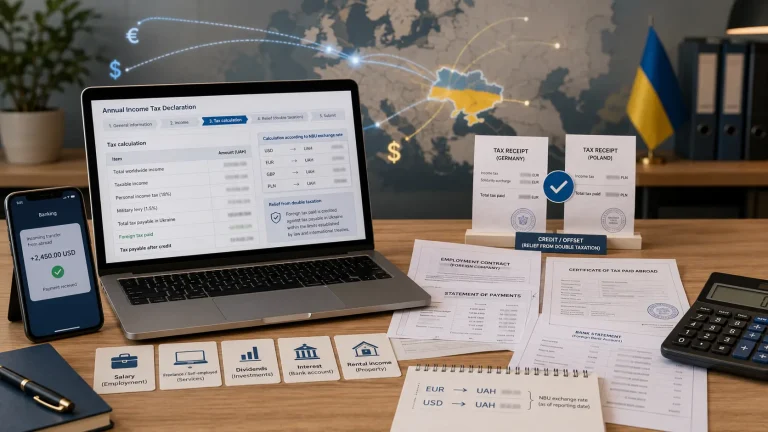
This is no longer a draft: the law on the taxation of income earned through digital platforms (No. 15111-d) was adopted on June 9, 2026, and will take effect on January 1, 2027. If you earn income through Ukrainian or foreign platforms - marketplaces, freelance platforms (Upwork, Fiverr), property rental platforms (Airbnb), or stock photography websites - the tax authorities will receive information about your income, and the platform operator will act as a tax agent.
How it will work:
- Ukrainian platforms (Prom.ua, Rozetka Marketplace, OLX, etc.) may be required to report income data to the tax authority and, under a separate model, act as tax agents. Moreover, the platform itself may become a tax agent and withhold tax when paying out your income - if such a model is approved.
- Foreign platforms (Etsy, Amazon, Upwork, Fiverr, Adobe Stock, Shutterstock, etc.) may also be required to report Ukrainians’ income to the State Tax Service (STS). internationalinformation exchange will be implemented.
What this means in practice: Hiding income online or abroad will become almost impossible. If previously it was possible to earn through foreign platforms and not declare this income, now this will no longer work - the data will be automatically sent to the tax authority.
Special tax regime for platform income - an alternative to a Sole Proprietor
To encourage the legalization of income, the law introduced a separate taxation regime for individuals who earn income through digital platforms.
Under the adopted law, the standard tax rate for income earned through platforms is 10% (5% for income from renting out residential property through a platform). Annual income of up to EUR 2,000 from the sale of personal goods is exempt from taxation. The tax is withheld by the platform operator acting as the tax agent.
At the same time, a military levy may also apply to such income (meaning the effective tax burden could be around 10%).
Important: the draft law discusses certain thresholds for simplified accounting and the use of accounts. However, this does not mean automatic tax exemption - the final rules will depend on the adopted version of the law.
Advantages of such a regime (if implemented):
- the ability to operate without registering as a Sole Proprietor
- simplified income accounting
- potentially lower tax burden compared to the traditional Sole Proprietor model
A model is also being discussed where platforms may act as tax agents and withhold taxes when paying out income. However, this mechanism has not yet been finally approved.
Example: you sell goods through a platform and receive 150,000 UAH in annual income. According to the logic of the draft law, the tax burden could be around 10% (PIT and military levy). In this case, after paying taxes, you would have approximately 135,000 UAH left.
*taxation rules, rates, and the role of platforms may change after the law is adopted.
Selling through marketplaces? Check your tax model
We will calculate which model is more выгодная in your case - Sole Proprietor or the new tax regime - taking into account taxes, risks, and your business format.
VAT on international parcels in 2027 - what will change for buyers and Sole Proprietors
Currently, parcels worth up to 150 euros can be imported without paying customs duties and VAT. The draft law proposes to change the current rules: the 150 euro exemption for distance sales in its current form may be abolished.
Exception for excisable goods: The exemption does not apply to alcohol, tobacco, perfumes, coffee, tea, and their extracts - even if the parcel costs less than 45 euros, it will still be taxed.
No exemptions for Sole Proprietors and legal entities: If you order goods for business purposes - all parcels are taxed regardless of their value.
Example: You ordered sneakers on AliExpress for 80 euros. Previously, you received them without additional charges. Now AliExpress will add 20% VAT (16 euros) to the price, and you will pay 96 euros. You do not need to pay anything extra at the post office - everything is already included in the price.
The 5% military levy will remain permanent
The military levy, which was initially introduced as a temporary wartime measure, is now proposed to become permanent. The 5% rate for individuals will remain even after the end of martial law - until the completion of the reform of the Armed Forces of Ukraine.
For Sole Proprietors on the simplified tax system, separate rates apply - 1% of income or 10% of the minimum wage (depending on the group).
What this means: Businesses should plan for this payment in the long term and include it in budgets and pricing.
Other changes from the draft law
- Public lists of risky VAT taxpayers
Information about VAT payers who pose risks (for example, blocked VAT invoices or violations) will become public. This will allow counterparties to check the reliability of partners.
- Mandatory electronic communication with the tax authority
For large taxpayers and excise taxpayers, electronic communication with the tax authority will become mandatory. Paper letters will no longer be accepted.
- Expansion of the "self-employed person" concept
The category of self-employed will include not only Sole Proprietors, but also lawyers, notaries, and other professions. They will also be subject to the 4 million UAH threshold for mandatory VAT registration.
FAQ: answers to key questions
I am a Sole Proprietor in Group 2 with annual income of 3.5 million UAH. Will I become a VAT payer in 2027?
No, if your income does not exceed 4 million UAH for the relevant period. The draft law also discusses automatic control mechanisms, but the final calculation logic may still change.
Can VAT be avoided by declaring less than 4 million in 2026?
No. If your income does not exceed the установленный threshold, the obligation to register for VAT does not arise. At the same time, the draft law discusses automatic control mechanisms, but the final calculation logic may change.
I sell on Rozetka Marketplace as an individual. What will change?
Under Law No. 15111-d, the platform operator, including Rozetka, acts as a tax agent and withholds tax when paying out income.
Will it still be possible to order parcels from AliExpress up to 150 euros without additional charges?
The draft law предусматривает changes: parcels worth from 45 to 150 euros may be subject to 20% VAT, while the tax may be paid by the marketplace rather than the recipient. The final conditions depend on the adopted version of the law.
When will the new law come into force?
If the law is adopted, the key provisions are planned to be launched from January 1, 2027, while information exchange and platform reporting will be implemented under a separate procedure after the mechanism is launched.
What happens if I do not declare income from a foreign platform?
International information exchange is expected, under which the tax authority will be able to receive data on income from foreign platforms. If such mechanisms are implemented, hiding income will become much more difficult.
Does it make sense to close a Sole Proprietor now and work as an individual through a platform?
The draft law discusses a separate taxation regime for individuals earning through platforms with a reduced rate (approximately around 10% including the military levy). In some cases, this may be more beneficial than a Sole Proprietor, but everything depends on income structure, expenses, and business model. Therefore, it is advisable to calculate both options before making a decision.
Conclusion
The new tax law is not just about higher taxes - it is a transformation of the entire system. The state is moving toward transparency, automated control, and European standards. Hiding income online or abroad is becoming almost impossible, and the simplified tax system is gradually losing its "preferential" nature.
What to do now:
- If your turnover is approaching 4 million UAH - prepare to transition to VAT from 2027. Learn how VAT credit works, how to issue invoices, and how to maintain accounting. Do not wait until the last moment.
- If you earn through platforms (Ukrainian or foreign) - determine whether it is more beneficial to operate as a Sole Proprietor or use the new 10% regime for individuals. Calculate taxes under both options.
- If you order goods from abroad for business - include an additional 20% VAT in your budget for all parcels, not just those over 150 euros.
Do not wait until 2027 - the draft law may still change, but the direction is clear. The rules are becoming stricter, control is becoming automated, and the tax authority will know everything.
How will the new tax rules affect your business?
The draft law may still change, but the risks are already clear: VAT, income control, and new taxation models. The buh.ua team will help analyze your business model and prepare a structure without risks of penalties and additional tax assessments.